What Changed — and Why It Matters Now
English Language Proficiency has been a federal requirement for commercial drivers for decades under 49 CFR 391.11(b)(2), which says a driver must be able to read and speak English well enough to converse with the general public, understand highway traffic signs and signals, respond to official inquiries, and make legible report entries. What changed is enforcement. For years the rule was on the books but rarely resulted in a truck being taken off the road. That is no longer the case.
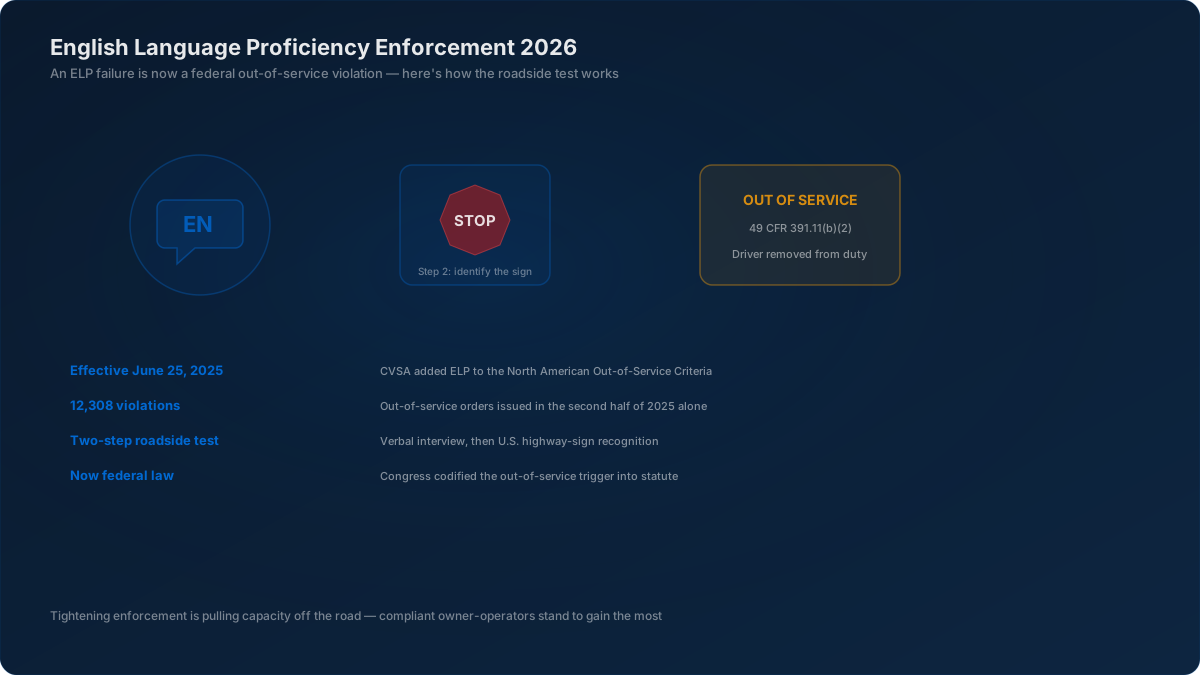
Effective June 25, 2025, the Commercial Vehicle Safety Alliance (CVSA) added English Language Proficiency to the North American Standard Out-of-Service Criteria — the rulebook inspectors use to decide when a driver or vehicle must be parked. The April 1, 2026 edition of the criteria lists ELP in print, cementing it as a permanent, nationwide inspection standard rather than a temporary directive. For a carrier, the difference is night and day: a violation that used to be a warning is now a stopped truck and a stranded load.
Jun 25, 2025
ELP added to OOS criteria
12,308
OOS violations (H2 2025)
~500
OOS in one 3-day, 26-state op
Federal law
Codified by Congress
How the Roadside ELP Test Actually Works
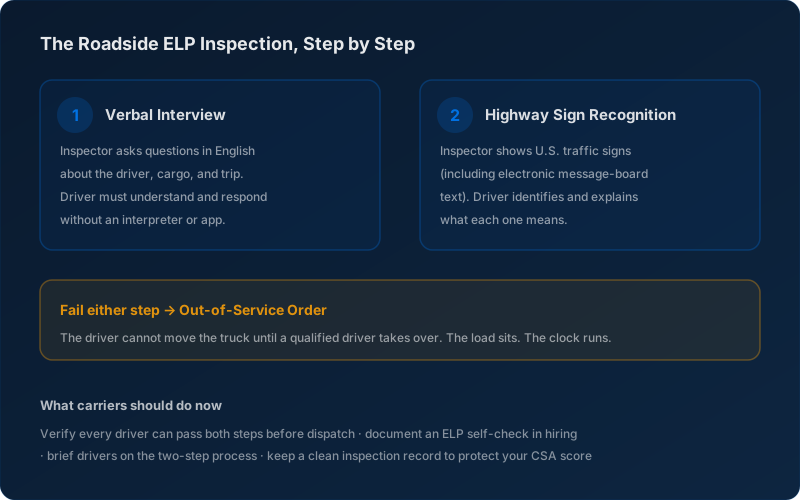
FMCSA's roadside assessment is a two-step process, and inspectors are instructed not to use translation apps, interpreters, or passengers to help the driver get through it. The point is to confirm the driver can operate safely on a U.S. highway in English without assistance.
Step 1 — Verbal interview. The inspector asks the driver questions in English about the driver, the cargo, and the trip, and evaluates whether the driver understands and can respond. This is conversational, not a formal exam, but a driver who needs a translation app to answer basic questions will not pass.
Step 2 — Highway-sign recognition. The inspector shows the driver common U.S. traffic signs — including the text shown on electronic message boards — and asks the driver to identify and explain what each one means. A driver who cannot read and interpret standard signage cannot demonstrate the safety competence the rule requires.
Fail either step and the driver is placed out of service on the spot. The truck does not move until a qualified driver takes over — which, for a solo owner-operator far from home, can mean a load that simply does not get delivered.
The Enforcement Is Real — and Nationwide
This is not a rule that lives only in a binder. In the second half of 2025 — the first six months ELP was an out-of-service criterion — enforcement generated 12,308 out-of-service violations. In January 2026, a coordinated operation across 26 states placed nearly 500 drivers out of service for ELP violations in just three days. Inspectors across the country are running the assessment as a standard part of Level 1 and Level 2 inspections.
The downstream cost to a carrier goes well beyond the stopped truck. An out-of-service order is recorded against your DOT number and feeds your CSA score, specifically the Unsafe Driving and Driver Fitness BASICs. A rising CSA score makes brokers and shippers nervous, raises your insurance exposure, and can cost you access to the best-paying freight. One ELP violation can quietly reduce the loads available to you for months.
The Border-Zone Exception
There is one narrow geographic carve-out. FMCSA has confirmed that drivers operating within certain designated commercial zones along the U.S.-Mexico border are exempt from being placed out of service for an ELP violation. Inspectors in those zones should still cite the violation, but should refrain from issuing the out-of-service order.
Two things matter here. First, the exception is geographically tiny — it applies only inside specific border commercial zones, not to cross-country freight. The moment a driver leaves those zones, the full out-of-service consequence applies. Second, the citation still happens, so it still creates a compliance record. If your operation runs cross-border freight, do not treat the border-zone exception as a reason to relax — treat it as a reminder that the rest of the route has zero tolerance.
Now Written Into Law
The requirement started as an April 2025 executive order and an FMCSA enforcement directive. It is now codified: Congress included a provision in a federal spending bill requiring FMCSA to update its regulations so that an ELP violation triggers an out-of-service order. That distinction matters for planning. Enforcement policies can shift between administrations; a statute is far stickier. Carriers should treat ELP compliance as a permanent operating requirement, the same way they treat ELD compliance or medical certification — not as a passing trend.
For the broader context on what else FMCSA is enforcing harder this year, see our 2026 FMCSA rules roundup and the parallel non-domiciled CDL crackdown, which is removing thousands of drivers from the road for an entirely separate reason.
What Carriers Should Do Now
1. Add an ELP check to hiring. Before you put a driver on a load, confirm they can complete both steps — a short structured interview and a run through common highway signs — and document the check in the driver qualification file. It costs you ten minutes and protects you from a stranded load and a CSA hit.
2. Brief your drivers on the process. A driver who knows the two-step format and has practiced sign recognition is far less likely to freeze at the roadside. Many capable English speakers fail simply because they are nervous and unprepared for what the inspector is doing.
3. Protect your inspection record. Your clean inspection history is a marketing asset. Brokers and shippers screen carriers on CSA data, so every out-of-service order you avoid keeps you eligible for premium freight. Use our DOT inspection guide to tighten up the rest of your roadside readiness.
4. Play the capacity angle. Every driver pulled off the road for ELP is capacity that leaves the market. Combined with the ongoing driver shortage, tighter enforcement firms up rates for compliant carriers. A professional dispatch service turns that tighter market into higher revenue per mile by negotiating every load while you drive.
The Bottom Line
English Language Proficiency enforcement went from a dormant rule to a high-volume, nationwide out-of-service standard in under a year, and Congress has now written the out-of-service trigger into law. For carriers, the message is simple: verify it, document it, and brief your drivers — because one failed roadside assessment can park a truck and dent the CSA score you depend on to win freight.
The flip side is opportunity. As non-compliant capacity exits the market, the carriers who stay clean and well-run capture firmer rates and steadier freight. If you want help turning a tighter, better-enforced market into more dollars per mile, talk to our dispatch team — no contracts, no pressure, just a straight read on where your operation can earn more.
Related Resources
- Non-Domiciled CDL Rule 2026 — The other 2026 crackdown removing thousands of drivers
- 2026 FMCSA Rules Roundup — Everything changing in federal trucking regulation this year
- How to Pass a DOT Inspection — Roadside readiness, step by step
- How to Fix a Bad CSA Score — Repair the damage an OOS order causes
- The 2026 Driver Shortage — Why tightening capacity pushes rates up
- Cross-Border Freight 2026 — Where the border-zone rules actually apply