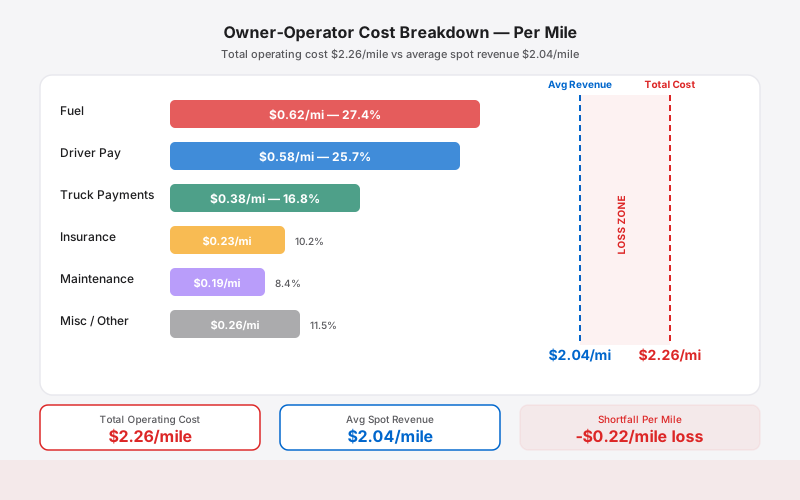
Quick answer: trucking cost per mile = (monthly fixed costs ÷ total miles) + variable cost per mile. Convert to a quote floor with loaded miles: required rate per loaded mile = (fixed + variable total for the month + target profit) ÷ loaded miles, then divide by (1 − fee %). Prefer your own books over industry averages — then sanity-check against ATRI's 2025 fleet average of $2.336 per mile (2026 ATRI report). Run the numbers live in our cost per mile calculator.
Why Cost Per Mile Is the Only Number That Matters on a Rate Con
Brokers quote dollars per mile. Your truck spends dollars per mile. If you cannot translate both into the same unit, every load decision is a guess. Carriers who know their cost per mile (CPM) reject soft freight early, push back on lowball offers with a clear floor, and stop confusing busy weeks with profitable weeks.
In 2026 that skill matters more: diesel has been volatile (EIA national on-highway diesel near $5.26/gal in mid-August 2026), insurance renewals keep shocking new authorities, and spot rates still punish operators who accept "something is better than sitting" without math. Something below CPM is worse than sitting — it burns tires, hours-of-service, and cash for the privilege of moving.
This guide is the companion to the calculator: the formulas, the line items people forget, worked examples for a solo owner-operator, and how to turn CPM into a broker-ready quote. If you are still standing up the business, pair this with the new authority cost calculator and our how to start a trucking business guide.
The Cost Per Mile Formula (Two Numbers, Not One)
Professional operators track two related figures:
- Cost per total mile — what every mile on the odometer costs, loaded or empty:
(monthly fixed ÷ total miles) + variable CPM. - Breakeven rate per loaded mile — the number you quote:
monthly all-in costs ÷ loaded miles, then grossed up for percentage fees.
Confusing them is how carriers accept $1.85/mi thinking they are "above costs" while 15% deadhead quietly puts them underwater. Empty miles still burn diesel and maintenance; they just do not appear on the rate confirmation.
Step 1 — List Monthly Fixed Costs
Fixed costs hit whether you run 4,000 or 12,000 miles. Gather one clean month (or a 90-day average) and annualize anything billed yearly:
- Truck payment or lease (principal + interest)
- Trailer payment or rental
- Liability, cargo, physical damage, occupational accident (monthly share)
- IRP plates, IFTA, UCR, permits (monthly amortization)
- Parking, shop rent, yard fees
- ELD, load boards, accounting software, phone
- Health insurance / owner benefits you treat as business-critical
Example solo OO fixed stack for 2026: truck $1,850 + insurance $1,100 + plates & permits $180 + parking $200 + subscriptions $120 = $3,450/month. Your stack will differ — insurance alone for a new authority can blow past $1,200/month. See the owner-operator insurance guide.
Step 2 — Build Variable Cost Per Mile
Variable costs scale with miles. Fuel is the giant; everything else is a reserve you must fund deliberately.
- Fuel CPM = diesel $/gal ÷ MPG. At $5.26/gal and 6.5 MPG → $0.809/mi.
- Maintenance / repair reserve: often $0.15–$0.25/mi for aging iron
- Tires: $0.04–$0.06/mi
- Tolls, scales, DEF: track a month, then divide by miles
- Lumper advances you never recover (treat as cost, not "float")
Example variable CPM: fuel $0.809 + maintenance $0.18 + tires $0.05 + tolls/DEF $0.04 = $1.079/mi. If your real MPG is 5.8 instead of 6.5, fuel alone jumps to $0.907/mi — which is why speed, idle time, and tire pressure show up on the P&L.
Cross-check fuel math with the fuel cost calculator and the 2026 diesel outlook.
Step 3 — Split Loaded Miles vs Empty Miles
Pull ELD or trip logs for the month. Total miles = loaded + empty (deadhead, bobtail, unpaid reposition). A healthy solo dry-van operation often targets under ~10–12% deadhead; hotshot and flatbed can run higher depending on freight density.
Example: 8,800 loaded + 1,200 empty = 10,000 total miles (12% deadhead). Fixed cost per total mile = $3,450 ÷ 10,000 = $0.345. Add variable $1.079 → $1.424 per total mile before owner pay.
Breakeven on loaded miles (no profit, no fees): ($3,450 + $1.079 × 10,000) ÷ 8,800 = $1.618 per loaded mile. That is the floor before factoring, dispatch, or paying yourself. For deadhead strategy, see avoid deadhead guide and the deadhead calculator.
Step 4 — Add Owner Pay, Fees, and Profit Target
Operating CPM is not take-home. Decide a monthly owner draw (example: $6,000) and optional profit buffer ($1,000). Add percentage drains: factoring 2–4%, dispatch 5–10% of gross when used.
Continuing the example: monthly cash need = $3,450 fixed + $10,790 variable + $6,000 draw + $1,000 profit = $21,240. Before fees, that is $21,240 ÷ 8,800 = $2.414 per loaded mile. If 8% of gross goes to factoring + dispatch combined, required quote = 2.414 ÷ 0.92 ≈ $2.62 per loaded mile.
That number feels high next to soft spot boards — which is the point. Either raise utilization (more loaded miles on the same fixed stack), cut costs, change lanes, or stop accepting $1.90 freight that only looks busy. Use the profit per load and rate per mile tools to stress-test individual offers.
2026 Benchmarks: ATRI vs Your Personal CPM
ATRI's Analysis of the Operational Costs of Trucking (2026 update, covering 2025) put average marginal cost at $2.336/mi ($1.854/mi excluding fuel), with driver wages $0.818 and benefits $0.210. Fleet averages include W-2 driver costs owner-operators often replace with an owner draw — so do not paste ATRI onto a rate con blindly.
Use ATRI to spot outliers: if your maintenance reserve is $0.05/mi on a 900,000-mile tractor, you are lying to yourself. If your all-in is $2.90/mi on a paid-off truck in a cheap insurance state, check whether you over-reserved or under-ran miles. Benchmarks audit your inputs; they do not replace them.
Worked Example: Same Truck, Two Deadhead Rates
Hold costs constant ($3,450 fixed, $1.079 variable, $6,000 draw, no fees) and change only empty miles on a 10,000-mile month:
| Deadhead | Loaded miles | All-in / loaded mi |
|---|---|---|
| 8% (800 empty) | 9,200 | $2.20 |
| 12% (1,200 empty) | 8,800 | $2.30 |
| 20% (2,000 empty) | 8,000 | $2.53 |
Moving from 8% to 20% deadhead adds roughly $0.33 per loaded mile to the floor — often more than the difference between a decent and a terrible rate offer. That is why dispatch and lane planning are cost tools, not just "finding freight."
Common Mistakes That Fake a Low CPM
- Dividing by loaded miles only for total CPM — understates cost and hides deadhead damage.
- Ignoring annual bills until IRP or Form 2290 week wrecks cash.
- Zero maintenance reserve on high-mile equipment — you are financing the next turbo with future you.
- Omitting fee gross-up — 5% dispatch + 3% factoring is not "close enough" to ignore.
- Using last year's diesel while quoting this week's freight.
Clean books make CPM a five-minute job. Start with the trucking bookkeeping guide.
How to Use CPM on Every Load Offer
Before you accept: (1) note all-in miles including empty to pickup and empty after delivery if the next load is unknown, (2) estimate fuel for the trip at current diesel, (3) compare linehaul ÷ loaded miles to your quote floor, (4) add known accessorials only if they are collectible. If the offer clears the floor with a buffer, take it. If it clears only by assuming zero deadhead and perfect detention pay, it does not clear.
Weekly, roll settlements into the weekly revenue calculator and ask whether average loaded RPM still beats CPM after real empty miles. That feedback loop is how operators stop losing money one "okay" load at a time.
Bottom Line
Learning how to calculate cost per mile is not accounting homework — it is the operating system for every rate negotiation in 2026. Build fixed and variable stacks from real invoices, separate loaded from empty miles, gross up for fees, and refresh when fuel or insurance moves. Then refuse freight that cannot clear the floor. For the interactive version of this math, use the cost per mile calculator; for help booking above that floor, talk to a dispatcher who works your numbers — not the board's.