
What the Heavy Vehicle Use Tax Is
The Heavy Vehicle Use Tax (HVUT) is an annual federal tax on heavy trucks that operate on public highways, reported and paid using IRS Form 2290. It applies to any vehicle with a taxable gross weight of 55,000 pounds or more — which means virtually every tractor and many heavy straight trucks. The tax helps fund the highways you run on, and paying it is not optional: your state requires proof of payment to register the vehicle.
That proof is the stamped Schedule 1 the IRS returns when you file and pay. Keep it somewhere you can find it instantly — you will need it to register a new truck, renew your plates, and renew your IRP apportioned registration. No valid Schedule 1, no plates. For new authorities, HVUT sits alongside the other startup compliance items covered in our new authority guide.
55,000 lb
Weight threshold
$100-$550
Annual tax range
Aug 31
Deadline (July use)
Jul 1-Jun 30
Tax period
How Much You'll Pay
The tax scales with taxable gross weight. It starts at $100 per year at 55,000 pounds and rises by $22 for each additional 1,000 pounds, topping out at a $550 maximum for vehicles at 75,000 pounds or more. Most loaded tractors hit that ceiling, so $550 per truck per year is the number to budget for.
If you put a truck into service partway through the tax period, the tax is prorated by the month of first use — you pay only for the months remaining until June 30. That matters when you buy a truck mid-year: you owe a partial-year HVUT for the new vehicle, due the month after you first use it. Fold this into your overall cost planning along with the other fixed costs in our cost-per-mile calculator.
How to File, Step by Step
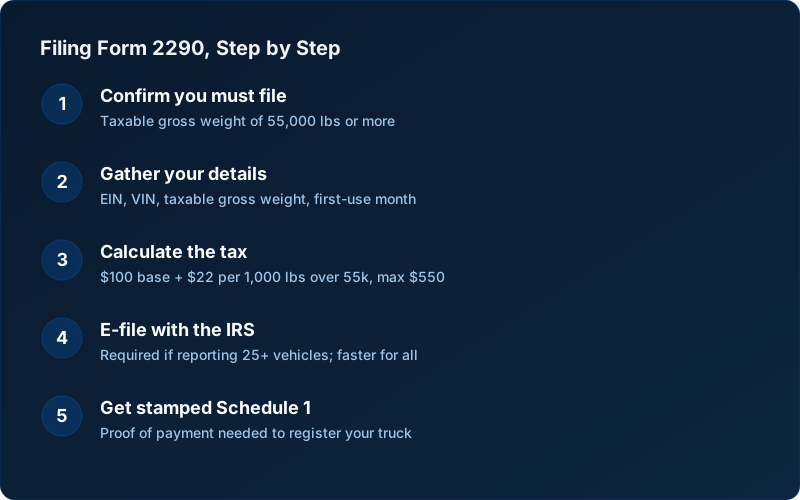
1. Gather your details. You need your EIN (not your Social Security number), the VIN for each truck, and the taxable gross weight category for each. If you don't have an EIN yet, apply early — a new one can take about two weeks to activate in the IRS system.
2. Calculate the tax. Use the weight schedule above, and prorate any vehicle first used after July.
3. E-file through an IRS-approved provider. E-filing is required at 25+ vehicles and is the fastest route to a stamped Schedule 1 for everyone — usually minutes, versus weeks for paper.
4. Pay the IRS. You can pay by EFTPS, electronic funds withdrawal (direct debit), debit or credit card, or check/money order. Choose your method during filing.
5. Save your stamped Schedule 1. This is your proof of payment. Store a copy in the truck and in your records — you cannot register or renew without it.
Don't Miss the Deadline
The HVUT tax period runs July 1 to June 30. For a truck in use during July, Form 2290 is due by August 31. For a vehicle first used later, it's due the last day of the following month. Filing late means IRS penalties plus monthly interest — and, just as damaging, no current Schedule 1, which can freeze your registration and put the truck off the road.
Build the August 31 deadline into your annual compliance calendar right next to your IFTA filings, the IFTA mileage calculator, IRP renewal, and tax planning. HVUT itself is a deductible business expense, so keep the receipt. And keep the rest of your books tight with our bookkeeping guide — the carriers who stay on top of these small recurring obligations are the ones who never get blindsided by a registration hold.
The Bottom Line
Form 2290 is one of the simplest compliance tasks you have — file once a year, pay up to $550 per truck, save the Schedule 1 — but skipping it creates outsized problems. E-file early, keep your proof of payment handy, and never let the August 31 deadline sneak up on you.
The best operators keep the compliance side boring and predictable so they can focus on the part that makes money: keeping the truck loaded with profitable freight. If that's the part you'd rather hand off, talk to our dispatch team — no contracts, no setup fees.
Related Resources
- Trucking Tax Deductions Guide — Every write-off owner-operators miss
- Trucking Bookkeeping Guide — Keep your records clean and audit-proof
- New Authority Guide — All the startup compliance steps in order
- IFTA Filing Guide — The other recurring filing every carrier owes
- Cost Per Mile Calculator — Fold HVUT into your true operating cost
- How to Start a Trucking Business — The full setup roadmap