The Market Case: Why Dispatch ROI Is Higher in 2026
Let's get the obvious question out of the way: is hiring a dispatcher worth it? In any market, the answer depends on the math. In 2026, the math has never been more favorable.
Here's why. The dispatch service market was valued at $688 million in 2024 and is projected to reach $1 billion by 2031, growing at 5.6% CAGR. That growth isn't happening because dispatchers are getting better at marketing — it's happening because the market conditions make their value proposition undeniable.
According to DAT Trendlines, the spot van rate hit $2.41 per mile by late February 2026 — the seventh consecutive monthly gain. Spot rates are running 20%+ higher year-over-year. The load-to-truck ratio sits at 7.73 in March, with a February average of 8.29 and a December 2025 spike to 9.9. Tender rejection rates hit 18% in the Midwest in early February — the highest since March 2022 — with reefer rejections exceeding 20%.
What do these numbers mean for dispatch value? In a loose market where loads are scarce, every carrier finds roughly the same rates because there's no rate spread to exploit. But in a tight market like 2026, the gap between the average load and the premium load widens dramatically. The carriers who capture that premium are the ones with dispatchers who monitor capacity signals, know which shippers are rejecting tenders at 18%, and can negotiate from a position of strength.
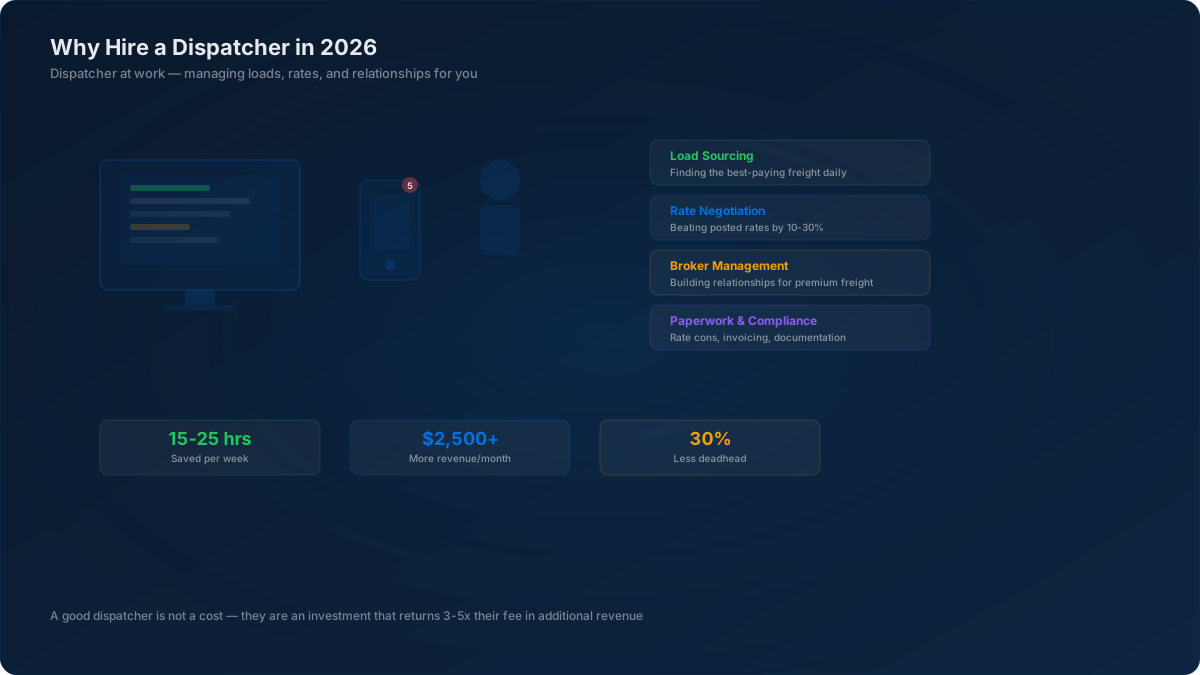
Industry data shows that owner-operators using professional dispatch services typically earn 10-30% more revenue than self-dispatching operators. In a $2.41/mile market at 10,000 monthly miles, even a 10% improvement is $2,410/month — well above the $1,200-$1,900 you would pay in dispatch fees. That's net positive ROI before you factor in the time savings.
The Numbers: Self-Dispatch vs Professional Dispatch
Let's break down the actual financial comparison. These numbers are based on current 2026 market conditions — a spot van rate of $2.41/mile, 10,000 monthly miles, and a 6% dispatch fee:
| Metric | Self-Dispatching | Professional Dispatch | Difference |
|---|---|---|---|
| Average Rate Per Mile | $2.41/mi | $2.71-$2.91/mi | +$0.30-$0.50/mi |
| Monthly Gross Revenue | $24,100 | $27,100-$29,100 | +$3,000-$5,000 |
| Dispatch Fee (6%) | $0 | $1,626-$1,746 | -$1,626-$1,746 |
| Deadhead Percentage | 15-20% | 8-12% | -5-10 pts |
| Time Spent Dispatching | 1-2 hrs/day | 0 hrs/day | 30-60 hrs/mo saved |
| Net Monthly Advantage | — | +$1,254-$3,254 | After fees |
Estimates based on current DAT spot rates, industry average dispatch fees, and TDE carrier performance data. Individual results vary by equipment type, lanes, and driving schedule. Run your own numbers with our Dispatch ROI Calculator.
The rate premium is where it matters most. The $0.30-$0.50/mile rate advantage comes from three things a dispatcher does that most owner-operators don't have time for: monitoring multiple load boards and broker channels simultaneously, negotiating rates above posted prices (most load board rates are starting points, not final offers), and timing loads to catch rate spikes on specific lanes. In a market where Midwest tender rejections are at 18% and reefer rejections exceed 20%, shippers with urgent loads will pay a premium — but only if someone is positioned to ask for it.
Deadhead reduction is the silent profit boost. The average self-dispatching owner-operator runs 15-20% deadhead (empty) miles. A professional dispatcher, planning loads 1-2 moves ahead, typically reduces that to 8-12%. On 10,000 monthly miles, reducing deadhead from 18% to 10% means 800 more revenue miles per month. At $2.41/mile, that's $1,928 in additional revenue — just from better planning.
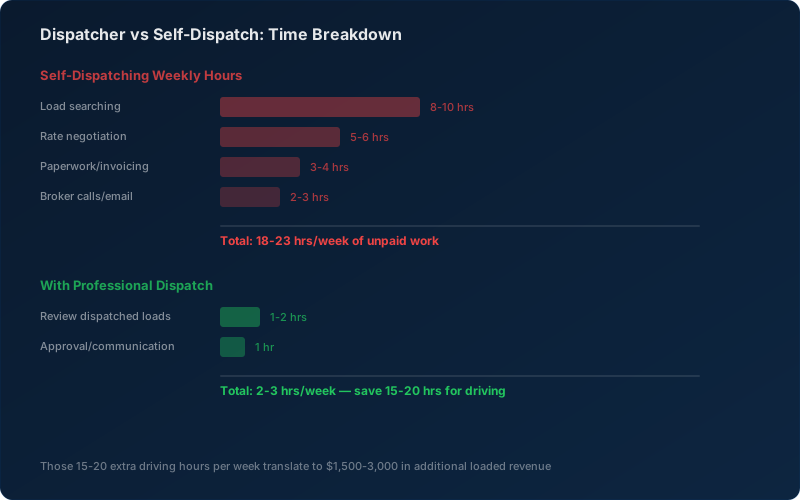
Time has a dollar value. Every hour you spend scrolling load boards, calling brokers, comparing rates, and planning routes is an hour you are not driving revenue miles. At 1-2 hours per day, that's 30-60 hours per month spent on tasks a dispatcher handles for you. For our full breakdown of dispatch economics, see Truck Dispatch Fees Explained.
What a Dispatcher Does in a Rising Market vs a Falling Market
The value of a dispatcher isn't static — it changes with market conditions. Understanding how a dispatcher operates differently in a rising market like 2026 versus the freight recession of 2023-2024 explains why the ROI is so much higher right now:
Rising Market (2026)
- •Pushes rates above posted prices — brokers will pay more when capacity is tight
- •Targets lanes with highest rejection rates (18% Midwest, 20%+ reefer) where shippers are desperate
- •Times loads to capture tariff-driven premiums on cross-border lanes
- •Locks short-term mini-contracts at elevated rates before market corrects
- •Reduces spot-to-contract transition timing — knows when to lock gains
Falling Market (2023-2024)
- •Focuses on maintaining volume — keeping the truck moving to cover fixed costs
- •Negotiates hard on detention and accessorial pay to supplement lower line-haul rates
- •Builds broker relationships that pay off when the market turns
- •Routes around dead lanes — avoids areas where oversupply kills rates
- •Manages contract freight to ensure minimum revenue floor
2026 is a rate-capture market. When tender rejections are at 18% and load-to-truck ratios are at 7.73, every load is a negotiation opportunity. The brokers posting loads on DAT and Truckstop are starting with lowball rates because that's their job. A dispatcher who calls back and says "I have a truck available, but not at that rate — what can you actually pay?" will consistently get $0.20-$0.40/mile more. You cannot have that conversation while you're driving through Kansas.
The tariff variable adds another layer. With the 15% Section 122 surcharge creating rate premiums on cross-border and manufacturing lanes, a dispatcher who tracks tariff-sensitive freight can route your truck to lanes paying 15-25% above domestic equivalents. That kind of real-time market intelligence is what separates professional dispatch from "I'll book whatever shows up on the board." For more on tariff rate impacts, see our Tariffs and Trucking Rates 2026 analysis.
Weather events create micro-opportunities. When Winter Storm Fern hit in January, tender rejection rates climbed from 9.75% to 12.19% in a single week (January 21-28). Carriers who had dispatchers monitoring the storm's path and repositioning ahead of the demand spike captured rate premiums. Carriers who were self-dispatching found out about the rate spikes after they had already passed. That one-week window was worth $2,000-$4,000 in additional revenue for carriers positioned correctly.
The Capacity Squeeze Amplifies Dispatch Value
The 2026 capacity environment isn't just cyclical recovery — it's structural tightening. And structural capacity reduction is the best possible environment for professional dispatch because it means the rate premiums are sustainable, not temporary spikes.
| Capacity Factor | Impact | Why It Helps Dispatched Carriers |
|---|---|---|
| 88,000 authorities revoked (2023) | Permanent capacity exit | Fewer competitors = more freight per truck = higher rates to capture |
| 5,000-8,000 carrier exits (2025) | Continued attrition | Ongoing thinning of competition benefits positioned carriers |
| Non-domiciled CDL rule (March 2026) | Up to 194,000 drivers affected | Driver shortage widens; shippers pay more for reliable capacity |
| Insurance: $0.102/mi record (2024) | Blocks new entrants | High barriers = less new competition = sustained tight capacity |
| STG Logistics Chapter 11 (Jan 2026) | $1B+ carrier bankruptcy | Displaced freight needs new carriers — premium rates for quick coverage |
| ~3,000 CDL mills removed | Fewer new CDL holders | Slower driver pipeline = prolonged capacity squeeze |
Sources: FMCSA, ATA, FreightWaves, ATRI. STG Logistics filed Chapter 11 on January 12, 2026.
The STG Logistics bankruptcy is a real-time example. When STG Logistics filed Chapter 11 on January 12, 2026 — with over $1 billion in both assets and liabilities — thousands of loads that were under contract with STG suddenly needed new carriers. The brokers and shippers scrambling to cover that freight paid premium rates for quick capacity. Dispatched carriers who were alerted to the opportunity within hours captured those loads. Self-dispatching carriers found out days later when the premiums had already been competed away.
Every carrier that exits makes the remaining carriers more valuable. With 88,000 authorities revoked in 2023 alone and another 5,000-8,000 carriers exiting in 2025, the supply of available trucks has structurally declined. The carriers who survived the freight recession — the ones still operating today — are the ones with the leverage. A dispatcher helps you use that leverage. Instead of accepting the first load that appears on a board, you have someone whose full-time job is ensuring your truck is always on the highest-paying load available.
For more on why the carrier exits aren't coming back, read our Carrier Exodus Reshaping Freight analysis and our Trucking Bankruptcies 2026 breakdown.
Common Objections (And the Real Answers)
We hear the same concerns from owner-operators considering dispatch for the first time. Here's the honest response to each:
"I can find my own loads on DAT/Truckstop"
You absolutely can — and many successful owner-operators do. The question is not whether you can find loads, it's whether you can find the best loads while driving 500 miles a day. The rates posted on load boards are starting points. A dispatcher who calls the broker and negotiates from current market data — knowing that Midwest rejections are at 18% and capacity is tight — will consistently get more than the posted rate. In a $2.41/mile market, that negotiation is worth $0.20-$0.40/mile. Over 10,000 miles, that's $2,000-$4,000 you left on the table. Compare your experience with our Dispatch vs Self-Dispatch breakdown.
"6% of my gross is too expensive"
If a dispatcher costs you 6% but earns you 15-25% more per load, you are coming out 9-19% ahead after fees. That is not an expense — it is an investment with a measurable return. Think of it this way: at $24,100/month gross (self-dispatching at $2.41/mi), paying a 6% dispatch fee on $27,100/month gross (dispatched at $2.71/mi) costs you $1,626 but earns you $3,000 more. Your net gain is $1,374/month. The math works even better on premium lanes. Use our Dispatch ROI Calculator to see your specific numbers.
"I tried a dispatcher before and got burned"
Unfortunately, bad dispatchers exist — just like bad brokers and bad carriers. The dispatch industry has its share of operators who charge fees for minimal work, lock you into restrictive contracts, or disappear when you need them. That is exactly why we wrote our Dispatch Scams Red Flags guide and our How to Choose a Dispatch Company guide. The key indicators of a legitimate dispatch service: no long-term contracts, transparent fee structure, real-time communication, verifiable carrier references, and a willingness to show you the broker rate on every load. At TDE, we operate with full transparency — you see what the broker pays, you see our fee, no surprises.
"The market will cool off — I should wait"
Maybe. But the structural capacity reduction — 88,000 authority revocations, CDL rule changes affecting 200,000 drivers, insurance barriers blocking new entrants — suggests this isn't a normal cycle. Even if spot rates moderate from $2.41/mile, the floor is higher than it was in 2023-2024 because there are permanently fewer trucks on the road. More importantly, the best time to establish a dispatch relationship is when rates are high and the ROI is obvious. If you wait for a downturn to hire a dispatcher, you are doing it backwards — you want the relationship established and the dispatcher familiar with your lanes and preferences before you need them to fight for every load in a tight market.
How to Get Started with Professional Dispatch
If the numbers make sense for your operation — and in 2026, they make sense for most owner-operators running 8,000+ miles per month — here's how to move forward:
Step 1: Know your numbers. Before talking to any dispatch company, calculate your cost per mile using our Cost Per Mile Calculator. Know your breakeven rate. Know your target rate. A good dispatcher will ask you for these numbers — if they don't, that's a red flag.
Step 2: Run the ROI calculation. Use our Dispatch ROI Calculator to model different scenarios. What does 10% more revenue look like after a 6% fee? What about 20% more? What if deadhead drops from 18% to 10%? See the numbers for your specific operation before you commit.
Step 3: Evaluate dispatch companies. Read our How to Choose a Dispatch Company guide. Look for no-contract, percentage-based pricing. Check for red flags. Ask for references from owner-operators running similar equipment on similar lanes.
Step 4: Start with a trial period. Any legitimate dispatch company will let you try their service without a long-term commitment. At Truck Dispatch Experts, we operate with no contracts and no setup fees. You evaluate us based on results — the rates we find, the miles we eliminate from deadhead, and the revenue we add to your bottom line. If we don't deliver, you walk away with nothing owed. See our pricing page for full details, or contact us to get started.
The freight market rewards carriers who are positioned correctly, negotiating effectively, and moving efficiently. In 2026, a professional dispatcher is how you do all three — simultaneously, while you focus on what you do best: driving.
Related Resources
- Truck Dispatch Fees Explained — Complete breakdown of how dispatch pricing works
- Dispatch vs Self-Dispatch — Detailed comparison of both approaches
- How to Choose a Dispatch Company — Evaluation criteria and red flags
- 2026 Freight Rate Recovery — Why rates are up and where the money is
- Dispatch ROI Calculator — Run the numbers for your specific operation
- Cost Per Mile Calculator — Know your breakeven before hiring a dispatcher
Truck Dispatch Experts
Published Mar 21, 2026