The one-sentence summary
The Safe Driver Apprenticeship Pilot Program is the single largest policy lever currently sitting on top of the US driver shortage, and in 2026 it is meaningfully underutilized: authorized to run 3,000 apprentices concurrently, cumulative enrollment since the 2022 launch is still in the low thousands, and almost all of it is concentrated in a handful of large fleets. This piece walks the program structure, the adoption bottlenecks, the safety data we actually have (versus the data people keep claiming we have), and the operational implications for carriers and CDL candidates deciding whether to engage in 2026.
The baseline rule — and why it exists
Under standard federal motor-carrier rules, a commercial driver must be at least 21 to operate across state lines. States issue CDL-As at 18, and many 18-20 year-olds are legally permitted to run intrastate freight within their home state — but the moment the load crosses a state border, age 21 becomes the floor. That boundary has been federal law for decades, and it predates the modern freight economy by a wide margin.
The original rationale was simple: interstate trucks run longer hours, cover unfamiliar lanes, and operate in a more complex regulatory environment than intrastate freight, and 18-20 year-olds on average have higher crash rates. Insurance industry data has historically supported that age band as a higher-risk population for large commercial vehicles, and the Federal Motor Carrier Safety Administration (FMCSA) has defended the age-21 interstate threshold on that basis for years.
What changed is the supply side. The American Trucking Associations recorded an 80,000-driver shortfall at its 2021 peak and projects the gap could surpass 160,000 by 2030 if nothing shifts. The average age of an over-the-road driver is about 57. Retirements are outpacing new CDL issuance by roughly two-to-one. And the most promising pool of new drivers — 18-20 year-olds — is locked out of interstate work during the exact three-year window when most of them pick a career path. For deeper context on why the shortage is not cyclical, see our analysis of the 2026 driver shortage crisis.
How the pilot works
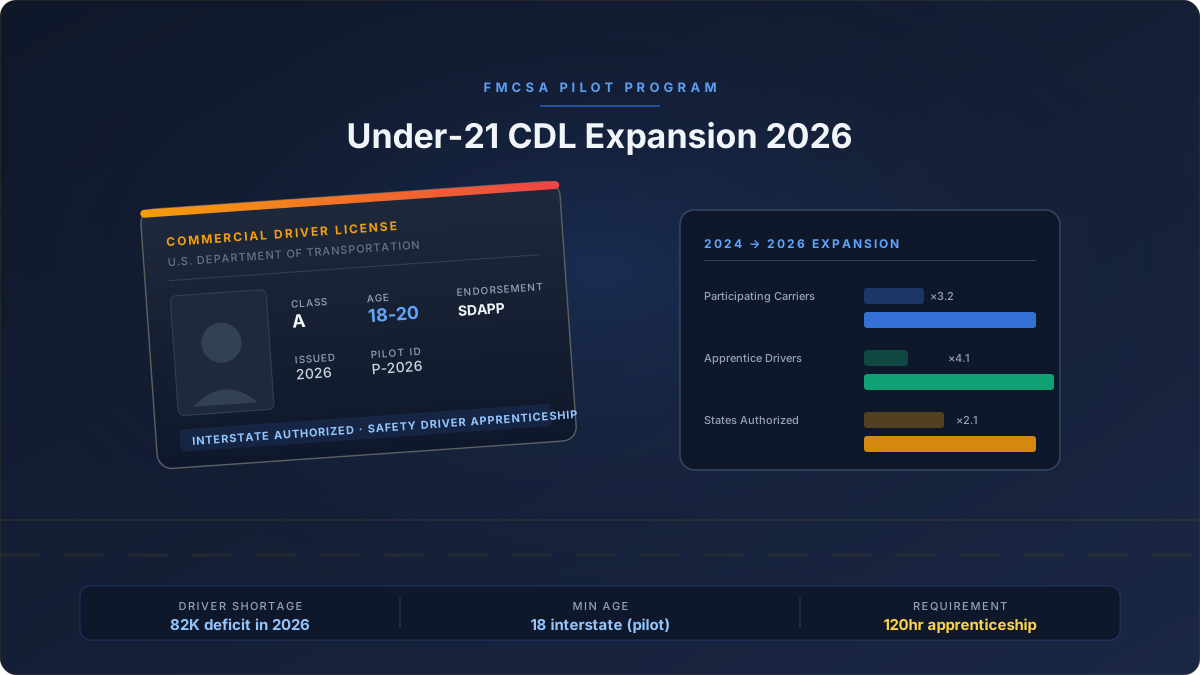
The Safe Driver Apprenticeship Pilot Program (SDAPP) was authorized under the Infrastructure Investment and Jobs Act in 2021 and launched in 2022. It is a carefully structured apprenticeship, not a deregulation — the 18-20 year-old cohort enrolled in SDAPP still faces tighter operating restrictions than any 21+ driver with equivalent experience.
The training is staged in two probationary periods. Probationary Period 1 requires at least 120 hours of on-duty driving time with an experienced driver-trainer physically in the cab, covering a defined skill checklist: backing, controlled braking, gear selection, hours-of-service documentation, interstate and city driving, and post-trip inspections. Probationary Period 2 requires another 280 hours of trainer-monitored driving — the trainer is not necessarily in the cab for every mile, but they are supervising performance, reviewing telematics, and certifying progress against a second skill list.
The equipment the apprentice drives is also specified. The tractor must have an electronic logging device (ELD), an active braking collision mitigation system, a forward-facing camera, and a speed governor set to 65 miles per hour or lower. That specification is not trivial — it rules out a meaningful share of older equipment still in service, especially among smaller fleets.
Participating carriers have to meet their own threshold. Their Compliance, Safety, Accountability (CSA) BASIC scores have to be clean, and their prior-period crash rates have to fall below specified benchmarks. The program has an overall cap of 3,000 apprentices enrolled at any one time. FMCSA collects detailed crash, inspection, and near-miss data for every apprentice.
Where adoption actually stands in 2026
Enrollment has never been close to the 3,000-concurrent ceiling. FMCSA's early progress reporting after the 2022 launch put active enrollment in the low hundreds. By 2024 the number had climbed but remained well below the cap. Industry reporting in early 2026 put cumulative SDAPP participation in the low thousands — counting all apprentices who have ever enrolled, not just active ones.
Put against the shortage math, that is a small number. If the pilot had been running at ceiling since 2022, it would have credentialed roughly 12,000 interstate-capable 18-20 year-old drivers over four years. At actual enrollment, the real contribution is a fraction of that. Every year that gap continues, the driver shortage compounds structurally.
Participation is also highly concentrated. Large national fleets with captive driver-training divisions — names like Schneider, Werner, Knight-Swift, Prime — have done the majority of the enrolling. Small fleets and owner-operators, which represent the majority of the US trucking industry by carrier count, are essentially absent from the program. That concentration matters for shortage math: the fleets adopting SDAPP are exactly the fleets with the most alternative recruitment levers (sign-on bonuses, lease-purchase programs, nationwide terminal networks), while the smaller carriers with the hardest recruitment problems cannot participate.
Why adoption is slow
The three bottlenecks are insurance, liability exposure, and training capacity.
On insurance: primary auto liability carriers price risk on actuarial data, and the historical under-21 commercial driver data reflects a higher claim frequency. Most liability carriers either surcharge under-21 drivers significantly or exclude them from the policy outright. In 2026, with nuclear-verdict exposure continuing to push premiums up across the board (see our breakdown of nuclear verdicts and trucking insurance), the surcharge for a 19-year-old apprentice can add thousands of dollars per truck per year. That cost has to be justified somewhere, and for most carriers it kills the SDAPP economics before training ever begins.
On liability exposure: CSA BASIC scores are a 24-month rolling reputation, and any crash or roadside violation by an SDAPP apprentice feeds into the carrier's BASICs like any other driver. Carriers with clean scores — exactly the carriers SDAPP requires — are reluctant to risk score damage for a program whose economics are already marginal. Carriers with questionable scores cannot participate. The program's safety-based eligibility creates an adverse-selection problem where the fleets most willing to take the risk are the ones explicitly blocked from enrolling.
On training capacity: 120 hours of in-cab training plus 280 hours of supervised driving requires a dedicated trainer-to-apprentice relationship, specified equipment, and administrative overhead to track hours and certify skill checklists. Large fleets already have driver-training divisions and can absorb this cost. Small fleets cannot — the fully-loaded cost of running a trainer-plus-apprentice pair during Probationary Period 1 can exceed the revenue the pair produces. The math only works at scale.
What the safety data shows — and what it does not
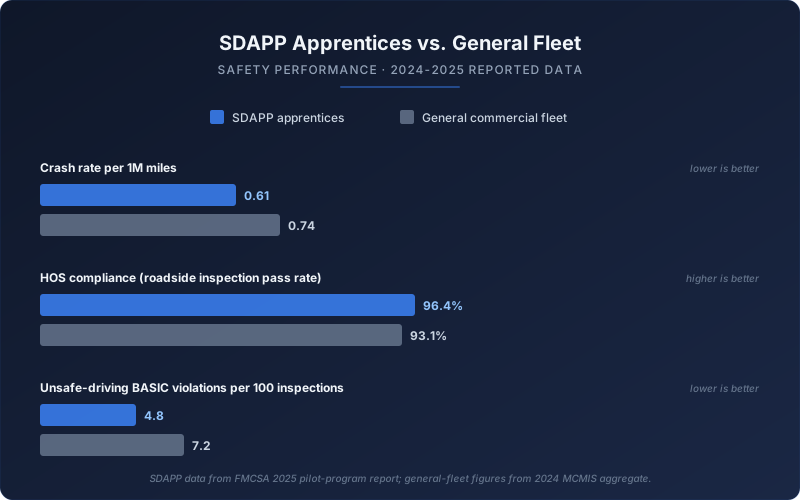
The honest read on the safety data is that we do not yet have enough. FMCSA has been collecting crash, inspection, and moving-violation data for every apprentice since the pilot launched, and the program's statutory design requires that data to be made public in progress reports.
The data that has emerged so far shows crash rates for apprentice cohorts in the same broad range as newly credentialed drivers in older age bands — higher than experienced drivers, lower than what the pre-pilot concerns about 18-20 year-olds on interstate freight predicted. That is a defensible read, but the sample is still small. A few thousand apprentice-miles is not a statistically robust basis for a national rule change, which is exactly why the program remains a pilot rather than a permanent policy shift.
Both sides of the debate are operating on limited evidence. Supporters, including most of the carrier industry and many workforce-development groups, read the early data as validation that the apprenticeship framework works and argue the program should expand. Critics, including the Teamsters, a number of independent safety advocates, and some insurance industry representatives, argue the sample is too small to conclude anything definitive and that the nuclear-verdict exposure environment justifies continued caution. Both readings are honest. The pilot is literally a data-gathering exercise, and 2026 is still inside the gathering phase.
What it means for carriers hiring in 2026
For large fleets with an existing driver-training operation, SDAPP is a real recruitment channel that is currently underutilized across the industry. The infrastructure is already built; the incremental cost of adding apprentice slots to existing training programs is modest; and the downstream retention benefit of onboarding drivers three years earlier — before they commit to a different industry — is meaningful. The fleets that have leaned in aggressively have used SDAPP as a competitive advantage, not just a shortage mitigation.
For small fleets and owner-operators, SDAPP is not currently a viable direct lever. The training overhead, insurance surcharge, and CSA exposure do not pencil out at the 1-5 truck scale. The more useful read is indirect: SDAPP participation by large fleets will over the next 3-5 years deliver 21-year-old drivers with 3 years of interstate experience into the broader market. Those drivers, once they age into unrestricted interstate status, become candidates for lease-on and owner-operator paths at a much younger age than the current pipeline delivers. Small carriers benefit from SDAPP even if they never enroll a single apprentice.
For carriers of any size, the near-term recruitment levers that actually move the needle are still the conventional ones — pay, home time, equipment quality, and dispatch support. The driver shortage is a multi-variable problem; SDAPP addresses the age-boundary variable specifically. The rest of the shortage math runs in parallel. If you are focused on owner-operator recruitment specifically, our dispatch and load finding hub covers the operational support side of the equation.
What it means for 18-20 year-old CDL candidates
If you are 18-20 and serious about a trucking career, SDAPP is the fastest path into interstate driving. Under the baseline rule, you are waiting three years for the age-21 threshold before interstate work opens up. Under SDAPP, you can be generating interstate revenue within months of earning a CDL-A — at apprentice pay during Probationary Period 1, then transitioning to something closer to conventional driver pay as you complete the program.
The practical work is finding a carrier that is actually enrolled in SDAPP, not just advertising it. Verify the carrier is on FMCSA's participant list, ask for documentation of their trainer-to-apprentice ratio, request the apprenticeship contract in writing before signing, and confirm the tractor you would drive meets the full SDAPP equipment specification (ELD, active braking collision mitigation, forward-facing camera, 65 mph speed limiter). Pay structure during Probationary Period 1 is typically lower than for a fully credentialed driver — that is by design — and the contract should make the progression from apprentice pay to full pay explicit.
Treat it like any other apprenticeship: the tradeoff is lower short-term pay in exchange for accelerated long-term career entry. For most 18-20 year-old candidates with a genuine interest in trucking, the math works. For candidates who are not sure, starting with intrastate work in a larger state (Texas, California) can give you a similar on-the-road test without the apprenticeship commitment.
The bottom line
The under-21 interstate CDL pilot is a genuine lever on the driver shortage, and it is underutilized. In 2026 the program is neither a failure nor a breakthrough — it is an ongoing data-gathering exercise that is credentialing fewer apprentices than it was designed to, almost entirely inside a handful of large fleets, against a shortage that compounds structurally every year. The adoption gap is driven by insurance, liability exposure, and training capacity — real operational barriers, not ideological ones.
The carriers who will look back on 2026 having made the right call are the ones who either enrolled in SDAPP and captured the early-entry pipeline, or who did not enroll but positioned their operation to hire SDAPP graduates as they age into unrestricted status over the next several years. Ignoring the program entirely in strategic recruiting planning is the option that makes the least sense in a market where the driver shortage is the single biggest input to rate pressure, capacity, and broker leverage. If you want to talk through what a practical recruitment plan looks like for your operation in 2026, reach out to our dispatch team — no contracts, no pressure, just a conversation.