The Worst Renewal Cycle in a Decade
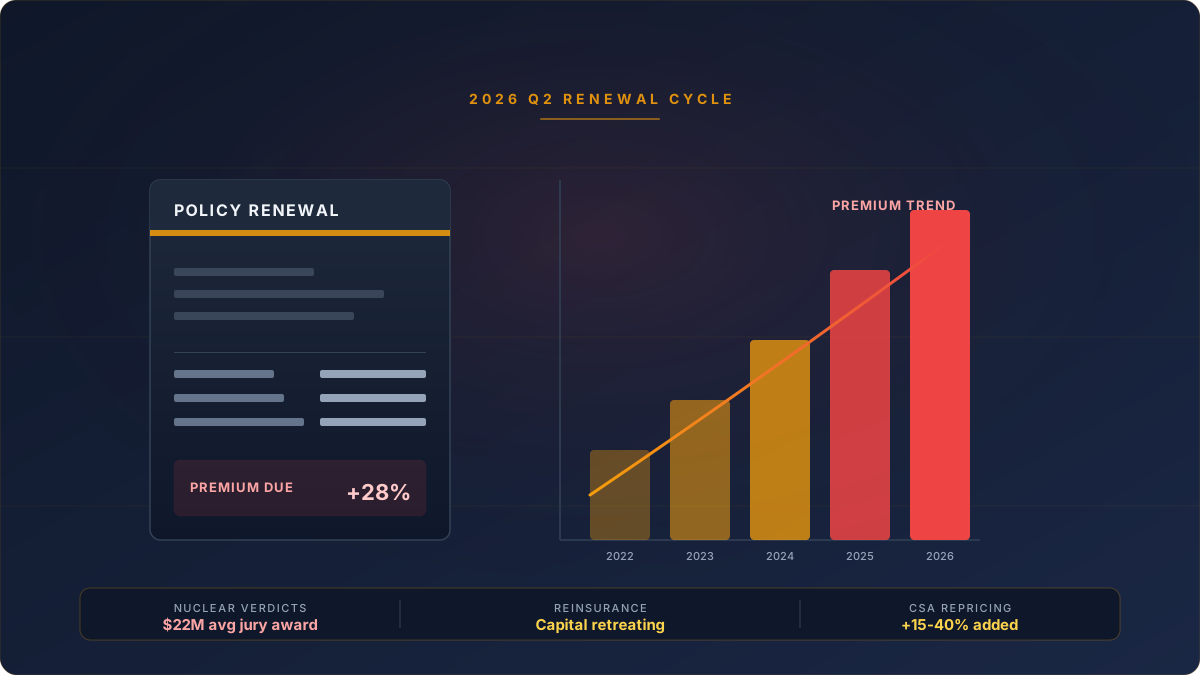
We are roughly halfway through the 2026 Q2 renewal cycle, and the picture coming out of small-carrier renewals is uglier than anything in recent memory. Owner-operators with clean records are opening renewal notices showing 18-32% increases. Small fleets with even a single accident on the loss run are seeing 40-70%. New authorities — carriers with less than 12 months of history — are getting quoted numbers that make the business mathematically unworkable.
This is not a temporary anomaly. It is the product of three forces compounding at once: the continued escalation of nuclear verdicts, a measurable retreat of reinsurance capital from trucking liability, and a CSA-scoring environment that is repricing tail risk aggressively. None of those forces is reversing in the next 12 months. Renewal 2027 is likely worse, not better.
The carriers who survive this cycle intact are the ones who stop treating insurance as a line item they pay and start treating it as an underwriting negotiation they run. This piece lays out what you are actually up against, what real carriers are paying right now, and the eight-step playbook that consistently produces better renewals than the default path.
Reality check: If you are about to let your broker auto-renew you at whatever number comes back, you are almost certainly overpaying by 10-25%. Underwriters reward carriers who present themselves professionally. They penalize carriers who don't. The difference between those two outcomes is paperwork and 30-45 days of lead time — not luck.
What Carriers Are Actually Paying in 2026
Published industry averages are misleading because they blend new authorities, established carriers, and fleet-scale operations into one number. The table below separates the picture by operator profile. All figures are annual, per truck, and reflect the middle 50% of observed renewals in Q1-Q2 2026 for carriers operating 48-state dry van, reefer, or flatbed at standard limits ($1M primary liability, $100K cargo, replacement-cost physical damage on newer equipment).
| Carrier Profile | Primary Liability | Physical Damage | Cargo | Typical All-In |
|---|---|---|---|---|
| Established O/O, clean, 2+ yrs authority | $14K-$19K | $2.5K-$4.5K | $1.8K-$3.2K | $19K-$27K |
| New authority (under 12 months) | $22K-$38K | $3K-$5K | $2.5K-$4K | $28K-$47K |
| O/O with 1 at-fault loss in 36 mo | $24K-$34K | $3K-$5K | $2K-$3.5K | $29K-$42K |
| Small fleet (2-10), clean | $11K-$17K | $2.5K-$4K | $1.5K-$3K | $16K-$23K |
| Hotshot / box truck | $9K-$14K | $1.8K-$3K | $1.2K-$2.5K | $12K-$19K |
Add approximately 25-60% if operating primarily in TX, FL, GA, LA, or CA. Add 15-30% for reefer (cargo-value risk). Heavy-haul and oversized operate on bespoke pricing and are excluded.
The Three Forces Driving 2026 Renewals
Nuclear-verdict inflation (the headline driver)
ATRI data shows average trucking verdicts crossed $22M in 2024 and kept climbing through 2025. Every $10M+ verdict pushes reinsurers to reprice the trucking book, and those increases flow straight through to primary carriers, who flow them straight through to you at renewal. This is not a cycle insurers can 'wait out' — it's a structural change in litigation that only tort reform can meaningfully reverse, and federal tort reform is not moving.
Reinsurance capital retreating from trucking
Multiple major reinsurers have trimmed or exited their trucking liability books since 2023. When reinsurers pull back, primary insurers retain more risk per policy — which means they price to retain capital adequacy, not to grow market share. The practical result: fewer carriers competing for your renewal, less aggressive quoting, and underwriters empowered to walk away from risks they would have written 18 months ago.
CSA-scoring repricing on the back end
FMCSA's continued CSA methodology refinements, combined with aggressive 2024-2025 roadside inspection activity, surfaced a wave of BASICs threshold exceedances that underwriters are now pricing in. If your CSA report shows any BASIC above threshold — unsafe driving, hours of service, vehicle maintenance — expect 15-40% on top of the market increase. Carriers with previously-hidden violations coming to light are getting repriced hardest.
The Three Carrier Tiers at Renewal
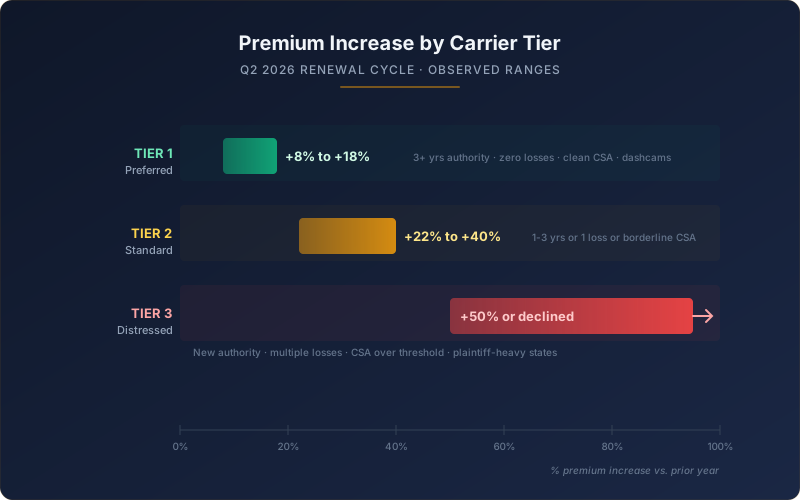
Underwriters in 2026 are effectively sorting every carrier into one of three buckets before they quote. Knowing which bucket you're in tells you what renewal approach actually works for your situation.
Tier 1 — Preferred. Three or more years of authority, zero at-fault losses in 36 months, all CSA BASICs under threshold, dashcam-equipped, documented maintenance program. Tier 1 carriers get competitive renewals in the 8-18% increase range. Multiple insurers will quote you. Shopping actually moves the needle here — the spread between high and low quote is often 15-20%.
Tier 2 — Standard. One to three years of authority, or one at-fault loss, or one CSA BASIC near threshold. Renewals in the 22-40% increase range. You'll get two or three quotes at most. The renewal playbook (below) matters most here — the difference between a well-presented Tier 2 renewal and a carelessly-presented one is easily 10-15 points of premium.
Tier 3 — Distressed. Under 12 months of authority, or multiple losses, or multiple CSA BASICs over threshold, or operation in plaintiff-heavy states without mitigants. Renewals in the 50%+ range, and some markets will decline outright. Tier 3 carriers need to think hard about whether the operating model still makes sense, or whether leasing on to an established carrier is cheaper than continuing to pay standalone premiums.
The 8-Step Renewal Playbook That Actually Works
Start 45-60 days before expiration, not 14
Every week of runway is worth real money. Starting 45 days out gives your broker time to market your risk to multiple carriers, negotiate the narrative, and give you options. Starting 14 days out means taking whatever your incumbent quotes — which is exactly what they're pricing for.
Pull your loss runs, CSA report, and MVRs yourself
Don't wait for your broker to request them. Order loss runs from every carrier you've had in the past 5 years, pull your current CSA report from the SAFER portal, and request MVRs for every driver. Review everything before anyone else sees it. Errors are extremely common — incorrect crash attributions, expired violations still showing, wrong driver on a citation. Every error you catch and correct is basis points off your renewal.
Write a cover memo framing the risk
Underwriters read 40+ submissions a day. The ones that get attention — and better pricing — are the ones that come with a one-page narrative explaining who you are, what you haul, your safety program, and context for any blemishes. 'The 2024 incident was a rear-end at a stop light; claim closed at $18K; installed dashcams the following month' reads very differently than a raw loss run with no explanation.
Work with a trucking-specialist broker, not a generalist
A commercial broker who writes a few trucking policies a year will cost you money. Work with someone who writes 100+ trucking policies annually — they know which underwriters are currently aggressive on your risk profile, which markets are pulling back, and how to structure your program (primary + excess, retention, endorsements) to minimize total cost rather than just primary premium.
Shop with 3+ carriers, in parallel
Get your broker to submit to at least three markets simultaneously. Sequential shopping — 'let's try Carrier A first, then B if that doesn't work' — wastes your 45-day runway. Parallel submissions give you real leverage: if Carrier A sees they're competing with B and C, they sharpen their pencil.
Install dashcams before renewal, not after
Most major trucking insurers now offer 5-15% premium discounts for dashcam-equipped fleets. The discount applies at bind, so installing hardware one week before your renewal quote goes out captures the savings. Waiting until after renewal means paying full price for another year. Dual-facing cameras are the baseline; forward-only is acceptable for price-sensitive budgets but doesn't trigger the same discount.
Raise deductibles where it makes sense
Moving from $1,000 to $2,500 or $5,000 deductible typically saves 8-15% on the premium — real money if your claim frequency is low. Run the math: if you haven't had a physical damage claim in the past five years, the higher deductible is almost certainly net positive even after accounting for one eventual claim. Don't raise the liability deductible casually; that's different math.
Ask about hired-and-non-owned, umbrella, and group programs
Bundling hired-and-non-owned auto coverage, adding a modest umbrella layer, or joining an established carrier's group program can be cheaper than standalone primary-only pricing. The answer varies by individual situation — which is why a specialist broker is worth their commission. A generalist won't surface these options because they don't know which markets offer them.
What If You're a New Authority?
New authorities (under 12 months) are taking the brunt of 2026. The numbers in the table above are the honest version — $28K-$47K all-in per truck is the market, and that is before any state-of-operation adjustments. If you are a one-truck new authority in Texas, $45K+ is entirely realistic.
The difficult but honest conversation: for many one-truck new authorities, the insurance math in 2026 does not work as a standalone operation. You are paying new-authority premiums for 12-24 months, competing for the same loads as established carriers with half your insurance burden, and you don't have the fleet size to absorb a single bad month. Two options worth seriously considering:
Option A: Lease on to an established carrier for your first 12-18 months. You operate under their authority and their insurance. You lose some margin and some independence, but you skip the new-authority insurance trap entirely and build a loss-free operating history that makes your Year 2 standalone renewal dramatically cheaper.
Option B: If standalone is non-negotiable, focus obsessively on the things that drop your Year 2 renewal — dashcams from day one, zero CSA violations, documented maintenance, conservative lane selection. The difference between a clean-record new authority hitting month 13 and one with two CSA violations and a near-miss on the loss run is easily $10K-$15K per year on renewal. Year 2 is where you either earn your way into Tier 2 or get stuck in Tier 3.
Why a Good Dispatcher Is an Insurance Play
This isn't a pitch — it's a mechanics point. Underwriters price your risk based on CSA score, loss history, and operational profile. Every one of those metrics is moved by what loads you run, which brokers you work with, and whether you're operating rushed or in control.
A professional dispatcher keeps you out of the rushed-pickup, hours-of-service-edge, unsafe-lane situations that produce CSA violations. They filter brokers for payment risk (so you don't end up running a factoring-dependent carrier at razor-thin margins that force you to cut corners). They help you avoid overloaded equipment. Over a 12-month cycle, the delta between well-dispatched and poorly-dispatched operations shows up in your CSA report — and your CSA report is priced directly into your next renewal.
Put another way: a dispatcher charging 6-8% of gross who helps you maintain a clean CSA in 2026 is paying for themselves through insurance savings alone, independent of rate improvements and deadhead reduction. See our breakdown of how dispatch fees actually work.
The Bottom Line
2026 renewals are the hardest market small carriers have seen in over a decade, and the three forces driving it — nuclear verdicts, reinsurance retreat, CSA repricing — are not reversing in the near term. The carriers who navigate this cycle without losing 20+ points of margin are the ones who treat renewal as a 45-day project, not a 14-day scramble.
Install dashcams. Pull your own loss runs and CSA report and correct errors. Write the cover memo. Work with a specialist broker. Shop three markets in parallel. Raise deductibles strategically. Add umbrella coverage rather than running on $750K primary. For new authorities where the standalone math doesn't work, seriously consider leasing on for 12-18 months rather than accepting a renewal you can't afford.
None of this is exotic. It's the basic discipline of treating your insurance as a managed liability rather than a bill that arrives in the mail. In a normal market, the difference between disciplined and default renewals is 5-10%. In 2026, it's 15-25%. That's the difference between a tough year and an unworkable one.
Related Resources
- Nuclear Verdicts in Trucking 2026 — The litigation trend behind every renewal increase
- Trucking Insurance Guide for Owner-Operators — Coverage types, limits, what you actually need
- How to Fix a Bad CSA Score — The single biggest lever on your renewal after dashcams
- How to Lease On to a Carrier — When standalone authority doesn't make sense in 2026
- Owner-Operator Dispatch Guide — How professional dispatch affects your CSA and your renewal