The Insurance Crisis Hitting Every Carrier's Bottom Line
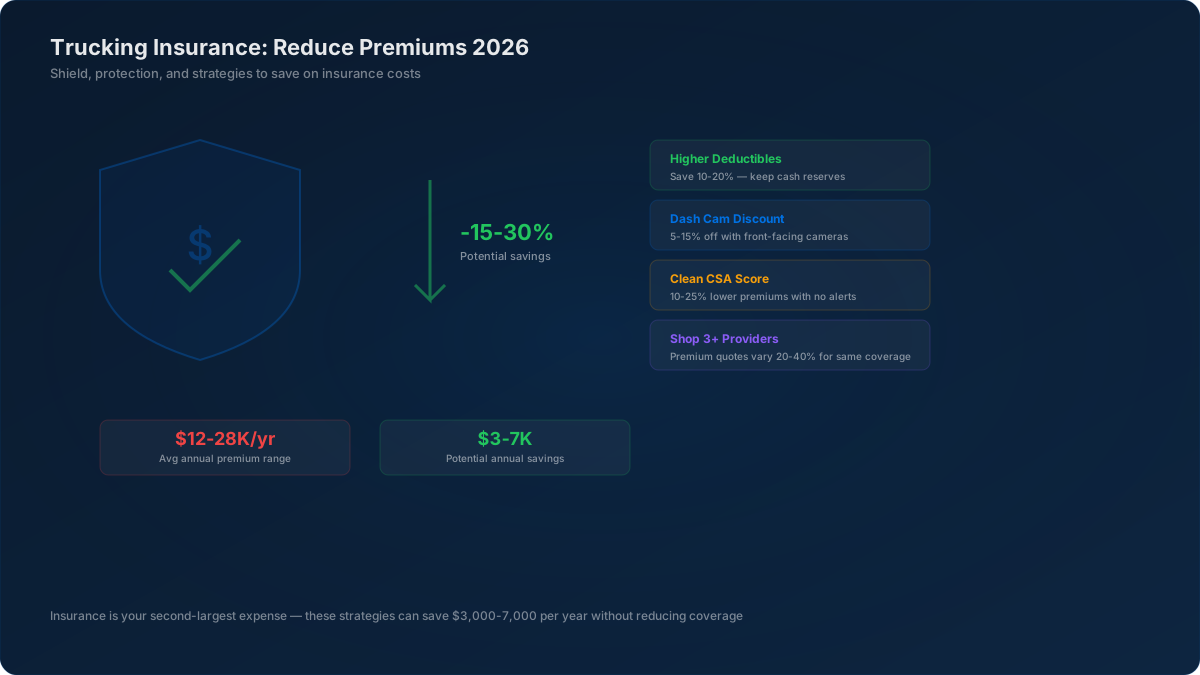
Trucking insurance is no longer just a line item — it is a make-or-break expense. In 2026, the average owner-operator pays $9,000-$20,000+ annually for a full insurance package, and new authority carriers face $18,000-$28,000 in their first year. Per-mile insurance costs have hit a record $0.102, making insurance the second or third largest expense after fuel for most operators.
The forces driving this are structural, not cyclical. Nuclear verdicts — jury awards exceeding $10 million in trucking accident cases — have increased 235% since 2012. Third-party litigation funding has turned trucking lawsuits into an investment asset class, incentivizing attorneys to pursue ever-larger settlements. The American Transportation Research Institute (ATRI) found that the average nuclear verdict in trucking now exceeds $22 million. Insurers price this risk into every policy they write.
You cannot control jury verdicts or litigation trends. But you can control the factors insurers use to price your individual policy. These 10 strategies are proven to reduce premiums — some immediately, others over time — and collectively can save you $2,000-$8,000 per year.
$0.102
Record per-mile insurance cost
235%
Nuclear verdict increase since 2012
$9-20K+
Annual premium range
5-15%
Dashcam discount
Premium Ranges by State (2026)
Insurance costs vary dramatically by state due to differences in litigation environments, traffic density, and regulatory requirements. Here is what owner-operators are paying across the country:
| State/Region | Annual Premium | Risk Tier | Key Factor |
|---|---|---|---|
| Florida | $18,000-$25,000 | High | No-fault state, high litigation |
| California | $16,000-$24,000 | High | CARB regs, congestion, litigation |
| Texas | $14,000-$22,000 | High | Nuclear verdict state, high volume |
| New York / NJ | $15,000-$22,000 | High | Congestion, litigation environment |
| Georgia | $13,000-$20,000 | Medium | Growing litigation, I-75/I-85 corridor |
| Illinois | $13,000-$19,000 | Medium | Cook County litigation, Chicago congestion |
| Pennsylvania | $12,000-$18,000 | Medium | Turnpike volume, moderate litigation |
| Ohio / Indiana | $10,000-$16,000 | Lower | Moderate litigation, lower congestion |
| Montana / Wyoming | $9,000-$14,000 | Lower | Low traffic density, rural operations |
| Idaho / Nebraska | $9,000-$13,000 | Lower | Low litigation, rural corridors |
Rates reflect single Class 8 owner-operator with 3+ years experience and clean record. Based on 2026 market data from trucking-specific insurance agents.
10 Proven Strategies to Lower Your Premiums
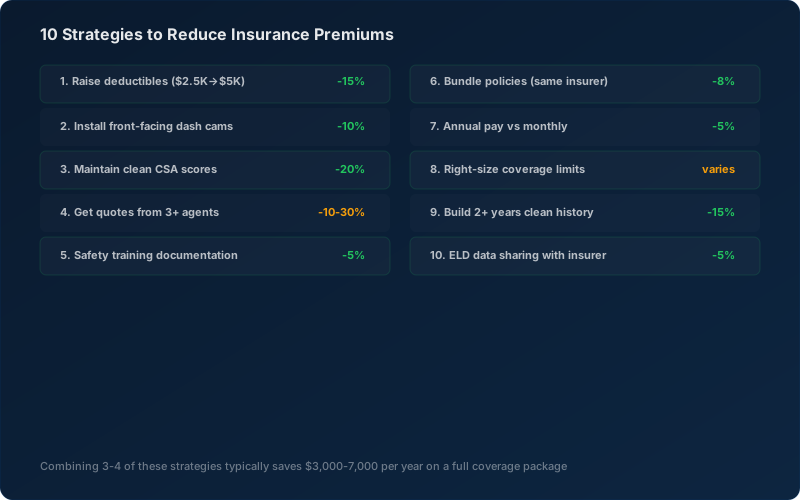
Each strategy below includes the estimated savings range so you can prioritize the ones with the biggest impact on your specific situation.
| Strategy | Est. Savings | Timeline | Difficulty |
|---|---|---|---|
| 1. Install dashcams | 5-15% | Immediate | Easy |
| 2. Clean CSA scores | 15-40% | 3-12 months | Medium |
| 3. Raise deductibles | 10-25% | At renewal | Easy |
| 4. Bundle coverages | 5-10% | At renewal | Easy |
| 5. Document driver training | 5-10% | 1-3 months | Easy |
| 6. Defensive driving course | 5-10% | 1-2 weeks | Easy |
| 7. Reduce operating radius | 15-25% | At renewal | Medium |
| 8. Join group program | 10-20% | 1-2 months | Easy |
| 9. Shop annually (5+ quotes) | 10-30% | 60-90 days pre-renewal | Medium |
| 10. Use trucking-specialized broker | 5-15% | Immediate | Easy |
Strategy 1: Install Forward and Driver-Facing Dashcams
This is the single easiest thing you can do to reduce insurance costs, and it pays for itself within months. A quality dual-camera dashcam system (Samsara, Motive, or Lytx) costs $300-$800 upfront plus $20-$40/month for cloud storage and telematics integration. The premium discount is 5-15% on liability and physical damage coverages — on a $15,000 annual policy, that is $750-$2,250 saved per year.
But the real ROI is in claim defense. A single disputed accident without camera evidence can cost $50,000-$500,000+ in settlement and premium increases. With dashcam footage, you can prove you were not at fault — or at minimum, reduce your liability share. Insurance companies know this: carriers with camera programs have 30-50% lower average claim costs, which is why the premium discount exists.
Strategy 2: Clean and Monitor Your CSA Scores
Your FMCSA CSA scores are the single biggest factor in how insurers price your policy — more impactful than years of experience, equipment age, or operating radius. The seven BASICs categories (Unsafe Driving, Hours of Service, Driver Fitness, Controlled Substances, Vehicle Maintenance, Hazardous Materials, Crash Indicator) each receive a percentile ranking against peer carriers.
Scores above the 65th percentile in Unsafe Driving, Crash Indicator, or HOS Compliance can increase your premiums 15-40%. Conversely, scores below the 50th percentile in all categories qualify you for preferred rates at most insurers. The difference between a carrier with clean CSA scores and one with violations can be $3,000-$8,000 per year in premiums.
Action steps: Check your CSA profile quarterly. Use the DataQs system to challenge any inaccurate violations — inspections where you were not at fault, errors in coding, or violations that have been corrected. A single successfully disputed violation can save $500-$1,500 annually. Our CSA score repair guide walks through the dispute process step by step.
Strategy 3: Raise Your Deductibles Strategically
Most owner-operators default to a $1,000 deductible because it feels safe. But that safety comes at a premium — literally. Moving from a $1,000 to $2,500 deductible typically saves 10-15% on physical damage and cargo coverages. A $5,000 deductible saves 15-25%. On combined physical damage and cargo premiums of $6,000-$8,000, that is $900-$2,000 in annual savings.
The math works in your favor over time. If you set aside the premium savings in a dedicated deductible fund, after two to three claim-free years you will have accumulated more in savings than the deductible amount. You are essentially self-insuring the first $2,500-$5,000 of any loss while paying less to the insurance company for the catastrophic coverage above that threshold.
Important: Only raise your deductible if you can actually cover it from reserves. A $5,000 deductible you cannot pay when a claim happens is worse than the $1,000 deductible — it delays repairs, keeps your truck off the road, and costs you revenue.
Strategy 4: Bundle All Coverages with One Insurer
Buying primary liability from one company, physical damage from another, and cargo from a third might seem like smart comparison shopping. In practice, it usually costs more. Insurers offer 5-10% multi-policy discounts when you bundle all coverages — liability, physical damage, cargo, bobtail, and general liability — under one policy.
Beyond the discount, bundling simplifies claims. When you have a single insurer, there is no finger-pointing between companies about which coverage applies. Your agent handles everything through one underwriter. If you have separate insurers and get into an accident that involves both liability and cargo damage, you could end up dealing with two separate claims adjusters, two deductibles, and two sets of paperwork.
Strategies 5-6: Training and Defensive Driving
Document all driver training. Insurers look favorably on carriers who maintain written training records — onboarding procedures, ongoing safety meetings, and corrective action documentation. Even if you are a solo owner-operator, documenting your own continuing education (Smith System course, hazmat refresher, winter driving certification) demonstrates a safety-first mindset. Many insurers offer 5-10% discounts for documented training programs.
Take a defensive driving course. The Smith System, National Safety Council Defensive Driving Course, or FMCSA-approved safety programs can earn an additional 5-10% premium discount with participating insurers. Great West Casualty, Sentry, and Progressive Commercial all recognize these courses. The courses typically cost $100-$300 and take 4-8 hours — and the premium savings recur every year as long as you maintain the certification.
Strategy 7: Reduce Your Operating Radius
If you primarily run regional freight (under 500 miles from your domicile), make sure your insurance policy reflects that. Long-haul policies covering 48-state operations are priced 15-25% higher than regional policies because the risk profile is fundamentally different — more miles driven, more states with different litigation environments, more fatigue-related accident exposure.
A regional radius designation does not mean you can never take a long-haul load. Most policies allow occasional trips outside your declared radius. But if 80%+ of your loads are within 500 miles, your policy should reflect that. Talk to your agent about radius-based pricing — the savings on a $15,000 annual policy can be $2,250-$3,750. Our regional vs. long haul comparison breaks down the full financial picture.
Strategy 8: Join a Group Insurance Program
Group insurance programs pool risk across multiple carriers, giving individual owner-operators access to rates normally reserved for fleets. The Owner-Operator Independent Drivers Association (OOIDA) offers group programs for occupational accident, physical damage, and liability coverage that run 10-20% below individual market rates.
State trucking associations, dispatch cooperatives, and carrier alliance groups offer similar programs. The larger the group and the better the collective safety record, the better the rates. Even after paying membership fees ($40-$150/year for most associations), the insurance savings typically exceed the cost by a wide margin. If you are not a member of any trucking association, OOIDA is the most accessible starting point for individual owner-operators.
Strategies 9-10: Shop Smart and Use Specialists
Shop annually with at least 5 quotes. Start 60-90 days before renewal. The trucking insurance market is not monolithic — different underwriters have different appetites for different risk profiles. Progressive might be cheapest for a 3-year carrier with no accidents, while National Indemnity might beat them on a new authority policy. You will never know unless you compare. The spread between highest and lowest quotes for identical coverage is often 30-40%.
Use a trucking-specialized insurance broker. General insurance agents who sell trucking policies as a side business do not know the market. A broker who specializes in commercial trucking has relationships with 10-20+ underwriters, understands how to present your risk profile favorably, and knows which companies are currently writing aggressively in your niche. They often access programs not available through general agents. Ask potential brokers how many trucking policies they write annually — if it is under 100, they are not a specialist.
For a deeper dive into coverage types, required minimums, and policy details, see our complete insurance guide for owner-operators and our analysis of 2026 insurance rate trends.
How Dispatch Helps Lower Insurance Over Time
A dispatch service does not directly appear on your insurance policy. But the indirect effects are significant and compound over time. Better load selection means fewer overweight violations. Proper route planning means less fatigue-related risk. Broker screening means fewer freight fraud incidents that generate cargo claims. Compliance support means cleaner CSA scores.
Every claim-free year strengthens your renewal position. After three consecutive years without a claim, most insurers move you into a preferred tier with 10-15% lower base rates. Our dispatch service focuses on load quality and compliance because we know that keeping your record clean is worth thousands in insurance savings year after year. Factor insurance into your cost per mile calculation so every rate negotiation accounts for your true operating costs.
The Bottom Line
Insurance is going up — that is the reality of operating in a market shaped by nuclear verdicts and litigation funding. But the carriers who treat insurance as a controllable expense rather than a fixed cost save thousands every year. The combination of dashcams, clean CSA scores, higher deductibles, group programs, and aggressive annual shopping can realistically reduce your premium 20-35% compared to a carrier who just passively renews each year.
On a $15,000 annual policy, 20-35% savings is $3,000-$5,250 — real money that goes directly to your bottom line. Start with the easy wins (dashcam, defensive driving course, bundling), then work on the longer-term strategies (CSA score cleanup, building tenure, group programs). Every dollar you save on insurance is a dollar that does not need to come from hauling freight.
Related Resources
- Trucking Insurance Rates 2026 — Complete rate analysis and trend breakdown
- Complete Insurance Guide — Every coverage type explained for owner-operators
- How to Fix a Bad CSA Score — Step-by-step DataQs dispute process
- Nuclear Verdicts in Trucking — Understanding the litigation crisis
- Cost Per Mile Calculator — Factor insurance into your operating costs
- Negotiate Better Insurance — Advanced negotiation tactics at renewal
- How to Pass a DOT Inspection — Keep your CSA scores clean
Truck Dispatch Experts
Published Mar 21, 2026