What Are Tender Rejections? (Plain English Version)
If you've been driving for a while, you know the feeling: a load comes through that barely covers your costs, and you say no. On a larger scale, that is exactly what tender rejections measure.
Here's how it works. Most large shippers — think Walmart, Procter & Gamble, Amazon — have contracted rates with carriers. They agree in advance to pay a set rate per mile for freight on specific lanes. When a shipper needs to move a load, they send an electronic "tender" to the contracted carrier — basically a load offer at the pre-negotiated price. If the carrier accepts, the load moves at the contract rate. If the carrier rejects it, the shipper has to find another truck, usually on the spot market at a higher price.
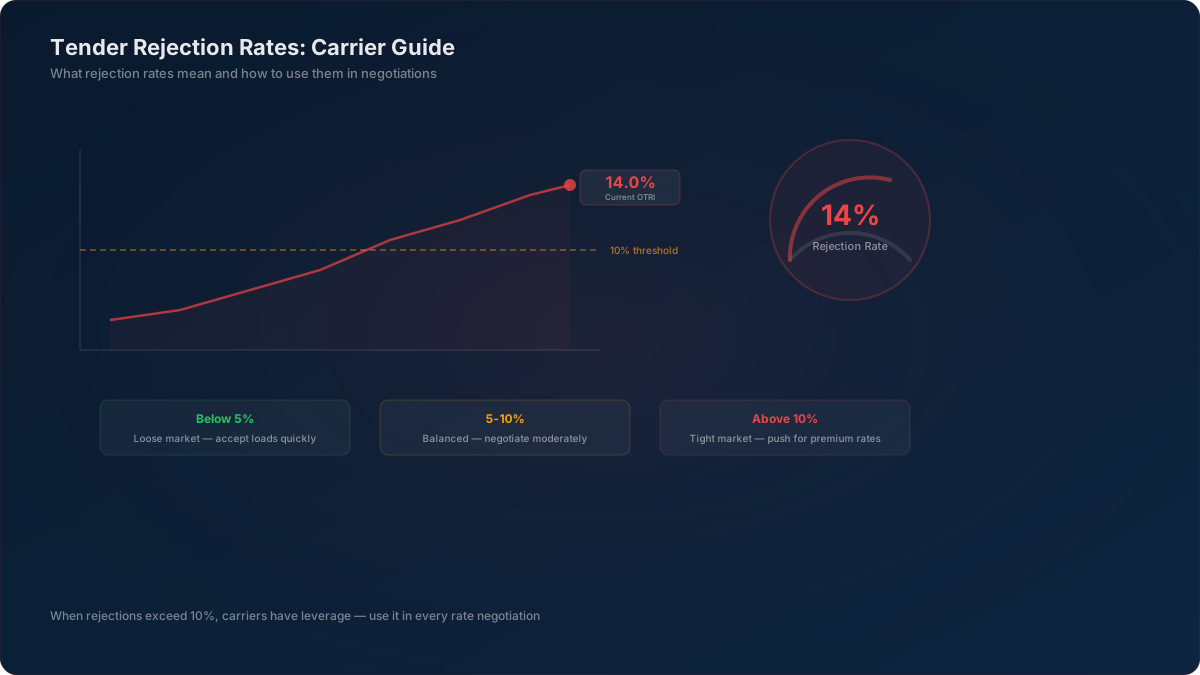
The Outbound Tender Rejection Index (OTRI), published by FreightWaves SONAR, tracks how often carriers are saying "no" to these contract tenders. When the OTRI is at 14%, it means 14 out of every 100 contracted loads are being rejected by carriers. Those rejected loads have to go somewhere — and they end up on the spot market, where you and other carriers can command higher rates.
Why should you care? Because tender rejections are one of the earliest and most reliable signals of where freight rates are heading. When carriers start rejecting contracted loads in significant numbers, it means the market has shifted in favor of carriers. There is more freight than there are trucks willing to haul it at current prices. And when that happens, rates go up — first on the spot market, then on contract rates. That 14% number is telling you something important: carriers have pricing power right now that they haven't had since mid-2022.
Why 14% Is the Number Everyone Is Watching
Not all OTRI levels are created equal. Here's the cheat sheet for what different rejection rates mean:
| OTRI Range | Market Condition | What It Means for Carriers | Last Seen |
|---|---|---|---|
| 0-5% | Shipper's market (oversupply) | Take what you can get — capacity is loose | 2023-2024 freight recession |
| 5-10% | Balanced / transitional | Market tightening — watch for opportunities | Late 2024 - early 2025 |
| 10-15% | Carrier-favorable | Pricing power returning — negotiate harder | Now (14% national, Feb 2026) |
| 15-20% | Tight capacity | Strong rate premiums — maximize every load | Early 2022 |
| 20%+ | Capacity crisis | Extreme pricing power — spot rates surge | 2020-2021 boom |
At 14%, we are solidly in carrier-favorable territory. This is the highest the national OTRI has been since mid-2022 — right before the freight recession pushed it down into the 3-5% range that dominated 2023 and much of 2024. The transition from "shipper's market" to "carrier's market" happened faster than most analysts expected, driven by a combination of tariff-related import surges, seasonal demand, and carriers who exited the industry during the lean years.
The spot market confirms the signal. DAT spot van rates averaged $2.41 per mile in February 2026, up from $2.03 per mile in August 2025. That is a 19% increase in six months. Spot rates are now running 20%+ above year-over-year levels. When the spot market pays significantly more than contract rates, carriers reject tenders to chase spot loads — and the OTRI climbs. It is a self-reinforcing cycle that typically continues until contract rates catch up.
For context on the broader market dynamics driving this shift, read our 2026 Freight Rate Recovery analysis.
Regional Breakdown: Where the Tightest Markets Are
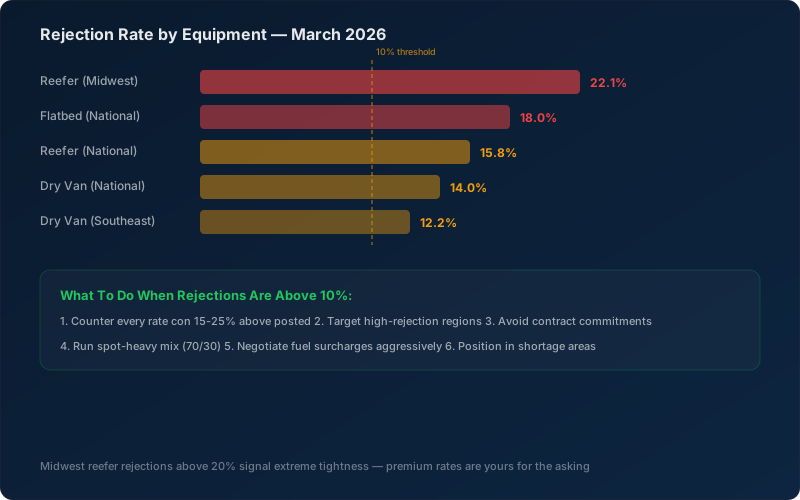
The national 14% headline masks significant regional variation. If you are making lane and positioning decisions based on the national number, you are leaving money on the table. Here is where the market is actually tightest:
| Region | OTRI | Key Drivers | Hot Lanes |
|---|---|---|---|
| Midwest | ~18% | Manufacturing demand, agricultural exports, winter repositioning gap | Chicago-Dallas, Detroit-Atlanta, Indianapolis-Nashville |
| Southeast | ~15% | Port activity (Savannah, Charleston), consumer goods distribution | Atlanta-Charlotte, Savannah-Jacksonville, Memphis-Birmingham |
| South Central / Texas | ~16% | Cross-border volume surges, tariff-related import repositioning | Laredo-Dallas, Houston-Atlanta, El Paso-Phoenix |
| West Coast | ~13% | Port congestion (LA/LB), seasonal produce ramp-up | LA-Phoenix, Fresno-Seattle, Portland-Salt Lake City |
| Northeast | ~10% | Higher carrier density, shorter haul lengths | NJ-Boston, Philly-DC, Buffalo-NYC |
The Midwest at 18% is the story. Carriers are rejecting nearly 1 in 5 contracted loads in the Midwest. Manufacturing demand out of Detroit, Chicago, and Indianapolis is running strong, while agricultural exports from the Plains states are adding volume. At the same time, fewer carriers repositioned into the Midwest during winter — nobody wants to run Wisconsin and Minnesota lanes in January if they have alternatives. The result is a region where demand outstrips capacity by a wider margin than anywhere else in the country.
Reefer is the equipment play. Nationally, reefer tender rejections are running above 20%. Temperature-controlled capacity is structurally tighter than dry van for several reasons: reefer trailers are more expensive, they require more maintenance, fuel costs are higher (running the reefer unit adds $0.15-$0.25/mi), and seasonal produce demand creates dramatic swings in demand. Right now, with early produce season ramping up in the Southeast and Southwest while winter-season citrus and vegetables are still moving, reefer carriers have extraordinary pricing leverage. If you run reefer, this is your season. See our reefer vs dry van profitability analysis for the long-term comparison.
Texas is getting a boost from tariff volatility. The Supreme Court tariff ruling has created a surge in cross-border import volume through Laredo and El Paso. Carriers running Texas lanes are seeing rejection rates around 16%, with Laredo-specific freight even tighter. The combination of normal demand plus tariff-driven volume is creating rate premiums of 15-25% above baseline on border-adjacent lanes.
What History Says: OTRI and Contract Rate Increases
The OTRI is not just a snapshot of today — it is a predictor of tomorrow. Historically, there is a consistent 60-120 day lag between sustained OTRI movements and corresponding changes in contract rates. Here's the pattern from the last three major market cycles:
| Period | OTRI Level | Contract Rate Change (Following 90 Days) | Spot Rate Premium vs Contract |
|---|---|---|---|
| Q4 2020 - Q1 2021 | 25-30% | +15 to +25% | +35 to +50% above contract |
| Q1 2022 | 14-18% | +10 to +12% | +20 to +30% above contract |
| Q2-Q4 2023 | 3-5% | -8 to -12% | At or below contract |
| Q1 2026 (Current) | 14% | TBD (est. +8 to +15%) | +20%+ above contract |
The pattern is remarkably consistent. When the OTRI sustains above 10%, contract rates follow upward within 60-120 days. The current 14% level, if it holds through spring, projects to contract rate increases of 8-15% by mid-2026. That is not a guess — it is what the data has consistently shown across multiple market cycles.
Why the lag? Contract rates do not respond instantly to market tightening because most freight contracts are negotiated annually or semi-annually. A shipper locked into a contract rate in Q4 2025 does not renegotiate that rate just because the OTRI jumped in February. But when their contracted carriers start rejecting 14-18% of tenders, that shipper is paying spot market premiums on those rejected loads — which is often 20-30% more than the contract rate. After a few months of that, the math makes it obvious: it is cheaper to raise contract rates by 10% than to keep paying 25% spot premiums on rejected tenders. That is when renegotiations happen.
For owner-operators and small carriers, this lag period is an opportunity. You can capture spot premiums right now while contract rates are still catching up. And when contract negotiations do happen in Q2-Q3 2026, you will have months of OTRI data to support your rate ask. For more on the broader rate environment, see our 2026 Trucking Industry Forecast.
How to Use Tender Rejection Data to Get Paid More
Knowing that the OTRI is at 14% is useful. Knowing how to turn that into higher revenue is where the money is. Here are five specific ways to use tender rejection data in your operation:
Lead with Data in Rate Negotiations
Stop saying "the market is tight" and start saying "the OTRI is at 14% nationally and 18% in the Midwest, with DAT spot van averaging $2.41/mi — that's 20% above last year." Brokers and shippers respect data. When you walk into a rate negotiation — or have your dispatcher make the call — with specific OTRI numbers, spot rate data, and regional breakdowns, you are speaking their language. Most shippers and brokers track these same metrics internally. Showing that you know the data puts you on equal footing and makes it harder to lowball you. Read our rate negotiation guide for more specific tactics.
Position Your Truck in High-Rejection Markets
The Midwest at 18% rejection rates and reefer nationally at 20%+ are where the money is right now. If you are running lanes that have 8-10% rejection rates, you are in a market where carriers still have limited leverage. Repositioning toward Chicago, Detroit, Indianapolis, or Dallas — where rejections are highest — puts you in the path of freight that shippers are desperate to move. Yes, repositioning costs money. But a $500 deadhead move that puts you into a market paying $0.30-$0.50/mi more on every load pays for itself in two or three loads.
Renegotiate Existing Contracts Now — Do Not Wait
If you have contract freight at rates set during the 2023-2024 downturn, those rates are below market. Do not wait for the annual renegotiation cycle. Approach your shippers or brokers now with the OTRI data and propose a rate increase. Most contracts have reopener clauses or can be renegotiated by mutual agreement. The pitch is simple: "My contract rate is $2.05/mi. The spot market is paying $2.41/mi. Carriers in my area are rejecting 18% of contract tenders. I'd rather keep hauling your freight reliably at $2.25/mi than chase spot loads at $2.40+." Most shippers will take that deal because reliability is worth a premium when capacity is tight.
Be Strategic About Which Loads You Accept
At 14% OTRI, the market supports selectivity. You do not have to take every load that comes your way. This is the time to prioritize loads by revenue per mile, not just availability. Reject loads that do not meet your target rate — you will find better-paying alternatives. Focus on lanes where rejections are highest because that is where rate premiums are biggest. And pay attention to the full trip economics: a $2.60/mi load that takes you into a dead market costs more than a $2.40/mi load that drops you in Chicago where your next load is waiting. Use our Deadhead Miles Calculator to evaluate the full trip, not just the single leg.
Use a Dispatcher Who Monitors OTRI by Lane
The national OTRI is a headline number. The real value is in lane-level rejection data — knowing that Chicago-to-Dallas is rejecting at 22% while Chicago-to-Memphis is at 9%. A good dispatcher tracks rejection rates by specific lane, by equipment type, and by day of week. They can position you ahead of demand spikes and route you through the highest-premium markets consistently. That is the difference between $8,000/week and $12,000/week on the same truck. Our dispatch team monitors these metrics daily and uses them to maximize your weekly revenue.
Spot Rate Snapshot: Where the Money Is Right Now
The elevated OTRI is already showing up in spot rates. Here's where rates stand as of early 2026, and how they compare to six months ago:
| Equipment | DAT Spot Rate (Feb 2026) | DAT Spot Rate (Aug 2025) | Change | YoY Comparison |
|---|---|---|---|---|
| Dry Van | $2.41/mi | $2.03/mi | +$0.38 (+19%) | +20%+ above Feb 2025 |
| Reefer | $2.78/mi | $2.31/mi | +$0.47 (+20%) | +22%+ above Feb 2025 |
| Flatbed | $2.62/mi | $2.24/mi | +$0.38 (+17%) | +18%+ above Feb 2025 |
Source: DAT Trendlines. National averages. Actual rates vary by lane, region, and market conditions. Rates include fuel surcharge.
Reefer is leading the recovery. At $2.78/mi nationally, reefer spot rates are the highest they have been since 2022. The 20%+ rejection rate on reefer tenders is pushing shippers to the spot market in large numbers, and spot rates are responding. If you are running reefer equipment, spring produce season (April-June) typically pushes rejection rates even higher — meaning the best reefer rates of the year may still be ahead of you.
The contract-to-spot spread is your opportunity. When spot rates are 20%+ above contract rates, you have a clear data point for renegotiation. Shippers know they are paying $2.40+ on the spot market for loads their contracted carriers rejected at $2.00-$2.10. A contract rate increase to $2.20-$2.30 is a bargain compared to spot market exposure. Make sure you — or your dispatcher — are using this spread as leverage.
For a full equipment-by-equipment comparison and revenue optimization strategies, check out our guide to maximizing revenue in the 2026 spot market and our spot vs contract analysis.
Related Resources
- 2026 Freight Rate Recovery — Full analysis of the rate rebound and what is driving it
- Rate Negotiation Tips — Proven tactics for getting higher pay from brokers and shippers
- Spot Market vs Contract Freight — When to run spot and when to lock in contracts
- Reefer vs Dry Van Profitability — Equipment comparison with current rate data
- Cost Per Mile Calculator — Know your numbers before you negotiate
- Deadhead Miles Calculator — Evaluate full-trip economics, not just single legs
Truck Dispatch Experts
Published Mar 21, 2026