
The Tariff Timeline: From IEEPA to Section 122
If you're an owner-operator trying to make sense of the tariff situation in 2026, you're not alone. The policy changes have come fast, and they've directly hit your rates, your equipment costs, and the freight environment on every lane within 500 miles of a border crossing.
Here's what happened: since early 2025, the administration had been using the International Emergency Economic Powers Act (IEEPA) to impose sweeping tariffs — 25-54% on imports from China, Mexico, Canada, and the EU. On February 20, 2026, the Supreme Court ruled 6-3 in United States v. Learning Resources, Inc. that IEEPA does not authorize tariffs. The Court said it plainly: IEEPA is for financial sanctions and asset freezes, not import duties.
The administration moved within hours. By February 24, a 15% global surcharge was in effect under Section 122 of the Trade Act of 1974. But Section 122 is a fundamentally different tool — it caps surcharges at 15% and limits them to 150 days. That puts the expiration around mid-July 2026. After that, either Congress acts, the surcharge expires, or we enter uncharted legal territory.
For the full legal analysis of the Supreme Court decision, read our detailed breakdown in Supreme Court Tariff Ruling: Trucking Impact. This article focuses on something different: the economic impact on your rates, your costs, and where the money is right now.
The Rate Impact: Spot Rates, Rejections, and Load Ratios
Tariffs don't just affect the price of goods crossing borders. They ripple through the entire freight network — import volumes shift, shippers accelerate or delay shipments, and the capacity-demand balance tilts. In 2026, those ripples are showing up clearly in rate data.
According to DAT Trendlines, the spot van rate reached $2.41 per mile by late February — marking the seventh straight monthly gain. Spot rates were running 20%+ higher year-over-year in early February, even before the Supreme Court decision added fuel to the fire. The tariff transition amplified a rate recovery that was already underway.
| Market Indicator | Current (March 2026) | Year Ago | Change | Tariff Effect |
|---|---|---|---|---|
| Spot Van Rate | $2.41/mi | ~$2.00/mi | +20%+ YoY | High — import volume surges |
| Load-to-Truck Ratio | 7.73 | ~4.5 | +72% | High — accelerated shipping |
| Tender Rejection Rate (Midwest) | 18% | ~8% | +10 pts | Very High — manufacturing freight |
| Reefer Rejections | 20%+ | ~9% | +11 pts | Very High — produce imports |
| Feb Avg Load-to-Truck | 8.29 | ~4.8 | +73% | Moderate — seasonal + tariff pull-forward |
| Dec 2025 L/T Spike | 9.9 | ~5.2 | +90% | High — pre-tariff frontloading |
Sources: DAT Trendlines, FreightWaves SONAR, FMCSA. Load-to-truck ratio is national average. Tender rejection data from FreightWaves OTRI.
The load-to-truck ratio tells the real story. At 7.73 in March and 8.29 in February, there are nearly 8 loads posted for every available truck. That ratio spiked to 9.9 in December 2025 — driven by importers frontloading shipments ahead of expected tariff increases. That pre-tariff demand surge pulled freight forward, creating what looked like a temporary boom. But it wasn't temporary. The demand carried through because the tariff environment kept shifting, and shippers kept adjusting their inventory strategies in real time.
Midwest rejections hit 18% — the highest since March 2022. The Midwest manufacturing belt is ground zero for tariff-sensitive freight. Auto parts, machinery components, and industrial supplies flowing through Detroit, Chicago, and Milwaukee are directly affected by surcharges on Mexican and Canadian imports. When those surcharges shift, shippers rush to move goods before the next policy change, creating demand spikes that overwhelm available capacity. Reefer rejections exceeding 20% reflect a similar dynamic on produce lanes from Mexico.
For the full rate picture across all equipment types, see our 2026 Freight Rate Recovery analysis.
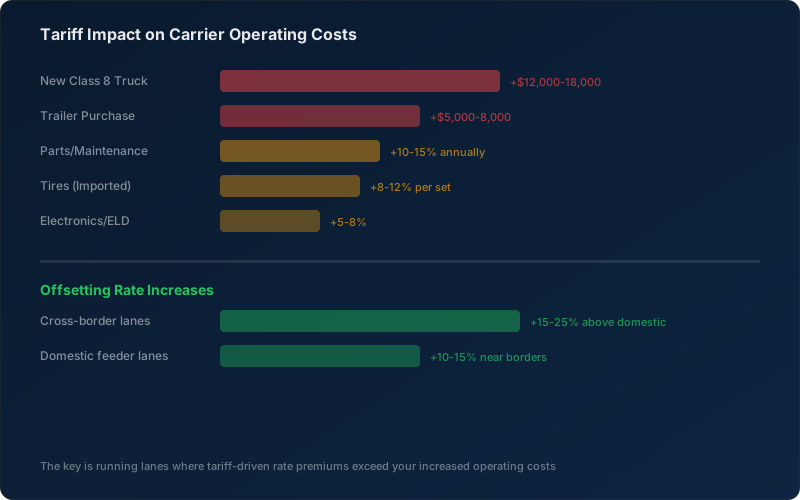
Equipment Costs: The $10K Tariff Premium
Rates are only half the profitability equation. The other half is your costs — and tariffs are hitting those hard. ACT Research projects that Class 8 truck prices have increased approximately $10,000 due to tariffs on imported components and finished trucks assembled in Mexico. That's $10,000 added to the sticker price of every new Freightliner, International, and Kenworth rolling off the lot.
The IEEPA-to-Section 122 transition moderated the impact somewhat — going from 25% tariffs to 15% surcharges — but the premium hasn't disappeared. Here's what it looks like across different cost categories:
| Cost Category | Pre-Tariff Baseline | Under IEEPA (25%) | Under Section 122 (15%) | Net Impact on CPM |
|---|---|---|---|---|
| New Class 8 Truck | $165K | $175K+ | $170K-$175K | +$0.04-$0.06/mi |
| Reefer Trailer | $72K | $78K-$80K | $75K-$77K | +$0.02-$0.03/mi |
| Tires (set of 18) | $5,400 | $5,900-$6,100 | $5,700-$5,900 | +$0.01-$0.02/mi |
| Annual Parts/Maintenance | $15,000 | $17,000-$18,000 | $16,000-$16,500 | +$0.01-$0.02/mi |
| Brake Components (annual) | $2,400 | $2,700-$2,900 | $2,550-$2,700 | +$0.005/mi |
CPM impact estimated at 120,000 annual miles. Equipment prices are estimates based on ACT Research projections and dealer reports. Actual prices vary by spec, dealer, and region.
The total cost-per-mile impact: $0.08-$0.15/mile. When you add up the truck payment premium, higher tire costs, elevated parts prices, and maintenance inflation, tariffs are adding roughly 8 to 15 cents per mile to your operating costs compared to pre-tariff baselines. At 10,000 miles per month, that's $800-$1,500 per month coming straight out of your profit.
This is why rate recovery alone isn't enough. Spot rates are up 20%+ year-over-year, but if your costs are up 8-12% due to tariffs, your actual margin improvement is smaller than the headline numbers suggest. The carriers who are genuinely profiting from this recovery are the ones tracking their real cost per mile and adjusting their minimum rate floors accordingly. Use our Cost Per Mile Calculator to see where you actually stand.
The used truck market is caught in the middle. Buyers priced out of new trucks at $170K+ are competing for a shrinking supply of late-model used equipment. That demand is keeping used truck prices elevated at $60,000-$80,000 for serviceable sleeper cabs, even though they're below the 2022 peak. If you're shopping for equipment, the window between the Section 122 expiration in July and year-end could be the best buying opportunity — new truck prices may drop $5,000-$8,000, which will put downward pressure on used prices too.
Cross-Border Lanes: Where Tariffs Hit Hardest
Cross-border freight is where the tariff impact is most visible and most volatile. According to the Bureau of Transportation Statistics, 85% of US-Mexico surface trade moves by truck. When tariff policy shifts overnight — as it did on February 20 and again on February 24 — the freight market on border lanes reacts in hours, not weeks.
The transition from 25% IEEPA tariffs to 15% Section 122 surcharges created a two-week period of chaos on cross-border lanes. Importers who had been holding inventory rushed to move goods during the transition. Shippers who had pre-paid higher duties scrambled to figure out refund procedures. And carriers on lanes like Laredo-to-Dallas and El Paso-to-Phoenix saw whipsaw rate movements — spikes of 15-25% followed by partial pullbacks as the dust settled.
+15-25%
Laredo Northbound
Busiest commercial land port in the Western Hemisphere. Auto parts, produce, and electronics dominate. Rate premiums running well above domestic equivalents.
+10-15%
Detroit/Windsor Corridor
Big Three auto parts flow. Manufacturing freight tied directly to tariff-sensitive Canadian and Mexican components. Midwest rejection rates at 18%.
+12-20%
El Paso/Juarez
Machinery, plastics, and textiles. Maquiladora supply chain freight is highly sensitive to surcharge levels. Repositioning opportunities on southbound runs.
+8-15%
California Ports
Long Beach and Oakland seeing import volume surges as shippers front-load ahead of tariff uncertainty. Drayage and outbound rates elevated.
The frontloading effect is real. The load-to-truck ratio spiked to 9.9 in December 2025 — driven largely by importers pulling shipments forward ahead of expected tariff increases. That frontloading drained some inventory, but it also trained shippers to be reactive. Now, every time tariff policy shifts, shippers accelerate or delay shipments, creating mini-surges that benefit carriers positioned on the right lanes at the right time.
Domestic ripple effects reach 500+ miles inland. You don't need to run cross-border freight to feel the tariff impact. Dallas, Houston, Phoenix, Chicago, and Detroit all see rate effects from border lane disruptions. When Laredo northbound rates spike, Dallas-to-Houston backhaul rates adjust. When Detroit cross-border volumes surge, the entire I-94 corridor from Michigan through Indiana tightens. If you run Texas or Michigan freight, you're in a tariff-sensitive market whether you know it or not.
For more on cross-border lane volatility, see our Cross-Border Freight Chaos 2026 deep dive.
The 150-Day Clock: What Happens After July 2026
Here's the thing about Section 122 that makes the next four months a unique window: it has a hard expiration. The Trade Act of 1974 limits temporary surcharges to 150 days and caps them at 15%. That clock started ticking on February 24, 2026, which puts the expiration around mid-July 2026.
After that, there are only three realistic outcomes:
Surcharge Expires
(Most Likely)Equipment prices drop $5K-$8K. Cross-border rates normalize. Parts and maintenance costs ease. Good for carriers buying equipment; potentially negative for carriers benefiting from tariff-driven rate premiums.
Congress Passes New Tariff Legislation
(Unlikely (Divided Congress))New permanent tariffs could range from 10-25%. Would sustain elevated equipment costs and cross-border rate premiums. Creates longer planning horizon for carriers.
New Executive Authority Attempted
(Possible But Legally Risky)Any new tariff mechanism faces immediate legal challenge given the SCOTUS precedent. Creates extended uncertainty — the worst outcome for freight planning.
What this means for your planning: The next four months — March through mid-July — represent a known tariff environment. You know the surcharge is 15%. You know equipment costs are elevated by roughly $10K. You know cross-border lanes are paying premiums. That certainty, however temporary, is valuable.
Smart carriers are using this window to do three things: capture premium rates on tariff-sensitive lanes while they last, delay major equipment purchases until July when prices may drop, and build cash reserves to weather whatever comes next. A professional dispatcher can help you maximize revenue during this window — finding the tariff-driven premium loads that are paying 15-25% above comparable domestic freight. See our Spot Market vs Contract guide for timing strategies.
Your Tariff Strategy: What to Do Right Now
Tariff uncertainty is expensive for carriers who don't have a plan. But for carriers who understand the dynamics and position accordingly, it's a revenue opportunity. Here's a practical playbook for the next four months:
1. Recalculate Your Breakeven Rate
Tariffs have added $0.08-$0.15/mile to your operating costs. If you're still using a breakeven number from 2024 or early 2025, you're underpricing your truck. Plug your current tire costs, maintenance expenses, and truck payment into our Cost Per Mile Calculator. Then add 10% margin minimum. That's your new floor — don't take loads below it regardless of how slow the week looks.
2. Target Tariff-Premium Lanes
Cross-border corridors and manufacturing lanes are paying 15-25% above domestic equivalents. If you're running the Midwest or Texas, position your truck to catch tariff-sensitive freight. You don't need a FAST card or C-TPAT to benefit — domestic relay legs feeding border crossings (Dallas-to-Laredo, Chicago-to-Detroit) capture much of the rate premium without the border complexity. Use our Rate Per Mile Calculator to compare lane options.
3. Time Your Equipment Purchases
If you need a truck or trailer, consider waiting until after the Section 122 expiration in mid-July. If the surcharge expires without renewal, new Class 8 prices could drop $5,000-$8,000, and the used market will follow. If you can't wait, negotiate hard — dealers know the clock is ticking and are more willing to discount to move inventory before a potential price drop. Check our Truck Payment Calculator to run the numbers.
4. Build Cash Reserves Now
The one thing we know about the post-July environment is that we don't know what it looks like. Rates could ease if the tariff premium disappears. Costs could drop if equipment prices normalize. Or Congress could surprise everyone with new legislation. The carriers who will handle any scenario are the ones with 2-3 months of operating expenses in reserve. At current rate levels, that cash reserve is achievable if you're running 10,000+ miles per month. Set a savings target and stick to it.
5. Get Professional Dispatch Support
In a market this volatile, the difference between self-dispatching and professional dispatch isn't just convenience — it's revenue. A dispatcher who watches tariff-sensitive lanes daily can route your truck to premium loads that load boards don't surface quickly enough for individual operators to catch. The ROI on dispatch fees in a tariff-driven market is significantly higher than in a stable one. Run the numbers on our Dispatch ROI Calculator, or talk to our team about how we're helping carriers navigate the tariff environment.
Related Resources
- Supreme Court Tariff Ruling: Trucking Impact — The legal breakdown of the IEEPA decision and Section 122 transition
- 2026 Freight Rate Recovery — Full rate data across all equipment types
- Cross-Border Freight Chaos 2026 — Deep dive on Laredo, El Paso, Detroit, and other border lanes
- 2026 Trucking Industry Forecast — Rates, capacity, and demand projections for the full year
- Cost Per Mile Calculator — Track how tariff-driven cost increases affect your bottom line
Truck Dispatch Experts
Published Mar 21, 2026