What Happened: The IEEPA Ruling Explained
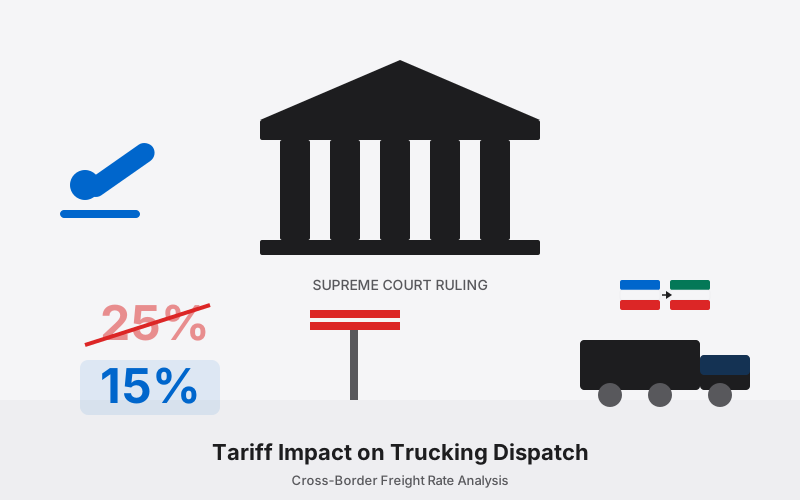
On February 20, 2026, the Supreme Court handed down one of the most consequential trade decisions in decades. In a 6-3 ruling in United States v. National Foreign Trade Council, the Court held that the International Emergency Economic Powers Act (IEEPA) does not give the President authority to impose tariffs. Full stop.
Here's what that means in plain English: since early 2025, the administration had been using IEEPA — a law designed for financial sanctions and asset freezes during national emergencies — as the legal basis for sweeping tariffs on imports from China (up to 54%), Mexico (25%), Canada (25%), and the EU (20%). The Court said that was never what IEEPA was for. Chief Justice Roberts, writing for the majority, was blunt: "IEEPA authorizes the regulation of financial transactions, not the imposition of import duties. The power to tax imports belongs to Congress."
The administration moved fast. Within hours of the ruling, the President signed an executive order imposing a 15% temporary surcharge on all imports under Section 122 of the Trade Act of 1974. Section 122 is narrower than IEEPA — it caps surcharges at 15% and limits them to 150 days. That puts the expiration somewhere around mid-July 2026. After that, the surcharge either expires, Congress acts, or we're in uncharted territory.
For trucking, the immediate impact was a drop from 25-54% tariffs to a flat 15% surcharge. That's meaningful — especially for equipment costs, cross-border freight volumes, and the price of parts and tires that come from Mexico and overseas. But the uncertainty is just as significant as the savings. Nobody knows what happens after July. And in trucking, uncertainty is expensive.
If you want the full legal breakdown, SCOTUSblog has the best plain-language analysis. For how it fits into the broader 2026 market picture, read our 2026 Trucking Industry Forecast.
How Cross-Border Freight Is Changing
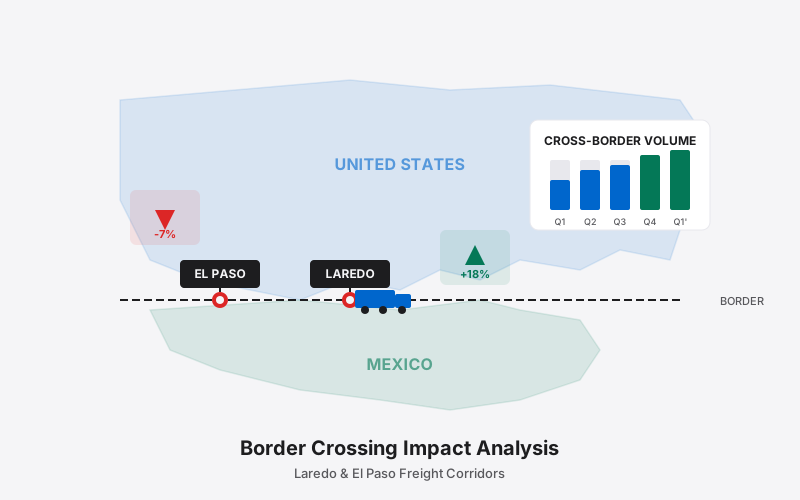
The numbers on cross-border trucking are staggering, and they explain why this ruling matters more to our industry than almost any other. According to the Bureau of Transportation Statistics (BTS), 85% of all surface trade with Mexico and 67% of surface trade with Canada moves by truck. That's over $800 billion in goods per year crossing borders on our equipment.
More than 100,000 trucking jobs are directly tied to international freight. And that doesn't count the domestic carriers running relay legs — the Dallas-to-Houston moves fed by Laredo crossings, or the Detroit-to-Chicago runs supplied by Ambassador Bridge traffic. When cross-border freight sneezes, domestic lanes within 500 miles of the border catch a cold.
| Border Crossing | Daily Truck Crossings | Top Commodities | Rate Impact Post-Ruling |
|---|---|---|---|
| Laredo, TX | 14,000-16,000 | Auto parts, produce, electronics | +12-18% (spiked), settling to +8% |
| El Paso, TX | 6,000-8,000 | Machinery, plastics, textiles | +10-15% (spiked), settling to +6% |
| Detroit, MI | 8,000-10,000 | Auto assembly, steel, chemicals | +8-12% (spiked), settling to +5% |
| Buffalo/Niagara, NY | 4,000-5,000 | Paper, dairy, manufactured goods | +6-10% (spiked), settling to +4% |
| Otay Mesa, CA | 3,500-4,500 | Medical devices, aerospace, produce | +8-12% (spiked), settling to +5% |
| Pharr, TX | 3,000-3,500 | Fresh produce (80%+), frozen foods | +15-20% (produce premium) |
Daily crossing estimates from BTS and CBP data. Rate impact reflects first 2 weeks post-ruling vs 30-day prior average. Source: DAT, FreightWaves SONAR, TDE internal data.
Laredo is ground zero. It's the busiest commercial land port in the Western Hemisphere, and it felt the ruling first. In the 48 hours after the decision, northbound load postings on Laredo lanes jumped 22% on DAT as importers scrambled to move inventory during the policy transition. Rates on Laredo-to-Dallas spiked to $3.80-$4.20/mi for reefer before settling back to $3.40-$3.60/mi — still well above the $3.00-$3.20/mi baseline from January. If you run Texas freight, Laredo is the lane to watch.
Detroit is the auto play. With the Big Three automakers importing billions in parts from Canada and Mexico, the tariff-to-surcharge shift directly affects the volume flowing through the Ambassador Bridge and Detroit-Windsor Tunnel. Auto parts freight is repositioning — some shippers who rerouted supply chains during the full tariff period are now evaluating whether to shift back. That indecision creates spot market opportunity for carriers who can handle the volatility.
The repositioning game matters. When northbound cross-border loads spike, southbound repositioning becomes the bottleneck. Carriers who can find paying southbound freight — machinery to maquiladoras, raw materials to Mexican manufacturing — capture both legs. Carriers who deadhead south to chase northbound premiums are leaving money on the table. A good dispatcher can make a $1,500-$2,000 difference per round trip just by finding the backhaul. That's what we do at Truck Dispatch Experts.
Equipment Costs: Will Truck Prices Drop?
If you've been shopping for a truck in the last year, you've felt the tariff pain firsthand. Class 8 truck prices jumped roughly $8,000-$12,000 above where they should have been, driven primarily by tariffs on Mexican-assembled trucks. Freightliner's Saltillo, Mexico plant and International's San Luis Potosi facility produce a significant share of the trucks sold in the US. When 25% tariffs hit those imports, the cost went straight to the sticker price.
The shift from 25% tariffs to a 15% surcharge is meaningful but not transformational. Here's the math:
| Equipment | Pre-Tariff Price | With 25% Tariff | With 15% Surcharge | Your Savings |
|---|---|---|---|---|
| New Class 8 (Sleeper) | $165,000 | $175,000-$177,000 | $170,000-$172,000 | $5,000-$7,000 |
| New Class 8 (Day Cab) | $135,000 | $143,000-$145,000 | $139,000-$141,000 | $4,000-$6,000 |
| New Reefer Trailer | $72,000 | $78,000-$80,000 | $75,000-$76,000 | $3,000-$4,000 |
| New Flatbed Trailer | $45,000 | $49,000-$51,000 | $47,000-$48,000 | $2,000-$3,000 |
| New Dry Van Trailer | $38,000 | $41,000-$43,000 | $39,500-$40,500 | $1,500-$2,500 |
Prices are estimates based on OEM MSRP adjustments and dealer reports. Actual prices vary by spec, dealer, and region. Tariff/surcharge impact varies by percentage of imported components.
The used truck market is where it gets interesting. Used Class 8 sleeper cabs, which peaked at $85,000-$110,000 in 2022 and dropped to $55,000-$75,000 during the freight recession, are now sitting at $60,000-$80,000. The tariff ruling hasn't directly affected used truck prices yet, but dealer sentiment is shifting. If new truck prices drop another $3,000-$5,000 when the surcharge expires in July, that puts downward pressure on used prices too. If you're shopping for a used truck right now, use that as leverage in negotiations — dealers know the floor is coming down.
Parts and maintenance costs matter more than the sticker. Tariffs and surcharges on imported steel, aluminum, and manufactured components don't just affect the truck you buy — they affect every part you replace. Brake drums, air filters, fuel filters, tires, and DEF fluid components all have imported content. The shift from 25% to 15% reduces your annual maintenance cost by an estimated $800-$1,500 depending on your equipment age and mileage. Track your costs with our Cost Per Mile Calculator to see the impact on your numbers.
What the 15% Surcharge Means for Carriers
Let's be clear about Section 122: it's a stopgap, not a strategy. The 150-day limit means this surcharge expires around mid-July 2026 unless Congress acts. And Congress acting quickly on trade legislation in an election year is... optimistic. So what we're dealing with is a temporary 15% surcharge that's lower than the tariffs it replaced, with an expiration date that creates a countdown clock of uncertainty.
For carriers, the surcharge flows through your cost structure in ways that aren't always obvious. It's not just about the truck you bought — it's about everything you buy to keep that truck running.
| Expense Category | Annual Cost (Pre-Tariff) | With 25% Tariff | With 15% Surcharge | Annual Savings |
|---|---|---|---|---|
| Tires (set of 18) | $5,400 | $6,750 | $6,210 | $540 |
| Brake Components | $1,800 | $2,250 | $2,070 | $180 |
| Oil & Filters | $2,400 | $2,880 | $2,640 | $240 |
| DEF Fluid | $1,200 | $1,440 | $1,320 | $120 |
| Aftermarket Parts | $3,600 | $4,500 | $4,140 | $360 |
| Trailer Maintenance | $2,200 | $2,640 | $2,420 | $220 |
Estimates based on average owner-operator annual expenses running 120,000 miles/year. Actual tariff/surcharge impact varies by product origin and import content percentage.
Add it up across all categories, and the average owner-operator saves roughly $1,500-$2,500 per year under the 15% surcharge versus the 25% tariff. That's not life-changing money, but it's a truck payment. Over a fleet of 10 trucks, it's $15,000-$25,000 — enough to matter.
The real question is what happens after July. If the surcharge expires and nothing replaces it, those costs drop further. If Congress passes new tariff legislation (some bills are already circulating), costs could go back up. The smart play is to bank the savings now, keep your cash reserves strong, and avoid making equipment purchases that assume permanently lower prices. The market has taught us that lesson repeatedly since 2020.
Fuel is the wild card. The tariff ruling doesn't directly affect fuel prices — oil and refined petroleum products were largely exempt from both IEEPA tariffs and the Section 122 surcharge. But trade policy affects the dollar's strength, and a weaker dollar means higher oil import costs. In the week after the ruling, diesel prices ticked up $0.03/gallon nationally. That's noise, not signal — but it's worth watching. The EIA's weekly diesel report is the best source for tracking this.
$175 Billion in Refunds: Who Gets What?
Here's the number everyone is talking about: approximately $175 billion in tariffs were collected under IEEPA authority that the Supreme Court just said was legally invalid. That money was paid by importers — companies that brought goods into the US and were assessed duties at the border. In theory, those importers are now entitled to refunds.
In practice, it's complicated. The refund process will go through U.S. Customs and Border Protection (CBP), and it involves filing claims, proving payment, and navigating a bureaucracy that was not designed to process $175 billion in returns. Trade attorneys are estimating 12-24 months before significant refund volumes flow. Some importers may never file — the cost of documentation and legal fees makes small claims uneconomical.
What this means for trucking: The direct recipients are importers — OEMs, parts manufacturers, retailers, and commodity traders. Carriers don't get refunds unless they directly imported goods (which most don't). The indirect benefit comes when importers pass savings through the supply chain. If Freightliner gets refunds on tariffs paid for trucks assembled at their Saltillo plant, some of that should eventually reduce dealer pricing. If tire manufacturers get refunds, tire prices should come down. But "should" and "will" are different words, and "eventually" is doing a lot of work in those sentences.
The realistic carrier impact: Do not plan your business around receiving indirect refund benefits. Plan around the current 15% surcharge reality and the July 2026 expiration. If cost reductions flow through from refunds in late 2026 or 2027, treat that as upside — not baseline. The trucking industry has been burned too many times by planning around best-case scenarios.
The one exception: if you or your company directly imported equipment, parts, or materials that were assessed IEEPA tariffs, talk to a trade attorney now. The refund window is open, and early filers typically fare better in these processes. The FMCSA has no role in the refund process — this goes through CBP and potentially the Court of International Trade.
How This Affects Dispatch Strategy
Volatility is a dispatcher's best friend — if they know what they're doing. The tariff ruling created a three-phase pattern that smart dispatch operations are already exploiting:
Phase 1: The Spike (Feb 20 - Mar 5)
Importers rushed to move goods during the policy transition. Cross-border rates spiked 12-20%. Carriers positioned near border crossings captured premium rates. Domestic lanes within 500 miles of Mexico/Canada borders saw 5-10% rate bumps from overflow demand.
Phase 2: The Settle (Mar - May)
Rates stabilize 5-10% above pre-ruling levels as the 15% surcharge becomes the new baseline. Shippers adjust procurement and routing. Best opportunity: domestic lanes feeding border hubs. Dallas, San Antonio, Phoenix, Detroit, and Chicago all benefit from repositioning demand.
Phase 3: The Expiration (Jun - Jul)
As the 150-day expiration approaches, expect another volume spike as importers front-load shipments (fearing new tariffs) or hold back (expecting zero tariffs). Either way, rate volatility returns. Dispatchers who read the signals early position their carriers to capture the upside.
Lane-specific opportunities right now: The highest-value lanes are the ones most affected by cross-border volume shifts. Here's what our dispatch team is seeing:
- •Laredo to Dallas/Fort Worth: Reefer rates at $3.40-$3.80/mi (vs $3.00-$3.20 baseline). Produce season is layering on top of tariff volatility — double tailwind for reefer carriers in Texas. The return trip (Dallas to Laredo) is paying $2.20-$2.50/mi for machinery and manufacturing inputs heading to maquiladoras.
- •El Paso to Phoenix/Tucson: Flatbed rates up 8-12% on construction materials and steel imports. The I-10 corridor between El Paso and Phoenix is one of the tightest capacity lanes in the Southwest right now.
- •Detroit to Chicago: Auto parts freight is the play here. The Ambassador Bridge handles more bilateral trade value than any other land crossing in North America. Dry van rates on Detroit-to-Chicago are running $2.60-$2.90/mi — 10-15% above January levels.
- •Buffalo to Northeast corridor: Paper, dairy, and manufactured goods from Canada are flowing at elevated volumes. Buffalo to NYC/NJ is paying $2.80-$3.20/mi for reefer with priority loads available same-day.
The carriers making the most money right now are not the ones chasing individual hot loads — they're the ones with dispatchers who understand the pattern and are positioning them ahead of demand. That's the difference between reactive and proactive dispatch. It's the difference between $8,000/week and $12,000/week on the same equipment. Our dispatch service is built for exactly this kind of market.
What Owner-Operators Should Do Now
Forget the politics. Forget the legal analysis. Here are five things you can actually do this week to position yourself for the tariff aftermath:
Delay Major Equipment Purchases Until May-June
Truck and trailer prices are trending down but haven't fully adjusted to the lower surcharge yet. Dealers are still working through inventory priced at 25% tariff levels. By May, the pipeline will reflect 15% surcharge pricing, and by July, if the surcharge expires, prices drop further. Exception: if your current truck is costing you $3,000+/month in repairs and downtime, waiting costs more than the savings. Use the Cost Per Mile Calculator to run the comparison.
Position Near Border Hubs If You Run Dry Van or Reefer
Cross-border volume shifts are creating premium rates within 500 miles of major crossings. You don't need to cross the border yourself — domestic relay legs (Laredo to Dallas, Detroit to Chicago, El Paso to Phoenix) are paying 10-20% above normal. If you're currently running I-95 or Midwest-to-Southeast lanes, consider repositioning toward Texas or Michigan for the next 60-90 days. Talk to your dispatcher about the timing.
Stock Up on Tires and Brake Components Now
This is counterintuitive — why buy now if prices are going down? Because the transition period creates supply chain hiccups. Distributors are adjusting inventory levels, some imported parts are sitting in customs during the tariff-to-surcharge transition, and there's always a lag between policy changes and shelf prices. If you need tires or brakes in the next 90 days, buy them now at current pricing rather than risking a supply gap. After July, reassess.
Renegotiate Contract Rates That Were Set During Full Tariffs
If you locked in contract rates with shippers or brokers during the 25% tariff period, those rates may have included tariff-driven cost assumptions. Now that the tariff environment has changed, shippers may try to renegotiate downward. Get ahead of it — approach your shippers proactively with data showing that while tariffs dropped, your operating costs (fuel, insurance, driver pay) haven't. A preemptive conversation protects your rate better than a reactive one. Your dispatcher can help you build the case.
Build a 60-Day Cash Reserve
The next 5 months are a policy rollercoaster. The surcharge expires in July, midterm election politics will drive trade headlines, and freight markets will react to every rumor. Cash reserves are your shock absorber. If you're currently running at $2,000-$3,000/month in reserves, push to $5,000-$8,000. Bank the savings from lower surcharge costs instead of spending them. If this year has taught us anything, it's that the only thing predictable about trade policy is that it will be unpredictable. Talk to our team about strategies for maximizing revenue during volatile markets.
The Bottom Line
The SCOTUS tariff ruling is genuinely good news for trucking — lower costs on equipment, parts, and maintenance, plus elevated rates on cross-border and border-adjacent lanes. But it comes wrapped in uncertainty. The 15% surcharge is temporary. The refund process is slow. And nobody knows what July brings.
The carriers who win in this environment are the ones who stay informed, stay flexible, and have dispatch partners who understand how policy changes translate into lane-level opportunities. This isn't the time to lock into rigid strategies. It's the time to have a team watching the market daily and positioning you where the money is.
We'll update this article as the situation develops — bookmark it and check back. In the meantime, if you want to talk through how the tariff ruling affects your specific operation and lanes, reach out to our dispatch team. No contracts, no pressure — just real talk about real market conditions.
Related Resources
- Trucking Industry Forecast 2026 — Full rate, volume, and capacity projections for the year ahead
- Cost Per Mile Calculator — Track how tariff and surcharge changes affect your operating costs
- Texas Dispatch Services — Laredo, El Paso, Dallas — the epicenter of cross-border freight
- 2026 Freight Rate Recovery — How the rate rebound intersects with tariff changes
- Diesel Price Outlook 2026 — Trade policy impacts on fuel costs
- FMCSA Rules 2026 — Full regulatory landscape including trade-related changes
Truck Dispatch Experts
Published Mar 4, 2026