The Short Version (If You're Reading This at a Truck Stop)
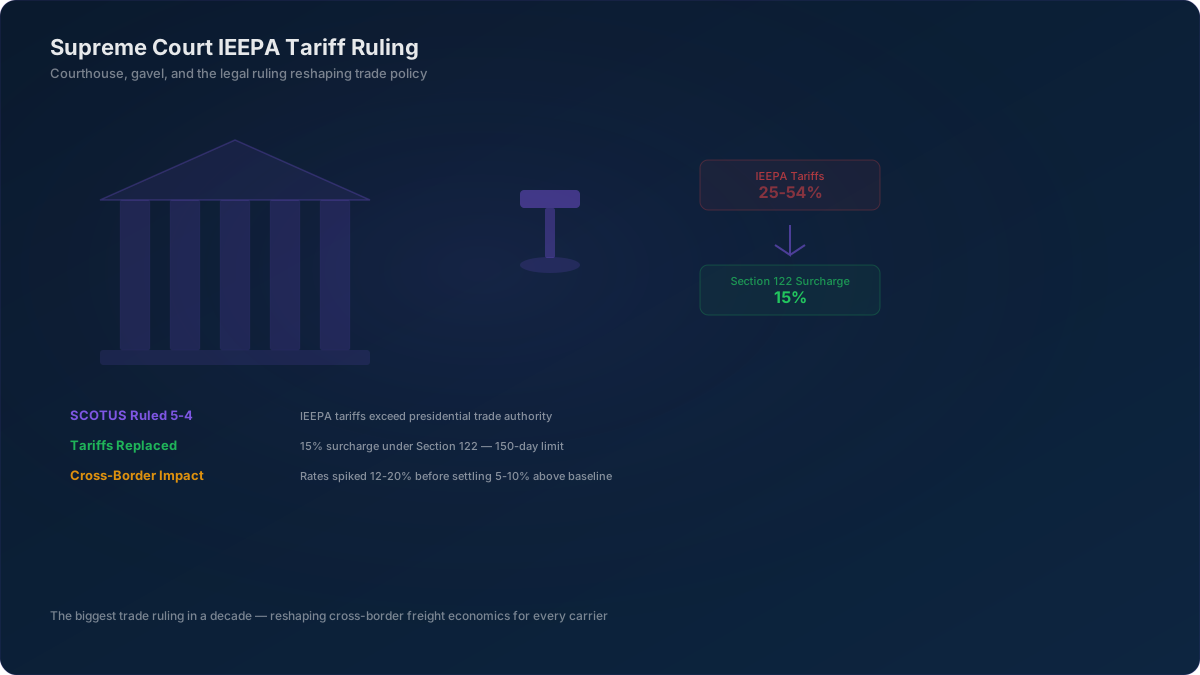
Here's what happened in one paragraph: The Supreme Court said the President can't use a financial sanctions law called IEEPA to put tariffs on imports. That means all the tariffs that were running at 25-54% on goods from China, Mexico, Canada, and Europe since early 2025 were technically illegal. The government replaced them within hours with a 15% temporary surcharge under a different law — Section 122 — but that one expires in about 150 days (mid-July 2026) and is capped at 15%. So tariffs went down, they have an expiration date now, and importers might eventually get refunds on what they already paid.
For truckers specifically: your truck and parts are getting a little cheaper, cross-border freight rates are elevated but volatile, and nobody knows what happens after July. That's the short version. Now let's break it down.
What Is IEEPA? (And Why Should a Truck Driver Care?)
IEEPA stands for the International Emergency Economic Powers Act. It was passed in 1977, and it was designed for a very specific purpose: giving the President the ability to freeze bank accounts, block financial transactions, and impose sanctions during a declared national emergency. Think of it as the law that lets the government cut off funding to terrorist organizations or freeze the assets of a foreign dictator.
What IEEPA was not designed for is import tariffs. Tariffs — taxes on goods coming into the country — are traditionally the responsibility of Congress under Article I of the Constitution. Congress has delegated some tariff authority to the President over the years through specific trade laws, but IEEPA was never one of those laws.
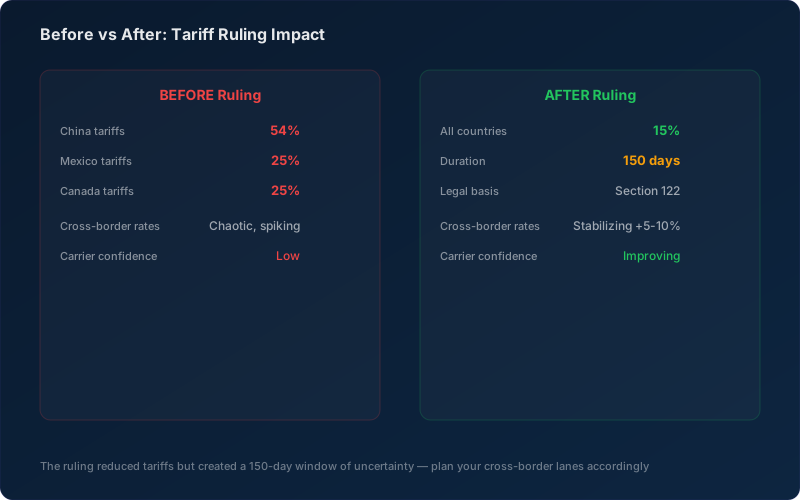
Starting in early 2025, the administration declared trade imbalances a national emergency and used IEEPA as the legal authority to impose tariffs on imports from China (up to 54%), Mexico (25%), Canada (25%), and the European Union (20%). The total tariff collections under IEEPA authority reached an estimated $175-179 billion according to Penn-Wharton before the Supreme Court stepped in.
Why should a truck driver care? Because those tariffs made your truck more expensive. They made your tires more expensive. They made the parts at the repair shop more expensive. They affected the volume and routing of cross-border freight that millions of trucks move every day. And now that the tariffs have been struck down and replaced with something temporary, everything is shifting again.
What the Supreme Court Actually Said
On February 20, 2026, the Supreme Court issued its decision in Learning Resources, Inc. v. Trump (case number 24-1287). The vote was 6-3. Chief Justice Roberts wrote the majority opinion, and his core conclusion was straightforward:
"IEEPA authorizes the regulation of financial transactions, not the imposition of import duties. The power to tax imports has been vested in Congress since the founding of the Republic."
— Chief Justice John Roberts, majority opinion
In plain English: the law that was being used to justify tariffs was never meant for tariffs. IEEPA is about financial sanctions — freezing bank accounts, blocking wire transfers, cutting off access to the dollar system. It is not about taxing physical goods at the border.
The three dissenting justices argued that the President has broad emergency powers and that IEEPA's language is flexible enough to cover tariffs. The majority disagreed, and in constitutional law, six votes beats three. The ruling is final.
This case was brought by Learning Resources, Inc. — an Illinois-based educational toy company that imports products from China. But the ruling applies to every tariff imposed under IEEPA authority, covering goods from all affected countries. For a deeper dive into how the ruling affects cross-border freight volumes, equipment costs, and lane-level rates, see our detailed trucking impact analysis.
| Country | Old IEEPA Tariff Rate | New Section 122 Rate | Change |
|---|---|---|---|
| China | Up to 54% | 15% | -39 percentage points |
| Mexico | 25% | 15% | -10 percentage points |
| Canada | 25% | 15% | -10 percentage points |
| European Union | 20% | 15% | -5 percentage points |
| All other countries | 10% (global baseline) | 15% | +5 percentage points |
Note: The 10% global baseline tariff under IEEPA applied broadly to countries not separately targeted. Under Section 122, the flat 15% applies uniformly to all imports regardless of origin.
Section 122: The Replacement (and Its Limits)
When the Supreme Court pulled the rug out from under IEEPA tariffs, the administration had to act fast. Within hours of the ruling, the President signed a proclamation invoking Section 122 of the Trade Act of 1974. Here's what makes Section 122 different from IEEPA — and why it matters:
15%
Maximum surcharge rate allowed
150
Maximum days the surcharge can last
~July 24
Approximate expiration date
The 15% cap is a hard ceiling. Under IEEPA, there was no cap — the administration set rates as high as 54% on Chinese goods. Section 122 does not allow that. Fifteen percent is the maximum, period. The administration initially set the surcharge at 10% on February 20, announced an increase to 15% on February 21, and the 15% rate took effect February 24. There is nowhere higher to go without Congressional action.
The 150-day clock is ticking. Section 122 was designed for temporary trade measures — not permanent tariff policy. Starting from the February 24 effective date, the surcharge can last a maximum of 150 days, putting the expiration around mid-to-late July 2026. The President cannot unilaterally extend it. Only Congress can authorize an extension or replacement.
Congressional action is uncertain. Could Congress pass new tariff legislation before July? Technically yes. Practically, in an election year with divided chambers, fast-tracking trade legislation is unlikely. Most trade analysts and policy watchers expect the surcharge to expire without renewal. That would mean zero additional tariffs on imports — a scenario the trucking industry has not seen since early 2025.
For a detailed breakdown of how the surcharge specifically affects truck prices, parts costs, and lane-level freight rates, read our Tariff Ruling Trucking Impact analysis. That article goes deep on the numbers. This one is about helping you understand the legal framework so you can make sense of the headlines.
The Refund Question: Is $175 Billion Coming Back?
One of the biggest questions after the ruling is what happens to the tariffs already collected. According to Penn-Wharton Budget Model estimates, approximately $175-179 billion was collected in tariffs under IEEPA authority. Since the Supreme Court ruled those collections lacked legal basis, importers can file refund claims with U.S. Customs and Border Protection.
But let's be realistic about what that means for trucking. First, trucking companies were not the ones paying tariffs directly — importers and manufacturers were. The costs flowed through to trucking indirectly via higher truck prices, higher parts costs, and higher prices on goods being shipped. Second, the refund timeline is measured in years, not months. Legal experts expect 12-24 months before refund procedures are fully established and claims start being processed at scale.
What this means for truck drivers practically: Do not expect any direct cash back. What you can expect is a gradual downward pressure on equipment and parts costs as manufacturers and suppliers receive refunds and the savings work their way through the supply chain. It will be a slow drip, not a sudden discount. If your truck dealer tells you prices are dropping because of tariff refunds in 2026, they are getting ahead of themselves — the real refund impact on consumer-facing prices is a 2027-2028 story.
The more immediate savings for truckers come from the going-forward reduction — from 25-54% tariffs down to 15% surcharge. That is real money, hitting your costs right now. On an annual basis, the difference in parts and maintenance alone is estimated at $800-$1,500 per truck, depending on equipment age and mileage. Track your numbers with our Cost Per Mile Calculator.
What Happens After July? Three Scenarios
The 150-day countdown is the single most important timeline in trade policy right now. When the Section 122 surcharge expires around mid-July 2026, three things could happen:
Scenario 1: The Surcharge Expires, Nothing Replaces It
Most likely. If Congress does not act and no new legal authority is invoked, the 15% surcharge simply disappears. Imports return to their pre-2025 tariff levels (which for most goods means very low or zero additional duties beyond existing trade agreements). For trucking, this means equipment costs drop further, parts get cheaper, and cross-border freight volumes potentially increase as importers take advantage of lower costs. However, the rate premiums carriers are currently earning on border-adjacent lanes would likely fade.
Scenario 2: Congress Passes New Tariff Legislation
Possible but slow. Congress has the constitutional authority to impose tariffs — the Supreme Court ruling made that very clear. If there is bipartisan support for targeted tariffs (particularly on Chinese goods), Congress could pass legislation. But the legislative process takes months, and election-year politics make trade bills contentious. Even if legislation is introduced before July, it is unlikely to be signed into law before the surcharge expires, creating a gap period.
Scenario 3: The Administration Tries a Different Legal Authority
Risky. There are other trade statutes the President could invoke — Section 301 (unfair trade practices), Section 232 (national security), or Section 201 (industry safeguards). Each has different requirements and limitations. However, after the Supreme Court's strong language about executive overreach on trade, any new tariff attempt under presidential authority would face immediate legal challenges. Courts would likely apply heightened scrutiny given the IEEPA precedent.
The bottom line for planning: Treat mid-July 2026 as a potential inflection point. Do not make major equipment purchases or long-term lane commitments that assume current tariff/surcharge conditions will persist indefinitely. Build flexibility into your strategy. And keep a cash reserve to ride out 30-60 days of uncertainty around the expiration date. For more on managing through market volatility, check out our guide to recession-proofing your trucking business.
Timeline: How We Got Here
| Date | Event | Trucking Impact |
|---|---|---|
| Early 2025 | IEEPA tariffs imposed (25-54%) | Truck prices rise $8K-$12K, cross-border freight disrupted |
| 2025-2026 | Legal challenges filed by importers | Uncertainty suppresses equipment purchases |
| Feb 20, 2026 | SCOTUS rules 6-3: IEEPA can't authorize tariffs | Immediate rate volatility on cross-border lanes |
| Feb 20, 2026 | 10% Section 122 surcharge signed (same day) | Tariff costs drop from 25-54% to 10% |
| Feb 21, 2026 | 15% increase announced | Surcharge rises to Section 122 maximum |
| Feb 24, 2026 | 15% surcharge takes effect | New baseline for import costs established |
| ~Jul 24, 2026 | 150-day Section 122 limit expires | Surcharge ends unless Congress acts |
Related Resources
- Tariff Ruling Trucking Impact — Detailed analysis of how the ruling affects freight rates, equipment costs, and lane strategy
- Trucking Industry Forecast 2026 — Full rate, volume, and capacity projections for the year ahead
- Cross-Border Freight Chaos 2026 — How border disruptions are reshaping lane economics
- Cost Per Mile Calculator — Track how tariff and surcharge changes affect your operating costs
- FMCSA Rules 2026 — Full regulatory landscape for the year
Truck Dispatch Experts
Published Mar 21, 2026