The Real Numbers: What Owner-Operators Actually Earn
The internet is full of vague claims about owner-operator income. Recruiting ads say "earn $300,000+ per year" and forums are packed with drivers saying they barely clear $50,000. The truth, like most things in trucking, depends on the details.
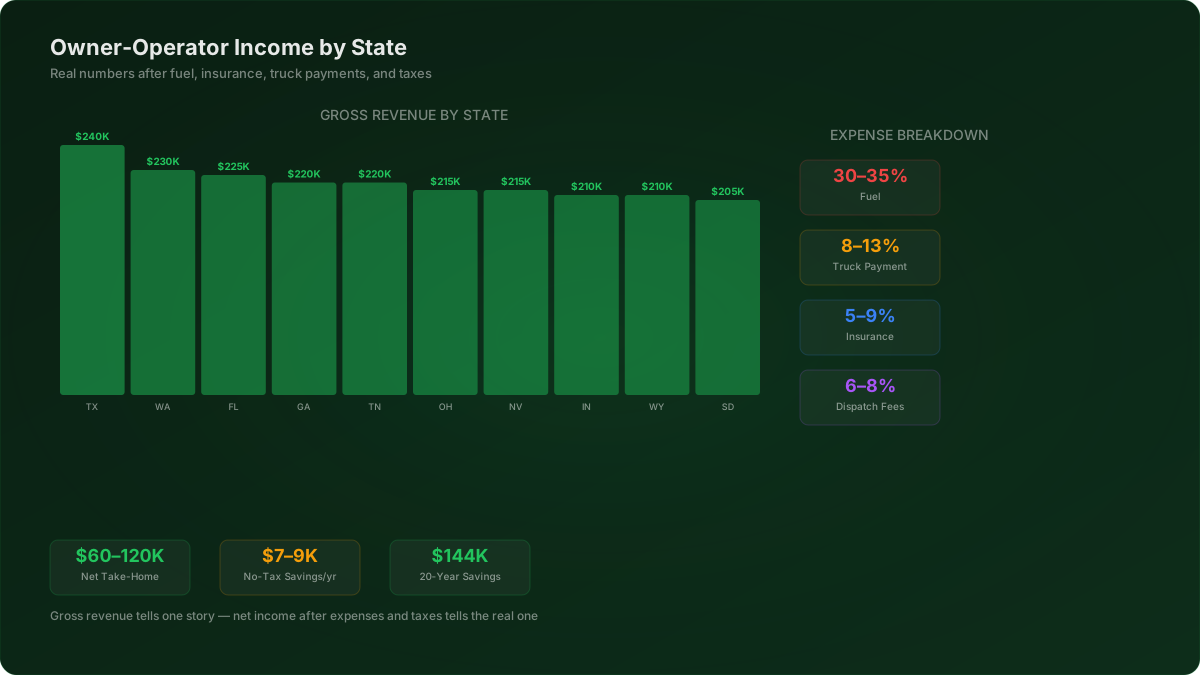
Nationally, owner-operators gross between $200,000 and $280,000 per year. That sounds great until you subtract the expenses that come with running your own truck. Fuel alone eats 30-35% of gross revenue. Add truck payments, insurance, maintenance, dispatch fees, IFTA, permits, and all the other line items, and you're looking at $120,000 to $180,000 in annual expenses. What remains is your actual take-home: $60,000 to $120,000 net before taxes.
The range is wide because it depends on equipment type, miles run per year, lane selection, how well you manage expenses, and — critically — whether you have a good dispatcher finding you the highest-paying loads on every lane. An owner-operator running smart lanes with professional dispatch can be on the $120K+ end. An operator accepting whatever load comes first on the load board, running 15% deadhead, and paying top dollar for everything is on the $60K end. Same truck, same industry, vastly different outcomes.
Gross vs Net: Understanding the Gap
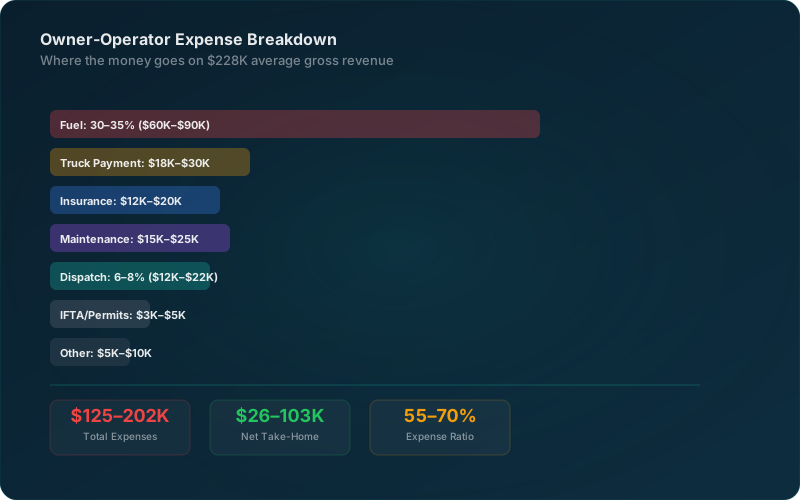
Before we compare states, you need to understand what eats your gross revenue. Most new owner-operators dramatically underestimate expenses. Here's the realistic breakdown based on a national average gross of approximately $228,000:
Typical Owner-Operator Annual Expenses
Fuel
30-35% of gross
$60,000 - $90,000/yr
Your single biggest expense. Varies hugely by state — California diesel can be $1.00+ more per gallon than Texas.
Truck Payment
$1,500-2,500/mo
$18,000 - $30,000/yr
Financed trucks. If you own outright, this drops to $0 but maintenance costs often rise.
Insurance
Liability + cargo + physical damage
$12,000 - $20,000/yr
New authorities pay the high end. Rates drop significantly after 2 years clean.
Maintenance & Repairs
Tires, oil, brakes, breakdowns
$15,000 - $25,000/yr
Older trucks cost more. Budget $0.10-0.15 per mile minimum for maintenance reserves.
Dispatch Fees
6-8% of gross
$12,000 - $22,000/yr
A good dispatcher earns this back 3-5x through better rates and less deadhead.
IFTA, Permits & Plates
Quarterly IFTA + annual permits
$3,000 - $5,000/yr
Includes IRP registration, fuel tax, UCR, HVUT (Form 2290), and state-specific permits.
Other (ELD, Accounting, Lumper, Tolls)
Everything else
$5,000 - $10,000/yr
ELD subscription, accountant/bookkeeper, lumper fees, scale tickets, tolls, parking, and misc supplies.
Total Annual Expenses
$125,000 - $202,000
On ~$228K Average Gross
Net: $26,000 - $103,000
This is before federal and state income taxes. The actual net range for most operators is $60K-$120K because operators at the low end of gross typically also have lower expenses (fewer miles = less fuel, less maintenance).
Top 10 Highest-Earning States for Owner-Operators
Not all states are created equal for trucking income. The best states combine high freight volume, favorable tax treatment, reasonable operating costs, and strategic location. Here are the top 10 states for owner-operator net income in 2026, ranked by estimated take-home pay:
Texas
No income taxAvg Gross Revenue
$240K
Est. Net Take-Home
$85K - $115K
I-35 NAFTA corridor, oil & gas freight, year-round volume. The highest freight density in the lower 48 combined with zero state income tax makes Texas the top-earning state for owner-operators.
Florida
No income taxAvg Gross Revenue
$225K
Est. Net Take-Home
$75K - $105K
Produce season boosts reefer rates significantly from October through April. Port of Miami and Jacksonville drive consistent import/export freight. Snowbird season adds household goods and specialty loads.
Tennessee
No income taxAvg Gross Revenue
$220K
Est. Net Take-Home
$75K - $100K
Memphis is the FedEx global hub and one of America's largest distribution centers. Nashville's growth brings construction and retail freight. Central location minimizes deadhead on cross-country runs.
Wyoming
No income taxAvg Gross Revenue
$210K
Est. Net Take-Home
$70K - $95K
Energy sector freight (oil, natural gas, wind turbines) pays premium rates. Long-haul runs through sparse territory mean less competition. No income tax on top of specialized freight rates.
South Dakota
No income taxAvg Gross Revenue
$205K
Est. Net Take-Home
$65K - $90K
Popular domicile state for owner-operators because of no income tax and minimal business regulations. Agricultural freight is seasonal but strong. Wind energy component hauling is growing rapidly.
Nevada
No income taxAvg Gross Revenue
$215K
Est. Net Take-Home
$70K - $95K
Las Vegas construction boom drives consistent flatbed and material freight. No CARB compliance costs (unlike neighboring California). Distribution center growth along the I-15 and I-80 corridors.
Washington
No income taxAvg Gross Revenue
$230K
Est. Net Take-Home
$75K - $100K
Port of Seattle/Tacoma generates strong import freight. Agricultural exports from eastern Washington keep backhauls loaded. No income tax, but higher cost of living cuts into the advantage.
Georgia
5.49% state taxAvg Gross Revenue
$220K
Est. Net Take-Home
$65K - $90K
Atlanta is the Southeast's largest distribution hub. Port of Savannah is the fastest-growing container port in the US. Year-round mild weather means fewer weather disruptions and consistent freight.
Indiana
3.05% state taxAvg Gross Revenue
$210K
Est. Net Take-Home
$65K - $90K
Called the 'Crossroads of America' for a reason — I-65, I-70, and I-69 intersect here. Indianapolis distribution centers, low cost of living, and a modest 3.05% tax rate make this a smart base.
Ohio
No income taxAvg Gross Revenue
$215K
Est. Net Take-Home
$70K - $95K
Columbus distribution hub rivals Atlanta. Manufacturing freight from Cleveland, Akron, and Toledo. Ohio eliminated its income tax for pass-through entities, and its central location keeps deadhead low.
5 Lowest-Earning States (or Most Expensive to Operate)
High gross revenue doesn't always mean high net income. These states look good on paper but eat into your earnings through taxes, tolls, compliance costs, and elevated expenses. If you're based in one of these states, you're likely working harder for less take-home than operators in tax-friendly states with comparable freight volume.
California
$250K grossHighest expenses in the nationCalifornia gross revenue looks impressive on paper, but fuel costs $1.00+ more per gallon than the national average. CARB compliance for trucks and trailers adds $10,000-$30,000 in equipment upgrades. The top state income tax rate is 13.3%. After expenses, many California-based owner-operators net only $55,000-$80,000 — less than operators in states with lower gross revenue but far lower costs.
New York
$230K grossTolls, taxes, and congestionNew York tolls can exceed $15,000 per year if you run metro-area freight regularly. The top state income tax rate is 10.9%, and NYC adds its own local tax on top. Congestion in the metro area eats into your hours of service, reducing the miles you can run per day. Net take-home of $55,000-$75,000 is common despite strong gross revenue numbers.
New Jersey
$220K grossToll burden and high cost of livingNew Jersey shares New York's toll infrastructure problems — the NJ Turnpike, Garden State Parkway, and bridge/tunnel crossings add up fast. The state income tax reaches 10.75% at the top bracket. Combined with some of the highest insurance rates and cost of living in the country, net income suffers significantly despite decent gross freight revenue.
Oregon
$210K grossWeight-mile tax adds unique costOregon is the only state that charges a weight-mile tax instead of a fuel tax for heavy vehicles. This unusual expense can add $8,000-$15,000 per year depending on miles driven. The freight itself pays well — especially timber and agriculture — but the extra tax layer eats into margins that most carriers don't account for until it's too late.
Illinois
$215K grossChicago tolls and seasonal challengesThe Chicago area toll system is one of the most expensive in the country for commercial vehicles. Illinois charges a 4.95% flat income tax. Harsh winters reduce productivity 3-4 months per year through weather delays and increased maintenance costs. The freight market is strong, but operating costs erode the advantage.
The Tax Advantage: How No-Income-Tax States Save You $7,000-$9,000/Year
Let's make this concrete. Say you net $90,000 after all operating expenses. If you're domiciled in a state with an 8% income tax rate, you pay approximately $7,200 in state income tax per year. That's $600 per month that goes to the state government instead of your bank account.
Over a 20-year trucking career, that adds up to $144,000 in state taxes alone. That's the price of a brand new truck — gone to state taxes that you could have avoided entirely by domiciling in a no-income-tax state.
Eight states currently have no income tax: Texas, Florida, Tennessee, Wyoming, South Dakota, Nevada, Washington, and Alaska. Ohio also recently eliminated income tax for pass-through business entities, which includes most owner-operator structures. If you have flexibility on where you establish your business, this is one of the single biggest financial decisions you can make.
Annual State Tax at 8%
-$7,200
On $90K net income
20-Year Career Cost
-$144,000
Enough to buy a new truck
No-Tax State Savings
+$144,000
TX, FL, TN, WY, SD, NV, WA, AK
Important caveat: Domiciling in a no-tax state only works if you genuinely establish residency and business presence there. The IRS and state tax authorities scrutinize trucking companies that claim residency in tax-free states but actually live elsewhere. Make sure your domicile is legitimate — you need a real address, driver's license, vehicle registration, and business filing in that state.
How to Maximize Your Income as an Owner-Operator
Where you operate matters, but how you operate matters even more. Two owner-operators in the same state with the same equipment can have a $40,000+ difference in net income. Here are the four factors that separate top-earning operators from average ones:
Run High-Paying Lanes, Not Just High-Volume Lanes
Not all freight lanes are equal. The busiest lane isn't always the most profitable. Some of the best-paying freight moves on lanes that most carriers overlook because they're not on the top 10 load board results. A lane paying $3.50/mi with slightly fewer available loads beats a $2.20/mi lane with endless volume — every time.
The difference between running $2.50/mi average lanes versus $3.50/mi lanes is $50,000+ per year at 50,000 loaded miles. That's a bigger impact than almost any other decision you can make. Study your lane data, track your per-mile earnings by route, and cut the underperformers ruthlessly.
Keep Deadhead Under 10%
Every deadhead mile costs you fuel with zero revenue. The national average deadhead percentage for self-dispatched owner-operators is 12-18%. Professional dispatchers consistently keep it under 8-10%. On 120,000 total miles per year, cutting deadhead from 15% to 8% saves approximately 8,400 empty miles — that's $5,460 in fuel savings alone at $0.65/mile fuel cost.
Better yet, those recovered miles can be loaded miles instead — adding revenue on top of the fuel savings. Our deadhead reduction guide covers this in detail.
Use a Professional Dispatcher
A professional dispatcher costs 6-8% of gross revenue, but the best ones earn that back 3-5 times over through higher rates, less deadhead, and more driving hours. The math isn't complicated: if dispatch costs you $15,000/year but generates $45,000-$75,000 in additional revenue through better lane selection, rate negotiation, and route planning, the 6% fee pays for itself many times over.
Self-dispatching also costs 2-4 hours per day in unpaid administrative time. That's 15-25 hours per week you could be earning revenue or resting. When you account for the full ROI of dispatch, most owner-operators are already "paying" more than 8% in lost revenue — they're just paying it in reduced earnings instead of a dispatch fee.
Domicile in a Tax-Friendly State If Possible
As we covered above, domiciling in a no-income-tax state saves $7,000-$9,000 per year. If you're flexible on where you base your operation — and many OTR drivers are — this is one of the simplest ways to increase net income without running a single extra mile or negotiating a single additional load.
Texas, Florida, and Tennessee are the most popular choices for trucking domiciles because they combine no income tax with strong freight markets, affordable living costs, and large trucking communities. South Dakota and Wyoming are popular for operators who want minimal business regulation on top of zero tax.
Related Resources
- Best & Worst States for Trucking — Full state-by-state analysis beyond just income
- Cost Per Mile Calculator — Calculate your actual operating cost and breakeven rate
- Is Truck Dispatch Worth It? — Real ROI math on whether dispatch pays for itself
- Freight Guides — Lane-specific rate data and seasonal trends
- IFTA Filing Guide — Understand fuel tax obligations across every state
Truck Dispatch Experts
Published March 1, 2026 by Truck Dispatch Experts