What's Happening: US-Iran Tensions and the Strait of Hormuz
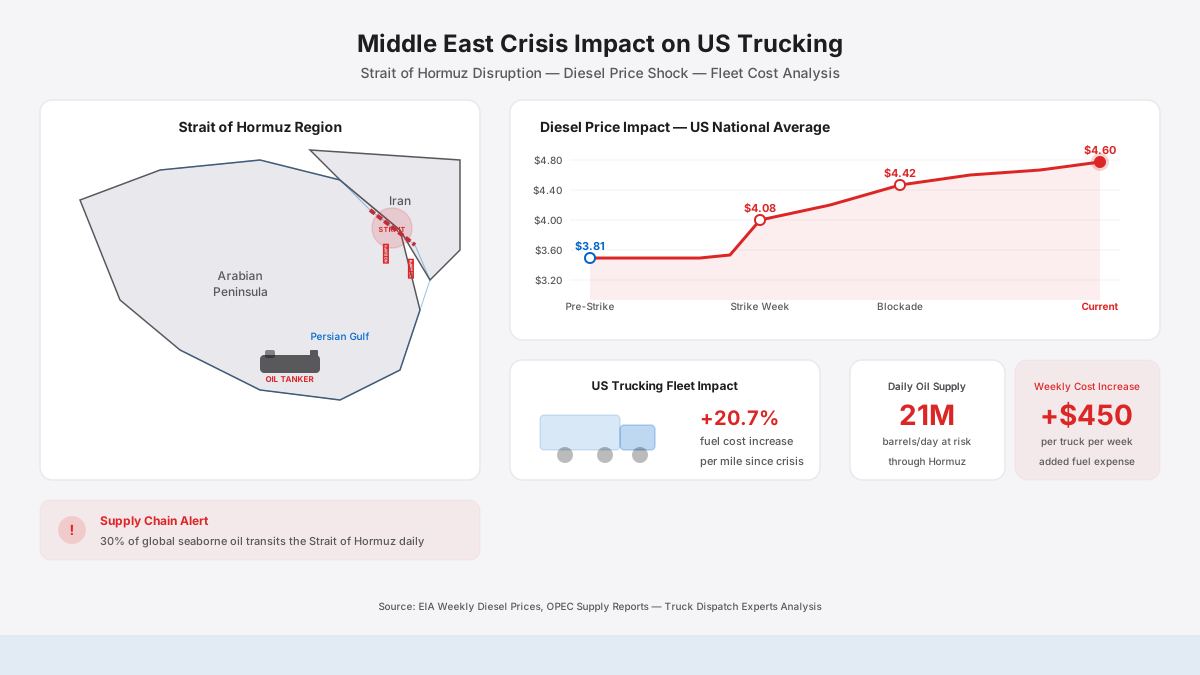
In late February 2026, escalating military tensions between the United States and Iran reached a tipping point. After months of proxy confrontations — Iranian-backed Houthi strikes on Red Sea shipping, retaliatory US strikes on Iranian military assets in Syria, and a series of tanker seizures in the Persian Gulf — Iran moved to partially blockade the Strait of Hormuz. Naval mines were deployed, Revolutionary Guard fast boats began intercepting commercial vessels, and two oil tankers were damaged in separate incidents within 72 hours.
The Strait of Hormuz is a 21-mile-wide chokepoint between Iran and Oman. Roughly 21 million barrels of oil pass through it every single day — approximately 20% of global supply. Saudi Arabia, Iraq, Kuwait, the UAE, and Qatar all depend on it to export their crude. When that flow gets disrupted, even partially, global oil markets react immediately and violently.
WTI crude oil jumped from $72/barrel to $89/barrel in the first week of the crisis. By the end of the third week, with no diplomatic resolution in sight and US naval forces in direct standoff with Iranian vessels, crude hit $98/barrel — a 36% increase. Brent crude, the international benchmark, topped $102.
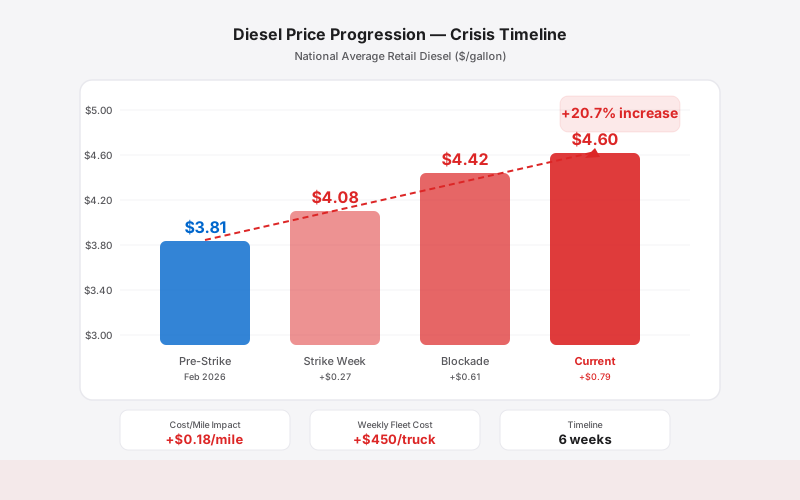
For trucking, the transmission mechanism is brutally simple: oil prices go up, diesel prices go up, and your cost per mile goes up. There is no buffer. There is no delay. The Energy Information Administration (EIA) weekly diesel survey showed the national average climbing from $3.81/gallon pre-crisis to $4.60/gallon in under three weeks. That's the fastest diesel spike since the Russia-Ukraine shock in March 2022.
If you want context on where diesel was heading before this crisis hit, read our 2026 Diesel Price Outlook. Everything in that forecast has been overtaken by events.
Diesel Price Impact: From $3.81 to $4.60 and Counting
The national average tells one story. Regional prices tell a much uglier one. Diesel pricing in the US varies by as much as $1.00/gallon depending on where you fuel, and the crisis hit some regions harder than others. California, which already had the highest diesel in the country due to state taxes and low-carbon fuel mandates, pushed past $5.20/gallon. The Gulf Coast states — Texas, Louisiana, Mississippi — which normally have the cheapest diesel thanks to proximity to refineries, jumped to $4.30-$4.45/gallon. The Northeast, dependent on imported heating oil that shares refinery capacity with diesel, hit $4.70-$4.85/gallon.
Here's the regional breakdown as of the first week of March 2026:
| Region | Pre-Crisis Avg | Current Avg | Increase | Extra $/Week* |
|---|---|---|---|---|
| California | $4.38 | $5.22 | +$0.84 (19%) | $323 |
| Northeast (PADD 1A) | $3.95 | $4.82 | +$0.87 (22%) | $335 |
| Midwest (PADD 2) | $3.72 | $4.51 | +$0.79 (21%) | $304 |
| Gulf Coast (PADD 3) | $3.55 | $4.32 | +$0.77 (22%) | $296 |
| Rocky Mountain (PADD 4) | $3.80 | $4.58 | +$0.78 (21%) | $300 |
| West Coast ex-CA (PADD 5) | $4.05 | $4.88 | +$0.83 (20%) | $319 |
| National Average | $3.81 | $4.60 | +$0.79 (21%) | $304 |
*Extra cost per week assumes 2,500 miles at 6.5 MPG (385 gallons/week). Source: EIA Weekly Retail Diesel Prices, PADD regional data, March 2026.
The monthly math is sobering. At the national average, you're paying an extra $1,215/month compared to pre-crisis levels. For an owner-operator netting $8,000-$12,000/month before the spike, that's a 10-15% hit to take-home pay. If you're running California lanes, it's closer to $1,290/month extra. Run our Fuel Cost Calculator with your actual MPG and weekly mileage to see your specific exposure.
The worst part is the lag. Diesel at the pump reflects crude oil prices from 7-10 days ago. If the crisis escalates further, today's $4.60 national average could be $4.90-$5.10 within two weeks — and the fuel surcharge you're collecting from shippers won't catch up for another 2-3 weeks after that. During rapid price spikes, carriers eat the difference. That gap can be $0.10-$0.20/mile — $250-$500/week of pure margin erosion on a 2,500-mile week.
Supply Chain Ripple Effects: Beyond Diesel
Diesel isn't the only thing flowing through the Strait of Hormuz. The Middle East crisis is creating second and third-order effects that are reshaping freight patterns across the US. Here's what's changing:
Auto Parts and Manufacturing Slowdowns
Petrochemical feedstocks from the Persian Gulf supply plastics, resins, and synthetic rubber used in auto manufacturing. Toyota, GM, and Stellantis have all flagged potential production slowdowns if the crisis extends past 60 days. When auto plants slow, the inbound parts freight (a major dry van and flatbed segment) drops with them. Carriers running Detroit, Nashville, and Midwest auto corridor lanes should watch OEM production announcements closely. If plants go to 4-day weeks or temporary shutdowns, load availability on those lanes could drop 15-25% within 30 days.
Consumer Goods Rerouting
Container ships that normally transit the Suez Canal and then the Strait of Hormuz en route from Asia are rerouting around the Cape of Good Hope — adding 10-14 days to transit times. That means imports arriving at West Coast ports (Long Beach, Oakland, Tacoma) are increasing as shippers shift away from East Coast/Gulf routing. The Port of Long Beach reported a 12% increase in vessel bookings for March-April. For trucking, that means more drayage volume out of Southern California, more intermodal loads originating on the West Coast, and longer domestic transit legs as goods that used to come through Savannah or Houston now land in LA and need to reach the same distribution centers in the Southeast and Midwest.
Chemical and Plastics Freight Disruption
The Gulf Coast petrochemical corridor — Houston, Beaumont, Lake Charles, Baton Rouge — processes Middle Eastern crude and naphtha into chemicals, plastics, and industrial feedstocks. With feedstock supply disrupted and prices spiking, some chemical producers are cutting output. That reduces tanker and bulk freight volume on Gulf Coast lanes in the short term. Paradoxically, it also increases spot rates on the chemical loads that do move, because shippers are willing to pay premium rates to keep their remaining supply chains intact. If you run Texas or Louisiana hazmat freight, rates are elevated but volume is thinner — a mixed bag.
Domestic Energy Freight Surge
Higher oil prices make domestic production more profitable. The Permian Basin, Bakken, and Eagle Ford are ramping up rig counts. That means more flatbed loads carrying pipe, drilling equipment, and frac sand into West Texas, North Dakota, and South Texas oilfield regions. Oilfield-adjacent flatbed rates from Midland-Odessa, TX are already up 18-22% from pre-crisis levels. If you run flatbed and have oilfield experience, the next 3-6 months could be extremely lucrative. Read our 2026 Trucking Industry Forecast for context on how this fits the broader market cycle.
What It Means for Freight Rates
The rate picture is complicated because diesel spikes affect different parts of the rate structure differently. Let's break it down.
Fuel surcharges are supposed to protect you. They don't — not fully. Most fuel surcharge schedules are pegged to the DOE weekly diesel average and adjust on a sliding scale. The standard formula adds roughly $0.01/mile for every $0.06 increase in diesel. At an $0.79/gallon increase, your surcharge should be up about $0.13/mile. But here's the catch: surcharges lag actual pump prices by 2-3 weeks. During the first three weeks of a rapid spike, you're absorbing the full increase while your surcharge slowly catches up. That gap has been costing carriers $0.08-$0.15/mile in real money since the crisis began.
| Equipment Type | Spot Rate Change | Contract Rate Change | Surcharge Gap | Net Margin Impact |
|---|---|---|---|---|
| Dry Van | +7-9% | +2-3% (surcharge only) | $0.08-$0.12/mi | -3 to -5% |
| Reefer | +8-12% | +3-4% (surcharge only) | $0.10-$0.15/mi | -5 to -8% |
| Flatbed | +5-7% | +2-3% (surcharge only) | $0.06-$0.10/mi | -2 to -4% |
| Tanker/Hazmat | +10-15% | +4-6% | $0.08-$0.12/mi | -3 to -5% |
| Oilfield Flatbed | +18-22% | N/A (mostly spot) | Minimal | +5 to +10% |
Rate changes reflect first 3 weeks of crisis vs 30-day prior average. Surcharge gap = difference between actual diesel cost increase and surcharge compensation. Source: DAT, FreightWaves SONAR, TDE internal data.
Reefer carriers get hit hardest. Reefer units burn diesel independently of the tractor — a running reefer uses 0.8-1.2 gallons/hour. On a 2-day transit, that's 20-30 extra gallons of diesel that the standard fuel surcharge doesn't account for. At $4.60/gallon, that's $92-$138 per load in reefer fuel alone that comes out of your pocket. Multiply across 4-5 loads per week and reefer operators are losing $370-$690/week to the surcharge gap that dry van operators don't face.
The bright spot is oilfield freight. Higher crude prices mean more drilling activity, which means more flatbed loads into the Permian Basin, Bakken, and Eagle Ford. Oilfield flatbed spot rates out of Midland-Odessa jumped from $2.80/mile to $3.40/mile in three weeks. If you have oilfield experience and the right equipment, this crisis is putting money in your pocket. For the broader freight rate picture, our 2026 Freight Rate Recovery analysis has the full market context.
10 Actionable Steps for Owner-Operators Right Now
You can't control geopolitics. You can control how you respond. Here are 10 specific things you can do this week to protect your margins during the diesel spike.
1. Audit Your Fuel Surcharge — Today
Pull your last 10 settlements and compare the fuel surcharge paid against the actual DOE diesel average for the week you ran each load. If your surcharge is based on a biweekly or monthly update, you are losing money right now. Call your broker or shipper and push for weekly DOE-based adjustments. Most will agree during a crisis because they know carriers will refuse loads that don't cover fuel. Use our Cost Per Mile Calculator to see exactly where your breakeven is at current diesel prices.
2. Tanker Your Fuel Strategically
"Tankering" means filling both saddle tanks completely when you find cheaper diesel rather than buying smaller amounts at each stop. With diesel varying $0.30-$0.50 between stops on the same corridor, a 300-gallon fill at $4.30 instead of $4.60 saves $90 per fill. Use apps like GasBuddy, Trucker Path, or the Pilot/Flying J app to find the cheapest stops on your route. Plan your fueling around the Gulf Coast and Midwest where prices are lowest. Avoid fueling in California, the Northeast, or anywhere within 20 miles of a major city where prices are highest.
3. Recalculate Your Minimum Rate Per Mile
At $3.81 diesel and 6.5 MPG, your fuel cost per mile was $0.59. At $4.60 diesel, it's $0.71. That $0.12/mile increase means your total operating cost per mile has gone from approximately $1.75 to $1.87. If you were accepting loads at $2.20/mile before the crisis, your margin just dropped from $0.45/mile to $0.33/mile — a 27% margin cut. Update your minimum rate and reject any load below your new breakeven. Running cheap loads to stay busy is how carriers go bankrupt during fuel spikes.
4. Shift Lanes Toward Fuel-Efficient Corridors
When diesel is this expensive, every mile matters more. Flat terrain lanes (I-10 corridor, I-40 through Texas/New Mexico/Arizona, I-80 through Nebraska/Iowa) give you better MPG than mountain routes (I-70 through Colorado, I-81 through Virginia/West Virginia, I-5 through Oregon). A 0.5 MPG improvement saves 58 gallons per 2,500-mile week — that's $267/week at $4.60/gallon. Let your dispatcher know fuel efficiency is a priority and factor terrain into lane selection.
5. Reduce Deadhead Miles Ruthlessly
Empty miles always cost money, but at $4.60 diesel they cost 21% more money than they did a month ago. Every deadhead mile now costs $0.71 in fuel alone. A 150-mile deadhead to pick up a load costs $107 in fuel — and that's before insurance, maintenance, and wear. Target loads with under 50 miles of deadhead. Use our Fuel Cost Calculator to price exact deadhead costs into your load-acceptance math. A good dispatcher keeps deadhead under 8% — that's the difference between surviving this crisis and bleeding cash.
6. Lock In Fuel Card Discounts
If you're not using a fuel card with network discounts, you're leaving money on the table. Comdata, EFS, and RTS fuel cards offer $0.15-$0.40/gallon discounts at participating truck stops. At 385 gallons/week, a $0.25 discount saves $96/week or $384/month. Some programs also offer locked-price fuel programs — essentially letting you pre-buy fuel at today's price for delivery next month. During a rising price environment, that's free money.
7. Slow Down — Literally
Reducing your cruising speed from 68 MPH to 63 MPH improves fuel economy by 0.5-0.8 MPG on a typical Class 8 truck. At 6.5 MPG baseline, going from 6.5 to 7.0 MPG saves 28 gallons per 2,500-mile week — $129/week at $4.60/gallon. Yes, it adds 30-45 minutes to your day. But $129/week is $516/month, and that more than compensates for slightly longer transit times. Adjust your trip planning and communicate with receivers about any delivery window flexibility.
8. Pursue Oilfield and Energy Freight
The crisis that is hurting your fuel costs is simultaneously creating freight opportunity. Domestic oil and gas production is ramping up in response to high crude prices. Flatbed loads into the Permian Basin (Midland-Odessa, TX), Eagle Ford (South TX), and Bakken (western ND) are commanding $3.20-$3.60/mile — well above the cost of elevated diesel. Even if you don't typically run oilfield, pipe and drilling equipment loads are straightforward flatbed freight. The premium over standard flatbed rates more than offsets the higher fuel costs.
9. Watch West Coast Port Drayage Volume
Container ships rerouting around the Cape of Good Hope are shifting import volume from East Coast and Gulf ports to the West Coast. Long Beach and Oakland drayage rates are ticking up as volume increases. If you operate near Southern California or Pacific Northwest ports, drayage and short-haul intermodal relay loads are worth exploring — they minimize deadhead and the high per-mile rates offset fuel costs. Port-to-warehouse runs of 50-150 miles can pay $4.00-$6.00/mile on drayage rates.
10. Get a Dispatcher Who Watches Fuel Markets Daily
During a fuel crisis, the difference between a good dispatcher and a load board is thousands of dollars per month. A dispatcher who tracks diesel prices by region, factors fuel surcharge gaps into load profitability, and positions you on fuel-efficient corridors with low deadhead is worth every penny of their fee. That's exactly what we do at Truck Dispatch Experts — we build fuel cost into every load decision, not as an afterthought, but as the first filter. When diesel is $4.60, the load that looks good on the rate sheet might be a money-loser after fuel. We catch that before you book it.
Outlook: Three Scenarios for What Comes Next
Nobody knows how the Middle East situation resolves. But we can plan for scenarios. Here are the three most likely paths and what each means for trucking.
| Scenario | Probability | Diesel Forecast | Timeline | Trucking Impact |
|---|---|---|---|---|
| Diplomatic Resolution | 35% | $4.00-$4.20 | 4-8 weeks | Diesel retreats, rates normalize, fuel surcharge gap closes |
| Prolonged Standoff | 45% | $4.40-$4.80 | 3-6 months | Sustained high diesel, supply chains adapt, rates stay elevated |
| Military Escalation | 20% | $5.20-$5.60+ | 6-12 months | Diesel crisis, carrier exits accelerate, severe rate spikes |
Probability estimates based on geopolitical analyst consensus. Diesel forecasts from EIA short-term energy outlook scenario modeling. Not investment or trading advice.
Scenario 1: Diplomatic Resolution (35% probability). If the US and Iran reach a de-escalation agreement — through direct negotiation, Omani mediation, or a UN-brokered framework — Strait of Hormuz shipping resumes within weeks. Oil prices retreat to $78-$85/barrel. Diesel drops back to $4.00-$4.20/gallon within 4-6 weeks. This is the best case for carriers: fuel costs come down, the surcharge gap closes, and the rate environment stabilizes. The risk is that carriers who panicked and signed cheap contract rates during the crisis are now locked into those rates as the market normalizes above them.
Scenario 2: Prolonged Standoff (45% probability). The most likely scenario. No resolution, no major escalation — just sustained tension, periodic tanker incidents, and naval standoffs that keep oil markets nervous. Diesel stabilizes in the $4.40-$4.80 range for 3-6 months. Supply chains adapt by rerouting around the Strait. Shipping costs increase permanently by 8-15%. For trucking, this means elevated fuel costs become the new normal. Carriers who adapt their operations (fuel planning, lane selection, surcharge renegotiation) survive and thrive. Carriers who don't adapt see margin compression that forces them out — continuing the carrier attrition trend already underway from tariff impacts.
Scenario 3: Military Escalation (20% probability). Direct US-Iran military conflict, sustained Strait of Hormuz closure, potential Saudi/UAE production facility damage. Oil spikes past $120/barrel. Diesel hits $5.20-$5.60 nationally, $6.00+ in California. This is the nightmare scenario for trucking. At $5.50 diesel, fuel cost per mile jumps to $0.85 — eating most of a carrier's margin on any load under $2.50/mile. Marginal carriers exit. The FreightWaves SONAR carrier revocation tracker, already running at 2,500+/month, could accelerate to 4,000-5,000/month. The upside: carriers who survive would see rates spike dramatically as capacity tightens. The 2022 playbook would repeat — those who lasted through the pain got paid on the other side.
The bottom line for every scenario: fuel planning, surcharge management, and smart dispatching are the difference between surviving and thriving. The carriers who treat this as a management problem (not just a cost problem) will come out ahead. The carriers who keep running the same lanes at the same rates and hope diesel comes down are gambling with their business.
Related Resources
- Diesel Price Outlook 2026 — Pre-crisis diesel forecast and long-term trends
- Trucking Industry Forecast 2026 — Full rate, capacity, and market cycle projections
- Fuel Cost Calculator — Calculate your exact fuel costs at current diesel prices
- Cost Per Mile Calculator — Find your true operating cost and breakeven rate
- Tariff Ruling Impact on Trucking — How the SCOTUS tariff decision compounds with the diesel crisis
- 2026 Freight Rate Recovery — Rate rebound context and where the market is heading
Truck Dispatch Experts
Published Mar 8, 2026