The Opportunity: Why This Rate Surge Is Different
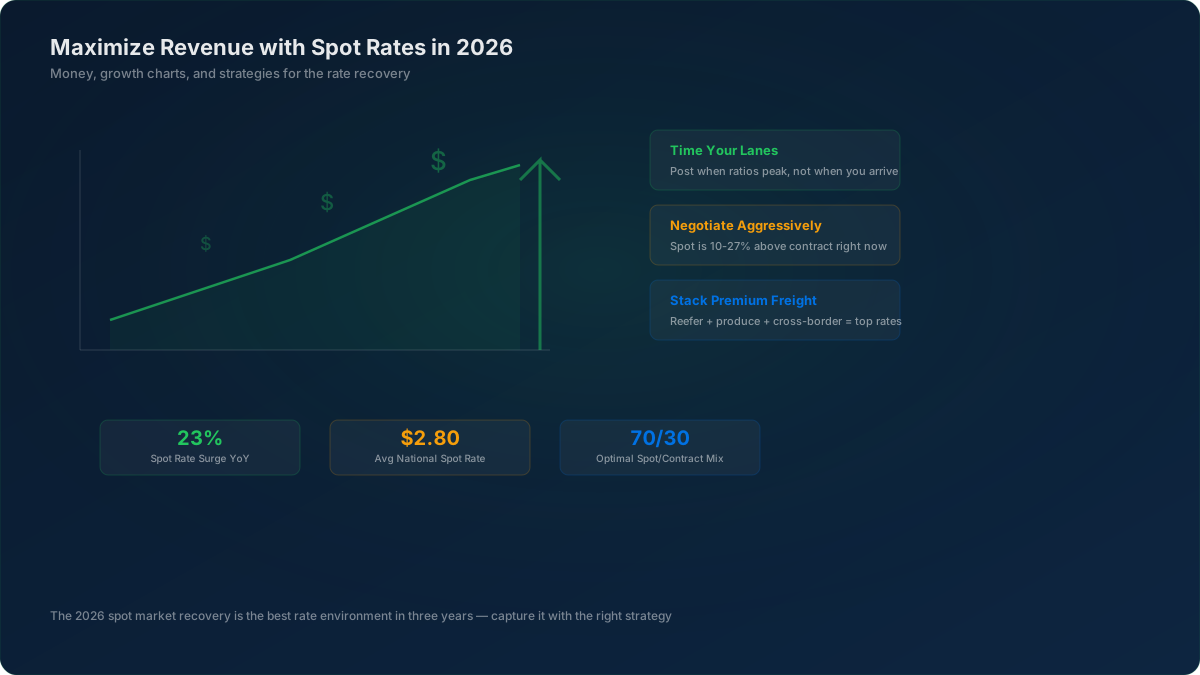
Here are the numbers that matter: DAT spot van rates reached $2.41 per mile by late February 2026 — the seventh straight monthly gain since August 2025, when rates bottomed at $2.03 per mile. That's a 20%+ year-over-year increase. The load-to-truck ratio climbed to 7.73 in March after peaking at 9.9 in December 2025. And the Outbound Tender Rejection Index hit 14% — the highest reading since mid-2022.
But here is what makes this rate cycle different from the COVID spike of 2021: the carrier base is structurally thinner. Roughly 88,000 carrier authorities were revoked in 2023. Another 5,000 to 8,000 carriers exited in 2025. Net capacity contracted by approximately 10,000 carriers in the first half of 2024 alone. Unlike 2021, when every new CDL holder rushed to get authority, the barriers to re-entry are now much steeper — insurance premiums hit a record $0.102 per mile (5.8% year-over-year increase in Q1 2025), and lenders require months of operating capital reserves before financing new trucks.
The carriers who survived the freight recession are now positioned for the best revenue opportunity in four years. The question is not whether rates are up — they clearly are. The question is whether you are capturing the full value of this market or leaving money on the table through suboptimal load selection, weak rate negotiation, or excessive deadhead.
For the full market outlook, see our 2026 Trucking Industry Forecast.
$2.41/mi
Spot Van Rate
7th straight monthly gain
7.73
Load-to-Truck Ratio
March 2026 (peaked 9.9 Dec)
14%
Tender Rejection Rate
Highest since mid-2022
Current Rates by Equipment Type
Not every equipment class is recovering at the same pace. Here is where spot rates stand across the three major equipment types, with the best-performing lane categories for each:
| Equipment | Spot Rate | YoY Change | Best Lanes |
|---|---|---|---|
| Dry Van | $2.41/mi | +20%+ | CA outbound, SE produce support |
| Reefer | $2.21/mi (linehaul) | +20%+ | SE produce, FL-to-NE corridors |
| Flatbed | $2.07/mi (linehaul) | +20%+ | SW construction, infrastructure |
Source: DAT Trendlines, FreightWaves SONAR, March 2026. Reefer and flatbed rates shown as linehaul (excluding fuel surcharge).
Regional Rate Hotspots: Where the Money Is
National averages tell one story, but your revenue is made on specific lanes. The difference between the best-paying and worst-paying regions right now is over $2.00 per mile. Positioning your truck in the right region at the right time is the single highest-impact decision you can make. Here is where the premium freight is concentrated — and which areas to avoid:
| Region | Equipment | Rate Range | Demand |
|---|---|---|---|
| SE Produce Corridors | Reefer | $3.50-$4.50/mi | Very High |
| TX Cross-Border (Laredo/El Paso) | All | $3.00-$4.00/mi | High |
| SW Construction Corridors | Flatbed | $2.80-$3.40/mi | High |
| CA Outbound (LA/Long Beach) | Dry Van | $3.00+/mi | High |
| Midwest-to-Midwest Short-Haul | Dry Van | $1.80-$2.10/mi | Low |
| Inbound FL/Laredo Backhaul | All | $1.50-$1.90/mi | Low |
The produce play. If you run reefer, Southeast produce season is your highest-revenue window. Florida strawberries, Georgia peaches, Carolina sweet potatoes — these are time-sensitive loads where shippers pay premium rates for reliable capacity. Check our Produce Season Trucking Guide for commodity timelines and lane specifics.
The cross-border advantage. Nearshoring continues to drive freight volumes through Texas border crossings. Northbound loads from Laredo and El Paso command significant premiums because the return trip (southbound) is typically lighter, meaning carriers need to be compensated for the deadhead or repositioning cost built into the outbound rate.
Avoid the traps. Midwest-to-Midwest short-haul dry van remains the weakest segment. Inbound Florida and inbound Laredo are classic backhaul traps — rates are depressed because everyone needs to get out but few loads are going in. If you deliver into these markets, have your next load booked before you arrive. For strategies on reducing empty miles in tough corridors, see our guide to reducing empty miles.
The 60/40 Rule: Blending Spot and Contract Freight
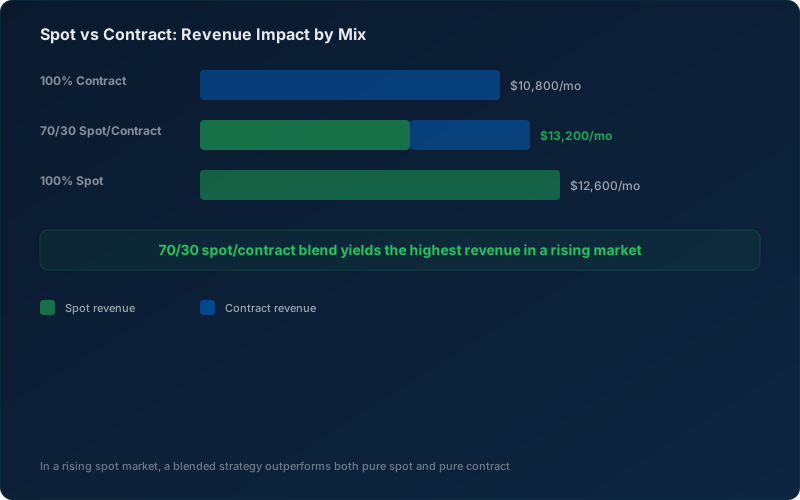
When spot rates are running hot, the temptation is to go 100% spot. Do not do it. Markets turn, and they turn faster than most carriers expect. The optimal strategy for most owner-operators in the current environment is a 60/40 or 70/30 spot-to-contract split.
Why not all spot? Because spot markets are volatile. A weather event, a port closure, or a seasonal dip can drop spot rates 15-25% in a matter of days. If 100% of your revenue comes from spot, your cash flow swings with every market hiccup. Contract freight provides a predictable revenue floor that covers your fixed costs regardless of what the spot market does on any given week.
Why not all contract? Because with the OTRI at 14% and spot premiums running 20%+ above contract rates, locking all your capacity into contracts means leaving significant money on the table. When OTRI stays above 12% for eight or more consecutive weeks — as it has been doing — contract rate increases of 5-10% typically follow. But those renegotiated contracts will not hit until the next bid cycle. In the meantime, spot is where the premium revenue lives.
The practical framework: Use your Cost Per Mile Calculator to determine your breakeven rate. Lock enough contract volume to cover your fixed costs — truck payment, insurance ($0.102/mile on average), fuel, maintenance, and living expenses. Run the remaining 40-60% of your capacity on spot, targeting lanes in the high-demand corridors we outlined above. For a deeper comparison of the two approaches, see our Spot Market vs Contract Freight guide.
Rate Negotiation Tactics That Work in a Tight Market
A tight freight market does not mean brokers will hand you premium rates without pushback. They are still trying to keep their margins. The difference is that you now have leverage — and you need to use it strategically. Here is how:
Know the lane rate before you call. Before you negotiate any load, check the DAT rate for that specific lane, origin, and destination. Know the average, the high, and the low. If a broker offers you $2.10 on a lane that is averaging $2.65, you have data to push back. Rate knowledge is negotiation power.
Use the load-to-truck ratio as your leverage tool. The current load-to-truck ratio of 7.73 means there are nearly eight loads for every available truck. When a broker lowballs you, remind them (politely) that you have options. You are not desperate for freight — they are desperate for trucks. That dynamic shift is what 7.73 means in practical terms.
Never accept the first offer. In a tight market, the first rate a broker quotes is almost never their best number. Counter at least once. Most experienced dispatchers push back two or three times on every negotiation. If the broker will not move, that is valuable information — but you should always ask.
Negotiate the accessorials, not just the linehaul. Detention time, layover, TONU (truck ordered not used), and lumper reimbursement all add up. In a tight market, shippers and brokers are more willing to agree to $75-$100/hour detention and full lumper reimbursement because the alternative is not having a truck at all. Read our complete rate negotiation guide for more tactics.
Learn when to walk away. The most powerful negotiation tool is your willingness to say no. With a load-to-truck ratio of 7.73, there is another load. A cheap load that puts you in a bad market position (delivered to a dead zone with no outbound freight) costs you more than an empty day. Calculate the full-trip economics — including your deadhead out of the delivery market — before you accept.
Deadhead Is the Silent Revenue Killer
You can negotiate $3.50 per mile on every load and still lose money if you are running 200 empty miles between each one. Deadhead — empty repositioning miles — is the number one profit killer for owner-operators, and it is the area where most self-dispatched carriers leave the most money on the table.
The math is straightforward. A 500-mile load at $3.00 per mile with zero deadhead generates $3.00 revenue per total mile. The same 500-mile load with 150 miles of deadhead to reach the pickup generates $2.31 per total mile — a 23% reduction in effective revenue. At current diesel prices, those 150 empty miles cost you roughly $100 in fuel alone, plus wear, plus time.
Book your next load before delivering the current one. This is the single most impactful habit you can develop. While you are driving to your current delivery, your dispatcher should be booking your next pickup within 50 miles of the delivery point. If you self-dispatch, start searching load boards two to three hours before delivery. Use our Deadhead Calculator to evaluate whether a load is worth the repositioning cost.
Think in round trips, not one-way loads. Before accepting a load into any market, ask yourself: what comes out? If you deliver to Laredo and there is no northbound freight for two days, that $4.00/mile load effectively becomes a $2.50/mile load when you factor in the empty reposition. The best dispatchers build triangle routes or round-trip loops that keep your loaded-mile percentage above 85%.
Professional dispatch increases revenue by 10-30% — and the largest portion of that gain comes from deadhead reduction, not just higher per-mile rates. A dispatcher who is constantly working your next load while you drive the current one is doing something you physically cannot do while behind the wheel. For a detailed breakdown, see our analysis of dispatch ROI.
Why Dispatch Pays for Itself in a Rising Market
The dispatch industry is growing for a reason. The market is projected to reach $1 billion by 2031 from $688 million in 2024, growing at 5.6% annually. That growth is not driven by marketing — it is driven by results. Carriers who use professional dispatch consistently outperform self-dispatched operators on revenue per mile, utilization rates, and total net income.
In a market where spot rates are up 20%+, the value of dispatch is amplified. Every missed rate negotiation costs more. Every unnecessary deadhead mile is more expensive. Every hour you spend searching load boards instead of driving is higher-value time wasted. At $2.41 per mile, one extra loaded hour is worth roughly $150 in revenue. If your dispatcher saves you two hours of load searching per day, that is $300 in additional daily revenue capacity.
The cost of dispatch — typically 5-15% of gross revenue or a flat rate of $200-$500 per week — is a fraction of the revenue uplift. If dispatch adds just $0.20 per mile to your average rate on 10,000 miles per month, that is $2,000 in additional monthly gross before accounting for deadhead savings and utilization improvements. Subtract a $300/week dispatch fee ($1,200/month) and you are still ahead $800/month minimum — typically much more.
To understand how truck dispatch works, what to expect from a dispatch service, and how to choose the right company, check our detailed guides. And to see our specific dispatch services and pricing, visit our services page.
Your 5-Step Action Plan for Q2 2026
Rates are up. Capacity is tight. The market favors carriers. Here is exactly how to capitalize over the next 90 days:
Step 1: Know your numbers. Calculate your all-in cost per mile using our CPM Calculator. Include truck payment, insurance ($0.102/mile average), fuel, maintenance, tires, permits, and your personal draw. This is your absolute floor rate — never go below it, no matter how convenient the load.
Step 2: Set a target RPM 30-40% above your cost. If your cost per mile is $1.80, your target should be $2.35-$2.50 minimum. In the current market, this target is very achievable on most lanes. Do not settle for break-even loads unless they reposition you into a high-demand market where the next load will more than compensate.
Step 3: Position for produce season. If you run reefer, get to the Southeast. If you run dry van, California outbound and Texas cross-border are your best bets. If you run flatbed, target Southwest infrastructure lanes. Use our Seasonal Freight Calendar to time your positioning.
Step 4: Adopt a 60/40 spot-to-contract split. Lock 40% of your capacity into contracts that cover your fixed costs. Run 60% on spot to capture the premium. Revisit this ratio monthly based on the load-to-truck ratio and OTRI readings.
Step 5: Get dispatch support. This is a market where dispatch pays for itself multiple times over. A good dispatcher will push your rates higher, keep your truck loaded, minimize deadhead, and handle the back-office work so you can focus on driving and earning. Contact us to discuss how our dispatch team can help you capture this rate cycle.
Frequently Asked Questions
What is the best spot-to-contract ratio for owner-operators in 2026?
In the current market with spot rates running 20%+ above year-ago levels and the load-to-truck ratio at 7.73, most owner-operators benefit from a 60/40 or 70/30 spot-to-contract split. The logic is straightforward: use contract freight to cover your fixed costs — truck payment, insurance, living expenses — and run the remaining capacity on spot loads where rates are significantly higher. This approach captures the upside of the rate surge while protecting against sudden downturns. As the market matures through mid-2026 and shippers renegotiate contracts upward, you can gradually shift more volume to contracts at better rates. A professional dispatcher can help you time this transition based on daily OTRI and load-to-truck data.
Which regions are paying the highest spot rates right now?
As of early 2026, the highest-paying regions are Southeast produce corridors — Florida, Georgia, and the Carolinas — where reefer rates are hitting $3.50 to $4.50 per mile during peak produce season. Texas cross-border lanes from Laredo and El Paso are averaging $3.00 to $4.00 per mile for northbound imports. Southwest construction corridors are driving flatbed rates to $2.80 to $3.40 per mile thanks to infrastructure spending. California outbound from LA, Long Beach, and the Central Valley is pushing dry van rates above $3.00 per mile due to CARB regulations and driver shortages. The weakest markets are Midwest-to-Midwest short-haul dry van and inbound Florida or Laredo backhaul lanes, which remain oversupplied.
How much more revenue can a dispatch service generate?
Industry data shows that professional dispatch services increase owner-operator revenue by 10 to 30 percent through a combination of better rate negotiation, reduced deadhead miles, higher loaded-mile utilization, and strategic lane selection. On a practical level, if you are self-dispatching at $2.20 per mile average, a good dispatcher might push that to $2.50 to $2.85 per mile by accessing loads that never hit public load boards, negotiating aggressively during rate spikes, and routing you through high-demand corridors. The dispatch fee — typically 5 to 15 percent of gross or $200 to $500 per week flat — is more than offset by the revenue increase. The dispatch market itself is growing rapidly, projected to reach $1 billion by 2031 from $688 million in 2024.
How do I use the load-to-truck ratio to decide when to book?
The load-to-truck ratio is your single best real-time indicator of market conditions. When the ratio is above 5:1 (five loads available for every truck), rates are climbing and you have pricing power — hold out for better rates and do not accept the first offer. When it exceeds 8:1, as it did in December 2025 when it peaked at 9.9, you are in a strong seller's market where shippers are desperate for capacity. At 2:1 or below, capacity exceeds demand and you should lock in contracts rather than chase spot. The current ratio of 7.73 in March 2026 signals strong carrier pricing power. Check DAT Trendlines daily for your specific lanes — regional ratios can differ dramatically from the national average.
When should I say no to a load even in a hot market?
Even with spot rates up 20 percent, not every load is worth taking. Reject loads that fall below your cost per mile — use our Cost Per Mile Calculator to know your floor. Say no to loads with excessive deadhead: if you need to drive 200 empty miles to pick up a 300-mile load, the effective rate drops dramatically. Avoid loads going into known weak markets like inbound Florida or Laredo unless you have a backhaul already booked. Skip loads from brokers with poor credit or slow-pay histories — a $3.00 per mile load means nothing if you do not get paid for 90 days. And do not chase a high rate that takes you into a dead zone with no outbound freight. Strategic load rejection is what separates profitable operators from busy ones who still lose money.
What is the relationship between tender rejections and spot rates?
Tender rejections and spot rates are closely correlated because they measure the same underlying dynamic: carrier willingness to haul freight at offered prices. The national Outbound Tender Rejection Index hit 14 percent in early 2026 — the highest since mid-2022. When OTRI rises above 10 percent, carriers are increasingly declining contract loads because spot rates are more attractive, which pushes spot rates even higher as shippers scramble for coverage. Historically, when OTRI stays above 12 percent for eight or more consecutive weeks, contract rate increases of 5 to 10 percent follow within one to two quarters. For owner-operators, a high OTRI is your green light to push harder on rate negotiations. For context, Midwest tender rejections hit 18 percent in early February, and reefer rejections exceeded 20 percent — both the highest readings since March 2022.