Why Interstate Choice Matters
The interstate you run determines almost everything about your trucking business: what freight is available, what rates you can negotiate, how much you spend on fuel and tolls, and how often you deadhead between loads. Running I-35 from Laredo to Kansas City is a completely different business than running I-95 from Miami to Boston. The freight types are different, the rate structures are different, the toll exposure is different, and the seasonal patterns are different. Treating all interstates as interchangeable is one of the most common mistakes owner-operators make — and it costs real money every week.
Smart carriers pick two or three corridors that match their equipment type and build deep knowledge of those routes. They know which segments pay well, which ones are freight-thin, where the best fuel stops are, and how seasonal patterns shift rates month by month. This guide breaks down the seven most important interstate freight corridors in America — what moves on each one, where the money is, and how to use them strategically to keep your truck loaded and your revenue high.
I-10: Coast-to-Coast Southern Corridor
Route
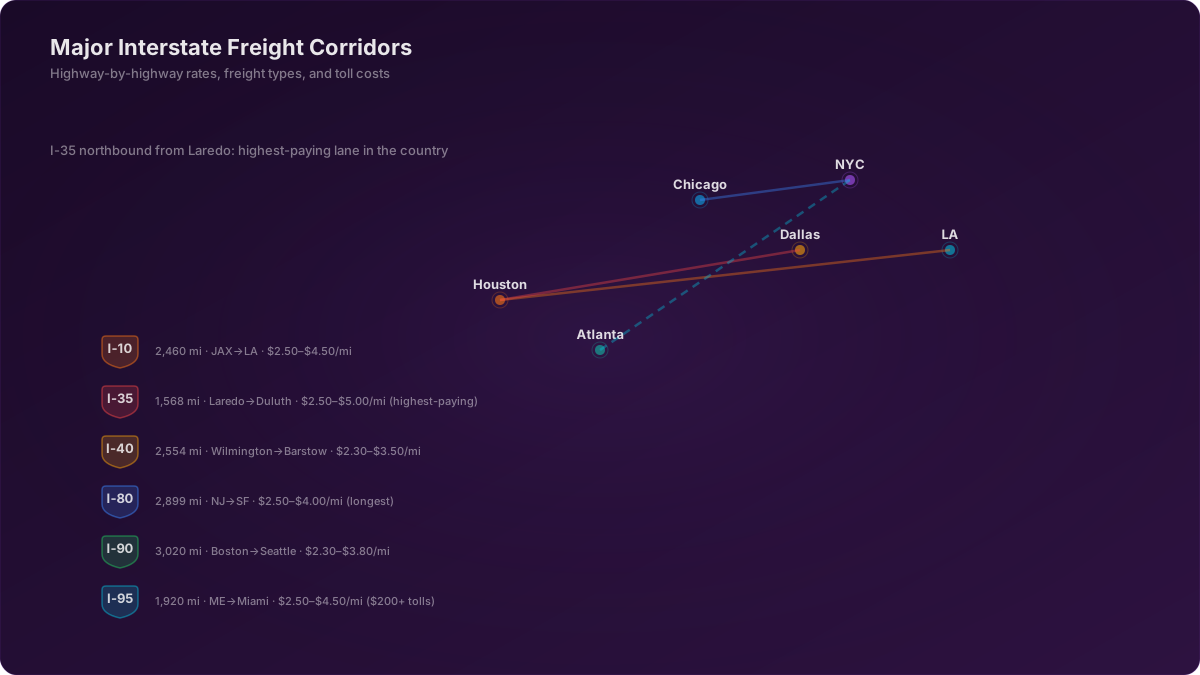
Jacksonville, FL to Los Angeles, CA — crossing Florida, Alabama, Mississippi, Louisiana, Texas, New Mexico, Arizona, and California. This is the longest coast-to-coast southern interstate and one of the most freight-diverse corridors in the country.
What Moves
Cross-border freight dominates the Texas segments, particularly between El Paso and San Antonio where Mexican imports flow north into US distribution networks. Petrochemicals and energy equipment move heavily between Houston and New Orleans along the Gulf Coast refinery corridor. Florida and California bookend the route with massive produce movements — Florida citrus and vegetables January through May, California produce year-round. Consumer goods flow through the entire corridor, feeding retail distribution centers from Jacksonville to the Inland Empire. The sheer variety of freight types means I-10 carriers can usually find loads regardless of equipment type or season.
Key Segments
- •Houston to San Antonio — Petrochemical and energy freight hub. Refineries, chemical plants, and oilfield services generate consistent flatbed and tanker loads. Rates spike when crude prices rise.
- •El Paso to Tucson — Cross-border corridor. Freight from Mexican manufacturing (automotive parts, electronics, appliances) enters at El Paso and moves west toward Arizona and California distribution centers.
- •Inland Empire to Phoenix — Port import distribution. Goods arriving at the ports of Los Angeles and Long Beach move east to Arizona distribution centers. This segment stays busy year-round due to the constant flow of Pacific Rim imports.
Best Months
Year-round for most segments. Florida produce from January through May boosts the eastern section significantly. Houston energy freight is crude-price dependent — when oil is above $75 per barrel, expect strong demand. The western segments stay consistent because port freight does not have a true off-season.
Tolls
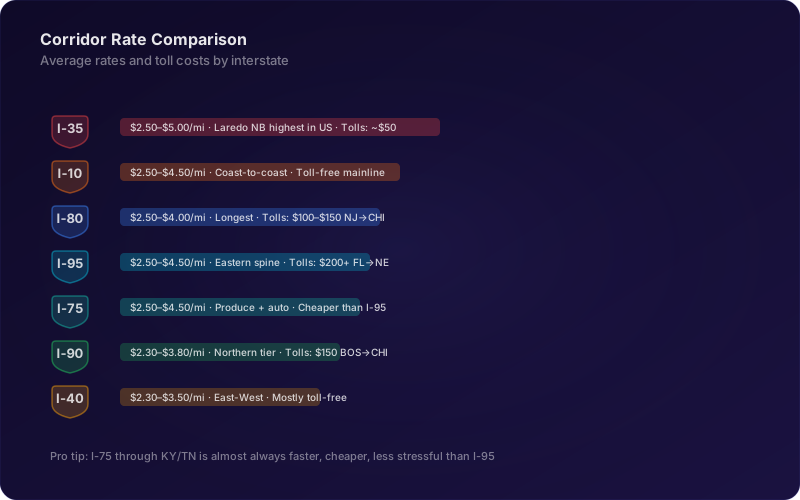
Minimal compared to northern interstates. Texas has some turnpike connector tolls but the mainline I-10 is toll-free. Florida tolls apply on alternate routes (Florida Turnpike) but not on I-10 itself. This makes I-10 one of the most cost-effective coast-to-coast options for carriers watching their overhead.
Pro tip: The I-10/I-35 junction in San Antonio is one of the most important freight interchanges in the country. Two of the highest-volume corridors in America cross here, which means loads are almost always available in both directions. If you are running I-10 east-west and your load delivers in San Antonio, you can pivot to I-35 northbound or southbound without deadheading. This interchange is a natural reset point for multi-corridor carriers.
I-35: The NAFTA Superhighway
Route
Laredo, TX to Duluth, MN — running through Texas, Oklahoma, Kansas, Missouri, Iowa, and Minnesota. I-35 is the primary north-south trade corridor connecting Mexico to the American Midwest, and it carries more cross-border freight tonnage than any other US highway.
What Moves
Cross-border imports from Mexico dominate the southern segments. I-35 is the number one NAFTA corridor by volume — automotive parts, electronics, household appliances, and fresh produce flow north from Laredo into the heart of the US distribution network. Consumer goods move in both directions along the full length, feeding retail distribution centers in Dallas-Fort Worth, Oklahoma City, Kansas City, and the Twin Cities. Agricultural products are the backbone of the northern segments: Kansas and Iowa grain moves south, while Texas produce moves north. Energy equipment and oilfield supplies move between the Texas and Oklahoma oil patches and Midwest manufacturing facilities.
Key Segments
- •Laredo to San Antonio — The highest-paying segment on any US interstate. Cross-border import demand creates consistently elevated rates of $3.50 to $5.00 per mile northbound. Carrier capacity at the border is limited by customs processing times, which keeps supply tight and rates high.
- •Dallas-Fort Worth to Oklahoma City — Mixed freight corridor combining energy sector loads, consumer goods distribution, and manufacturing. DFW is one of the largest inland freight markets in the country, ensuring strong load availability in every direction.
- •Kansas City to Des Moines — Agricultural corridor. Grain, livestock feed, and processed food products move through this segment year-round, with harvest season (August through November) creating significant rate increases for flatbed and hopper carriers.
Best Months
October through December is peak season — holiday imports from Mexico surge as retailers stock for Black Friday and Christmas. August through November brings harvest-season agricultural demand on the northern segments. January and February are the slowest months, though Laredo northbound rates rarely drop below $3.00 per mile even in the off-season.
Tolls
Oklahoma turnpikes and the Kansas Turnpike are the main toll segments. Total toll cost for a full Laredo-to-Duluth run is moderate — roughly $40 to $60 depending on your route through Oklahoma. Many carriers use US-69 or US-75 through Oklahoma to avoid turnpike tolls, though this adds mileage.
Pro tip: Laredo northbound is consistently one of the highest-paying lanes in America — but getting a load into Laredo can require deadheading from San Antonio, roughly 150 miles south. The math still works in your favor: even with 150 miles of unpaid deadhead, a $4.50 per mile load from Laredo to Dallas (about 450 miles) nets you roughly $3.38 per mile when you spread the cost across total miles driven. That is still well above the national average. The key is not to chase Laredo loads from further than San Antonio — the deadhead math stops working past that point.
I-40: East-West Backbone
Route
Wilmington, NC to Barstow, CA — running through North Carolina, Tennessee, Arkansas, Oklahoma, the Texas Panhandle, New Mexico, Arizona, and California. I-40 is the workhorse east-west corridor through the middle of the country, connecting Southeast manufacturing with Southwest and West Coast markets.
What Moves
I-40 carries the most diverse freight mix of any east-west interstate. North Carolina and Tennessee generate manufacturing freight — furniture, textiles, auto parts, and industrial equipment. Arkansas is home to Walmart's headquarters in Bentonville, which makes the Little Rock-to-Memphis segment one of the densest distribution corridors in the country. Walmart's supply chain alone generates thousands of truck movements per week along this stretch. Oklahoma and the Texas Panhandle contribute energy equipment and agricultural loads. The western segments through New Mexico and Arizona carry consumer goods and intermodal transfers heading to and from Southern California. Flagstaff to Barstow is the critical connector feeding freight into the Los Angeles basin and the Inland Empire warehouse complex.
Key Segments
- •Memphis to Little Rock — Distribution hub corridor. Memphis is a global logistics capital (FedEx hub, multiple Class I rail connections) and Little Rock anchors Arkansas's distribution network. Loads are plentiful and rates are stable year-round.
- •Amarillo to Albuquerque — Long and sparse. This 290-mile stretch crosses the Texas Panhandle and eastern New Mexico with minimal freight origins along the way. Fuel stops are spread thin. Plan to transit this segment with a load rather than hunting for freight here.
- •Flagstaff to Barstow — The gateway to Southern California freight. This segment connects I-40 to the massive LA and Inland Empire market. Westbound loads tend to pay well because carriers are positioning into one of the largest freight markets in the country.
Best Months
Eastern sections perform well year-round due to the manufacturing and distribution base. Spring through fall is strongest for the western desert segments when construction and agricultural freight peak. Holiday season (October through December) lifts the entire corridor as retail distribution ramps up.
Tolls
Oklahoma turnpike sections are the only significant tolls on I-40. The rest of the corridor is essentially toll-free, making it one of the most cost-effective east-west routes for carriers who want to avoid the toll burden of I-80 or I-90 through the Northeast and Midwest.
Pro tip: The I-40/I-35 junction in Oklahoma City is a strategic pivot point where you can switch between east-west and north-south freight. If you deliver a load on I-40 into OKC, you can immediately pick up an I-35 load heading north to Kansas City or south to Dallas without deadheading. The I-40/I-44 junction in Oklahoma City offers another option — I-44 connects OKC to Tulsa, Joplin, Springfield, and St. Louis, opening up an entirely different set of freight opportunities. Multi-corridor flexibility at these junctions is what separates high-revenue carriers from single-lane operators.
I-80: Northern Tier Connector
Route
Teaneck, NJ to San Francisco, CA — crossing New Jersey, Pennsylvania, Ohio, Indiana, Illinois, Iowa, Nebraska, Wyoming, Utah, Nevada, and California. I-80 is the longest interstate in the country and the primary northern east-west freight artery connecting the Eastern Seaboard to the Bay Area.
What Moves
Intermodal freight from Chicago dominates the middle segments — Chicago is the largest intermodal hub in North America, and thousands of containers transfer from rail to truck every day for final-mile delivery across the Midwest and East. Midwest manufacturing (automotive, steel, machinery) generates heavy outbound loads from Ohio, Indiana, and Illinois. Agricultural freight — particularly Iowa and Nebraska grain, corn, and soybeans — flows in every direction during harvest season. Port freight bookends the route: Newark on the east end handles massive container volumes from Europe and Asia, while Oakland on the west end serves as the Bay Area's primary import gateway. The Lehigh Valley in Pennsylvania has emerged as the warehouse capital of the East Coast, generating enormous outbound freight from Amazon, FedEx, and dozens of major retail fulfillment operations.
Key Segments
- •New Jersey to Pennsylvania (Lehigh Valley) — The densest warehouse cluster on the East Coast. Outbound loads from fulfillment centers pay well and are available daily. Rates on this segment are among the highest on I-80, typically $3.50 to $4.00 per mile for short-haul runs.
- •Chicago Corridor — Intermodal capital. Rail-to-truck transfers generate a constant stream of loads heading in every direction. Chicago-area rates fluctuate with seasonal demand but rarely drop below $2.50 per mile due to the sheer volume of freight available.
- •Nebraska (Omaha) — Beef processing capital. Omaha and the surrounding area house major meatpacking and food processing facilities that generate consistent reefer loads year-round.
- •Wyoming — Pass-through territory. Freight origins are extremely sparse. Use this as a transit segment, not a freight source.
- •Nevada to California — Bay Area connector. Reno has a growing distribution cluster (Tesla, Amazon, Walmart DCs) that feeds freight into the Sacramento and Bay Area markets. This segment has strengthened considerably over the past three years as Reno's logistics footprint has expanded.
Best Months
September through November is peak season — harvest freight from Iowa and Nebraska combines with holiday pre-positioning to create strong demand along the entire corridor. January and February are the slowest months, with winter weather adding transit risk through Wyoming, Iowa, and Pennsylvania.
Tolls
I-80 has one of the most expensive toll corridors in the country. The NJ Turnpike, PA Turnpike, Ohio Turnpike, and Indiana Toll Road create a nearly continuous toll zone from New Jersey to Illinois. A full eastbound run from Chicago to New Jersey can cost $100 to $150 in tolls alone. Factor this into every rate calculation on this corridor.
Pro tip: I-80 through Wyoming has the fewest loads per mile of any major interstate in the country. Do not stop for loads in Wyoming — keep moving to Salt Lake City westbound or Omaha eastbound. The freight will find you at either endpoint. Treat the Wyoming segment as a 400-mile transit corridor and price your loads accordingly: if you are picking up in Omaha and delivering in Salt Lake City, your rate needs to cover the reality that Wyoming miles are essentially empty-mile equivalents from a freight availability standpoint.
I-75/I-95: Eastern Seaboard Spine
Routes
I-75 runs from Sault Ste. Marie, MI to Miami, FL through Michigan, Ohio, Kentucky, Tennessee, Georgia, and Florida. I-95 runs from Houlton, ME to Miami, FL along the entire Eastern Seaboard. Together, these two interstates form the north-south spine of eastern freight movement, connecting the Great Lakes manufacturing belt to the Southeast distribution network and Florida's massive consumer and produce markets.
What Moves
Everything. These corridors collectively handle more freight diversity than any other north-south routes in the country. Port freight flows through Miami, Jacksonville, Savannah, Charleston, Norfolk, and Newark. Florida produce — citrus, tomatoes, peppers, strawberries — moves northbound on both I-75 and I-95 from January through May, creating some of the highest reefer rates of the year. Automotive freight dominates the I-75 corridor from Michigan through Ohio, Tennessee, and Alabama, connecting assembly plants, parts suppliers, and distribution centers. Retail distribution drives consistent demand through the Atlanta, Charlotte, and DC-to-New York corridor, with Amazon, Walmart, and Target all operating major fulfillment networks along both routes.
Key Segments
- •Miami to Atlanta (I-75) — Produce and retail. Florida produce season (January through May) pushes northbound reefer rates to $3.50 to $4.50 per mile. Year-round retail freight fills the gaps between produce seasons.
- •Atlanta to Chattanooga (I-75) — Automotive corridor. Multiple assembly plants and parts suppliers line this segment, generating consistent flatbed and dry van loads for the automotive supply chain.
- •Cincinnati to Detroit (I-75) — Automotive parts. The Detroit-Toledo-Cincinnati triangle is the heart of American automotive manufacturing. Parts flow between suppliers and assembly plants multiple times before a finished vehicle ships, creating dense, short-haul freight demand.
- •DC to NYC (I-95) — Northeast corridor retail. The densest consumer market in the country. Rates are strong but congestion is brutal, especially through Baltimore, Wilmington, and the New Jersey approaches. Factor in significant transit time delays.
- •Jacksonville to Savannah (I-95) — Port freight. Both Jacksonville and Savannah are rapidly growing container ports, generating consistent drayage and long-haul loads heading inland to Atlanta, Charlotte, and the Midwest.
Best Months
January through May for Florida produce (highest reefer rates of the year on I-75 northbound). October through December for holiday retail distribution along both corridors. Automotive freight on I-75 is steady year-round except for brief model-changeover shutdowns in July and August.
Tolls
I-95 is one of the most expensive toll corridors in America. Florida Turnpike, Maryland I-95 tolls, Delaware Memorial Bridge, NJ Turnpike, and George Washington Bridge add up to $200 or more for a full Florida-to-New-England run. I-75 is significantly cheaper — Georgia Peach Pass is the main toll, and it is modest. The Kentucky and Tennessee segments of I-75 are toll-free.
Pro tip: I-75 through Kentucky and Tennessee is the cheaper, less-congested alternative to I-95 for north-south runs. Both routes effectively connect the same endpoints — Florida to the Great Lakes and Northeast — but I-75 avoids the DC, New Jersey, and New York toll and congestion gauntlet. If you are running freight from Florida to Ohio, Michigan, or even Pennsylvania, I-75 to I-71 or I-75 to I-77 is almost always faster, cheaper, and less stressful than the I-95 route. Save I-95 for loads that specifically deliver to the DC-to-Boston corridor where you have no alternative.
I-90: Northern Cross-Country
Route
Boston, MA to Seattle, WA — crossing Massachusetts, New York, Pennsylvania, Ohio, Indiana, Illinois, Wisconsin, Minnesota, South Dakota, Wyoming, Montana, Idaho, and Washington. I-90 is the longest interstate in the United States and the only continuous east-west route connecting Boston to the Pacific Northwest.
What Moves
Manufacturing freight dominates the eastern and central segments — Ohio, Indiana, and Wisconsin produce automotive parts, industrial equipment, paper products, and machinery that ship east to New England and west to the Pacific Northwest. Agricultural products move heavily through Minnesota and South Dakota during harvest season — grain, corn, soybeans, and sugar beets. Energy freight (oil and gas equipment, wind turbine components) flows through the Wyoming and Montana segments, though volumes are cyclical and tied to commodity prices. Technology and consumer electronics move through the Seattle-Tacoma corridor, driven by Amazon's headquarters operations, Microsoft, and the broader Pacific Northwest tech ecosystem. Port freight from the Port of Seattle and Port of Tacoma generates inbound Asian imports heading east.
Key Segments
- •Boston to Buffalo (Mass Pike / NY Thruway) — Manufacturing and retail distribution. Albany and Syracuse are modest freight markets, but Buffalo connects to the I-90/I-79/I-81 interchange network that opens up freight from Pennsylvania and the Great Lakes.
- •Cleveland to Chicago — Industrial heartland. Steel, automotive, and manufacturing freight create dense, consistent load availability. This is the strongest rate segment on I-90 east of the Mississippi.
- •Minneapolis to Sioux Falls — Agricultural transition zone. The Twin Cities are a strong freight market, but loads thin out quickly as you head west into South Dakota. Plan your pickup in Minneapolis, not along the way.
- •South Dakota through Montana — Scenic but freight-sparse. Energy loads exist in the Bakken region of western North Dakota and eastern Montana, but they require detours off I-90. The mainline corridor is largely a transit route.
- •Spokane to Seattle — Pacific Northwest connector. Agricultural freight (Washington apples, wheat, hops) combines with port and technology freight to create a decent westbound market. Eastbound rates out of Seattle are strong due to port import volumes.
Best Months
Eastern segments perform best September through November when manufacturing output is at peak combined with harvest freight. The western segments are seasonal — summer and early fall are best, while winter brings pass closures and weather delays through Montana and South Dakota. I-90 over Snoqualmie Pass near Seattle can close temporarily during winter storms.
Tolls
The Mass Pike, New York State Thruway, Ohio Turnpike, and Indiana Toll Road create a continuous toll corridor from Boston to Chicago. Total toll cost for this eastern stretch runs $120 to $180 depending on your specific entry and exit points. West of Chicago, I-90 is essentially toll-free all the way to Seattle.
Pro tip: I-90 through South Dakota and Montana is beautiful country, but it is freight-thin territory. Use this corridor as a positioning route between the Midwest and Pacific Northwest, not as a freight hunting ground. Book a load from Minneapolis or Chicago that delivers to Spokane or Seattle, and price it knowing that you will have 800 to 1,000 miles of sparse freight country in between. Do not accept a load that delivers in Rapid City or Billings unless you already have a reload lined up — finding freight in those markets can take a day or more, and sitting idle burns money faster than running at a slightly lower rate.
How to Choose Your Corridors
Knowing what each corridor offers is the first step. Turning that knowledge into a profitable lane strategy requires matching corridors to your specific operation. Here are three principles that separate high-revenue carriers from the ones who chase loads at random.
1. Match Your Equipment to the Corridor's Dominant Freight
Every corridor has a freight personality. I-35 is dominated by cross-border imports and energy — if you run a flatbed, the Texas and Oklahoma oil patch segments are your sweet spot. I-75 is the produce highway — reefer carriers should build their lane strategy around the Florida northbound corridor during January through May. I-80 is intermodal territory — dry van carriers who can handle container freight out of Chicago have a natural advantage. Running a reefer on I-80 through Wyoming makes no sense. Running a flatbed on I-75 during produce season means you are ignoring the highest-paying freight on the road. Match your equipment to the corridor, and the loads will come to you rather than the other way around.
2. Build Relationships on Two or Three Corridors
The carriers who earn the most per mile are not the ones running everywhere — they are the ones who know two or three corridors deeply. When you run the same corridors consistently, you learn which shippers pay well, which receivers are easy to work with, where the best fuel stops are, and how seasonal patterns shift rates week by week. You build relationships with brokers who specialize in those corridors and get first call on premium loads. Trying to cover every interstate in the country means you are always a stranger, always taking whatever is available rather than being selective. Pick your corridors, commit to them, and let your knowledge compound into higher revenue over time.
3. Let Your Dispatcher Handle the Corridor Intelligence
Tracking rate fluctuations, seasonal patterns, toll costs, fuel prices, and load availability across multiple corridors is a full-time job. Your job is driving. A good dispatcher knows which corridors are hot this week and which to avoid, which segments have rate surges due to weather or demand spikes, and how to chain loads corridor-by-corridor so you minimize deadhead and maximize loaded miles. Instead of spending hours on load boards trying to piece together your next move, your dispatcher should be planning your route two or three loads ahead — always positioning you into the highest-paying corridor for your equipment type and current location.
Related Resources
- Regional Freight Guides — State-by-state freight data, top lanes, and equipment demand across every major market
- Seasonal Freight Calendar — When rates peak and dip throughout the year by region, corridor, and equipment type
- How to Avoid Deadhead Miles — Strategies for chaining loads and minimizing unpaid miles between corridors
- Fuel Cost Calculator — Calculate your fuel expense for any corridor run based on distance, MPG, and current diesel prices
Truck Dispatch Experts
Published March 1, 2026