The Revenue Gap: Self-Dispatch vs Professional Dispatch
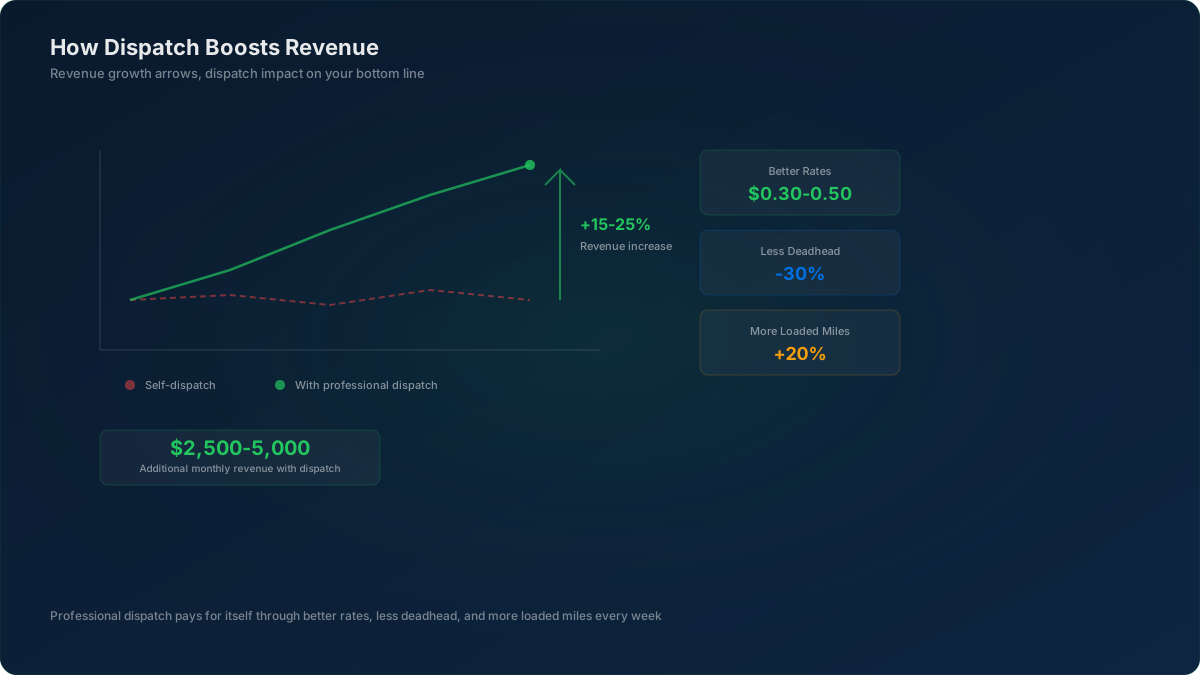
Let's start with the number that matters: professional dispatch increases owner-operator revenue by 10-30%. That's not a marketing claim — it's what carriers consistently report when they switch from self-dispatching to working with a professional dispatch service. The dispatch market is growing at 5.6% CAGR toward $1 billion by 2031, and it's growing for one reason: the ROI is real.
But "10-30% more revenue" is a range, not a guarantee. Where you land depends on how efficiently you're operating now. If you're already a strong negotiator who runs 88% loaded miles and collects detention pay religiously, you'll probably see 10-15% gains. If you're spending 3 hours a day on load boards and running 20% deadhead, you could see 25-30%. Let's break down exactly where those gains come from.
| Revenue Lever | Self-Dispatch (Typical) | Pro Dispatch (Typical) | Annual Impact |
|---|---|---|---|
| Rate Per Mile | $2.20-$2.40 | $2.40-$2.75 | +$12,000-$24,000 |
| Loaded Mile % | 80-85% | 88-92% | +$8,000-$16,000 |
| Detention Pay Collected | $500-$1,500/yr | $3,000-$8,000/yr | +$2,500-$6,500 |
| Time Savings | 15-25 hrs/wk on admin | 2-4 hrs/wk on admin | +$6,000-$15,000* |
| Total Gross Impact | — | — | +$18,000-$54,000 |
*Time savings converted to revenue at additional driving hours x loaded-mile rate
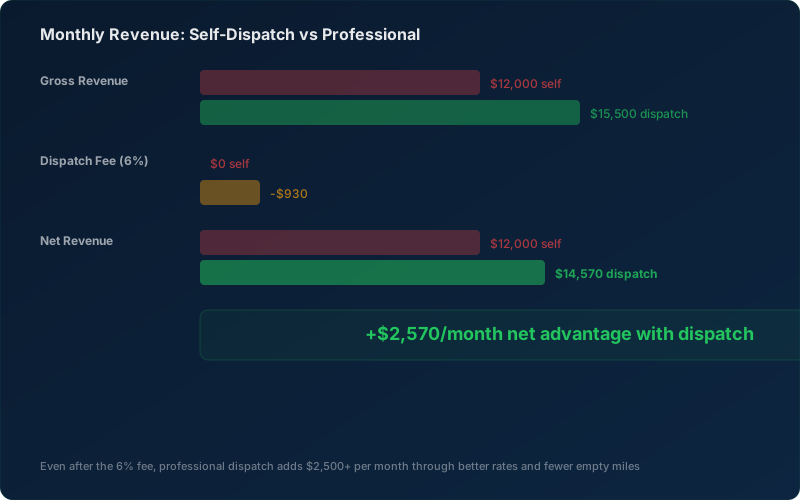
Now let's subtract the cost of dispatch. At 6% of gross revenue on a $198,000-$234,000 annual gross (the $180K base plus gains), that's $11,880-$14,040 per year. Net gain after dispatch fees: $6,120-$39,960 per year. That's the real ROI — and it's why the dispatch industry is growing while carrier counts are shrinking.
Revenue Lever #1: Rate Negotiation (Where Most of the Money Is)
Rate negotiation is the single biggest source of dispatch ROI. A professional dispatcher negotiates 8-15% higher rates than what the average owner-operator accepts on a load board. Here's why:
Data-Driven Pricing
A dispatcher who handles 10-20 trucks sees rate data across hundreds of loads per week. They know what lanes are paying, what brokers are willing to go above posted rates, and when the market is shifting. Individual carriers see their own loads and load board postings — which are the floor, not the ceiling. Rate intelligence from DAT Trendlines and FreightWaves shows that negotiated rates consistently outperform posted rates by $0.15-$0.35/mile.
Broker Margin Knowledge
Brokers typically mark up shipper rates by 12-22%. That means there's margin to negotiate. A dispatcher who knows the typical broker spread on a given lane can push rates $200-$500 higher per load without the broker losing money. Brokers are more willing to negotiate with dispatchers they work with regularly because the relationship produces consistent volume — they'll take a smaller margin on one load to keep getting loads booked reliably.
Timing and Urgency
Experienced dispatchers know when to push and when to book. A load that's been posted for 4 hours has different pricing dynamics than one posted 30 minutes ago. Loads that need to move today — especially after 2 PM — have the most negotiation room because the broker is running out of time. A dispatcher monitoring these patterns can capture $200-$600 more per load simply by understanding urgency pricing and timing their calls accordingly.
Volume Leverage
A single owner-operator booking 12-15 loads/month has minimal leverage with any individual broker. A dispatch service booking 100-200 loads/month can negotiate preferred rates, priority access to premium freight, and better payment terms. That leverage translates directly into higher per-load revenue for every carrier in the dispatch network. It's the same reason buying clubs get better prices than individual shoppers.
Let's run the math. If a dispatcher negotiates an average of $0.20/mile more across 120,000 loaded miles per year, that's $24,000 in additional gross revenue. At a 6% dispatch fee on total gross of $204,000 ($180K base + $24K gain), the fee is $12,240. Net gain from rate negotiation alone: $11,760. And that's before we count the other revenue levers.
Want to see what better rates mean for your specific operation? Run your numbers through our Rate Per Mile Calculator or our Dispatch ROI Calculator.
Revenue Lever #2: Deadhead Reduction (The Silent Revenue Killer)
Empty miles are the most expensive miles you run. You burn fuel, accumulate wear, use HOS hours, and earn exactly zero. The average self-dispatched owner-operator runs 15-20% empty miles. Professional dispatch typically cuts that to 8-12%. That gap is worth more than most carriers realize.
| Metric | 18% Deadhead | 10% Deadhead | Difference |
|---|---|---|---|
| Total Miles/Month | 10,000 | 10,000 | — |
| Loaded Miles | 8,200 | 9,000 | +800 miles |
| Revenue at $2.41/mi | $19,762 | $21,690 | +$1,928/mo |
| Annual Impact | $237,144 | $260,280 | +$23,136/yr |
How does a dispatcher cut deadhead? Three core strategies:
Pre-Planning Return Loads
A professional dispatcher starts booking your return load before you deliver your current one. They know where you'll be, when you'll be available, and what's moving in that market. By the time you drop your current load, your next pickup is already confirmed — often within 20-50 miles of your delivery point. Self-dispatching carriers typically don't start looking until they've delivered, which means they're searching from a static position while the best loads are already being booked.
Triangular Routing
Instead of running A→B and then deadheading back to A, a skilled dispatcher creates A→B→C→A routing where each leg is a paying load. This is especially powerful in regions with complementary freight flows — for example, hauling produce out of Florida, then picking up auto parts from Georgia to the Midwest, then grabbing a Midwest-to-Southeast load. Individual carriers rarely think in triangles; dispatchers do it all day, every day.
Market Knowledge and Seasonal Awareness
A dispatcher who understands seasonal freight patterns positions your truck to avoid deadhead traps. They know that delivering to south Florida in January means cheap or empty return loads — so they route you to central Florida instead, where citrus and produce freight provides paying backhauls. This kind of market awareness takes years to develop and is nearly impossible for individual carriers to maintain while also driving.
See what deadhead is costing you right now with our Deadhead Miles Calculator.
The Full Math Breakdown: $180K to $234K
Let's walk through a realistic scenario for a typical owner-operator running a single Class 8 sleeper, currently self-dispatching and grossing $180,000 per year. Here's what happens when they switch to professional dispatch:
| Category | Before Dispatch | With Dispatch | Change |
|---|---|---|---|
| Annual Miles | 120,000 | 120,000 | Same |
| Loaded Mile % | 82% | 90% | +8% |
| Loaded Miles | 98,400 | 108,000 | +9,600 miles |
| Average Rate/Mile | $1.83 | $2.00 | +$0.17 |
| Gross Load Revenue | $180,072 | $216,000 | +$35,928 |
| Detention Pay Collected | $1,200 | $5,500 | +$4,300 |
| Additional Driving Revenue* | — | $12,000 | +$12,000 |
| Total Gross Revenue | $181,272 | $233,500 | +$52,228 |
| Dispatch Fee (6%) | $0 | -$14,010 | -$14,010 |
| Net Revenue After Dispatch | $181,272 | $219,490 | +$38,218 |
*Time previously spent self-dispatching (10-15 hrs/wk) converted to additional driving hours at loaded-mile rates
That's a $38,218 annual net gain after paying the dispatch fee. The dispatch service cost $14,010 and generated $52,228 in additional gross revenue. That's a 3.7x return on the dispatch investment. Even in a conservative scenario where gains are half of the above, the net benefit is still $19,000+ per year.
The reason more carriers aren't using dispatch comes down to two things: they don't know the math, and they worry about giving up control. Let's address the control concern directly.
Addressing the Objection: "Why Pay 5-8% When I Can Self-Dispatch?"
This is the most common objection, and it's completely understandable. You started your own trucking business for independence. Paying someone to do something you can do yourself feels like a tax on your freedom. Let's address it honestly.
"Free" Self-Dispatch Costs $60-$200 Per Day
The 2-4 hours per day you spend on load boards, calling brokers, comparing rates, and handling paperwork is not free — it has an opportunity cost. If you're an owner-operator earning $30-$50/hour driving, those 2-4 hours represent $60-$200 in lost driving revenue every day. Over a month, that's $1,200-$4,000. Over a year, $14,400-$48,000. A dispatcher charging 6% of $200,000 gross costs $12,000/year and gives you those 600-1,000 hours back to drive, rest, or run your business. The "savings" of self-dispatch are an illusion when you account for opportunity cost.
You Don't Lose Control — You Gain Time
With a reputable dispatch service, you always have final say on which loads to accept. You set your preferred lanes, home time, minimum rates, and no-go zones. The dispatcher presents options; you decide. Your MC authority, your truck, your business. The difference is that instead of spending 3 hours finding those options yourself, someone who does it professionally presents them to you in a 5-minute call. You're not giving up control — you're delegating the search while keeping the decision. For a deeper comparison, read our dispatch vs self-dispatch breakdown.
Individual Carriers Have an Information Disadvantage
A broker negotiating with a single owner-operator knows they're dealing with someone who sees one side of one market. A broker negotiating with a dispatcher who moves 100+ loads per week knows they're dealing with someone who has rate data across dozens of lanes, relationships with competing brokers, and the leverage to walk away. Information asymmetry is how brokers maintain their 12-22% margins. Professional dispatch reduces that asymmetry in your favor.
Dispatch Quality Matters Most in Tight Markets
With 88,000+ carrier authorities revoked and rates recovering, the gap between well-dispatched and poorly-dispatched trucks is widening. In a loose market, the difference between a mediocre and great load might be $0.10/mile. In a tightening market — where the best lanes are commanding $3.00-$4.50/mile — the difference between having dispatch relationships with the right brokers and scrolling through a load board can be $0.30-$0.50/mile or more. The tighter the market gets, the more valuable professional dispatch becomes. Read our full analysis in The Capacity Squeeze.
The Revenue Streams You're Probably Leaving on the Table
Beyond rate negotiation and deadhead reduction, professional dispatch captures revenue that most self-dispatching carriers simply don't pursue. These are not minor line items — they add up to thousands per year.
Detention Pay Collection
The average owner-operator loses $3,000-$8,000 per year in uncollected detention pay. Shippers hold you past the 2-hour free time window, you grumble about it, and nothing happens. A dispatcher negotiates detention terms on the rate confirmation before your truck arrives — typically $50-$75/hour after 2 hours. They document arrival times and follow up with brokers to ensure payment. On 8-12 detention events per year at $150-$300 each, that's $1,200-$3,600 in recovered revenue just from enforcing what was already agreed to.
Layover and TONU Fees
When a load cancels after you've already positioned your truck, you deserve a Truck Order Not Used (TONU) fee — typically $250-$500. When weather, shipper delays, or appointment changes force an overnight stay, layover pay of $200-$350 should be negotiated. Most self-dispatching carriers accept these losses silently. A dispatcher negotiates TONU and layover terms upfront and enforces them consistently. Over a year, this recovers $1,000-$3,000 in revenue that would otherwise disappear.
Load Selection Discipline
One of the hardest things in self-dispatch is saying no to a bad load when you're sitting empty. Urgency bias pushes you to take the first available load even when the rate is below your target. A dispatcher removes that emotional pressure — they're not sitting in a truck stop; they're at a desk with multiple options across multiple load boards. They can wait for the right load while you rest, knowing that a $0.20/mile better load is worth an extra 2-hour wait. That discipline across 150-180 loads per year is worth $3,000-$6,000.
Administrative Time Savings
Beyond load searching, dispatchers handle rate confirmations, broker communication, load tracking updates, appointment scheduling, and paperwork coordination. That's 6-10 hours per week of administrative work removed from your plate. For an owner-operator earning $30-$50/hour driving, that's $180-$500/week in recovered productive time — time you can spend driving (earning revenue), maintaining your truck (reducing breakdown risk), or resting (improving safety and HOS compliance). The ATA identifies administrative burden as a top-5 cause of driver turnover.
When you add detention pay, TONU/layover fees, load selection discipline, and administrative time savings to the rate negotiation and deadhead reduction we covered above, the total revenue impact ranges from $18,000 to $54,000 annually. After subtracting the 5-8% dispatch fee, the net gain is consistently positive for the vast majority of carriers.
Curious how the fee structures compare? Our dispatch fees explained guide covers every pricing model and what to watch for.
The Bottom Line
Professional dispatch is not a luxury — it's a revenue multiplier. The 5-8% fee is not a cost; it's an investment that returns 3-5x in additional gross revenue. The math works because dispatchers bring rate intelligence, broker relationships, deadhead elimination strategies, and administrative capacity that individual carriers simply cannot replicate while also driving a truck.
A typical owner-operator grossing $180,000 self-dispatching can expect to gross $198,000-$234,000 with professional dispatch — a net gain of $8,000-$40,000 after fees. The carriers who understand this are investing in dispatch during the tightest capacity market in years, positioning themselves to capture the rate recovery that's already underway.
The carriers who don't are spending 2-4 hours per day on load boards, accepting whatever rate the load board shows, running 15-20% empty miles, and leaving $3,000-$8,000 per year in detention pay uncollected. Both approaches require the same truck, the same fuel, and the same driver. Only one generates 10-30% more revenue.
If you want to see what professional dispatch can do for your specific operation, talk to our team. No contracts, no setup fees. We'll run your lanes, look at your current rates, and show you exactly where the revenue gains are before you commit to anything. Want to run the numbers yourself first? Use our Dispatch ROI Calculator or compare dispatch structures in our percentage vs flat-rate dispatch guide.
Related Resources
- Dispatch vs Self-Dispatch — Side-by-side comparison of time, cost, and revenue impact
- Truck Dispatch Fees Explained — Every pricing model and what to watch for
- Rate Negotiation Tips — How to get better rates from brokers
- Reduce Empty Miles Strategies — Actionable deadhead reduction tactics
- The Capacity Squeeze — Why 88K carriers left and what it means for rates
- Dispatch ROI Calculator — Run the numbers for your specific operation
Truck Dispatch Experts
Published Mar 21, 2026