Where We Actually Are: Four Years Into the Freight Recession
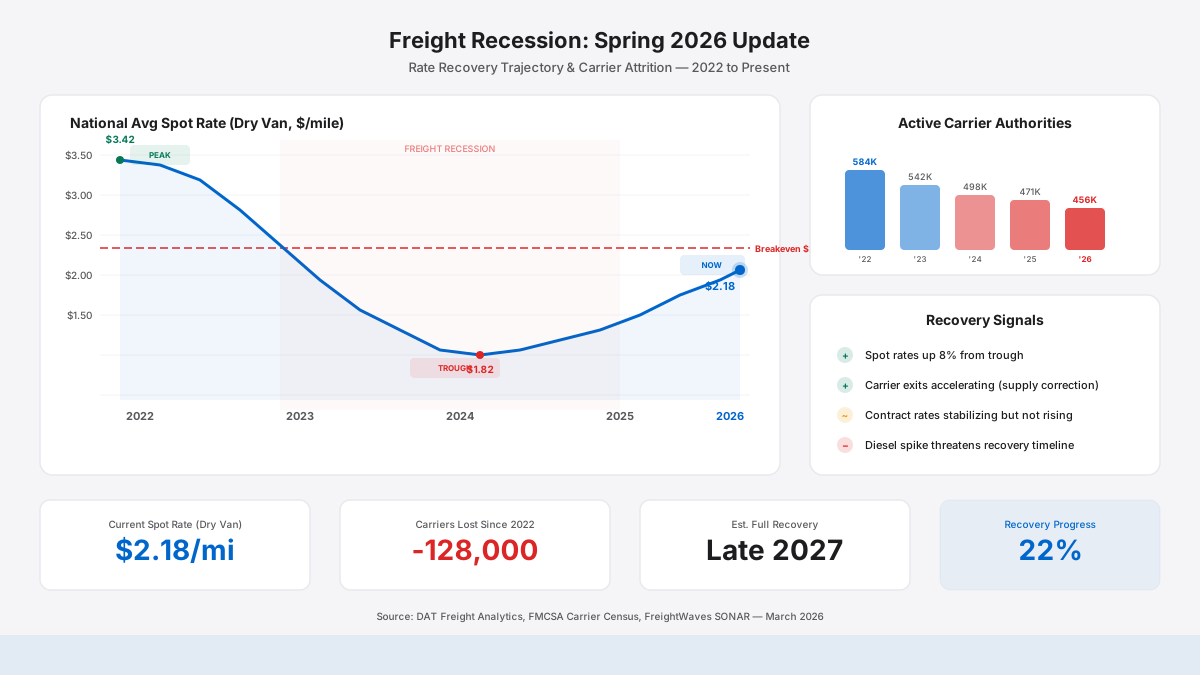
The freight recession started in mid-2022 when the post-pandemic freight boom collapsed. Spot rates cratered. Capacity stayed elevated because tens of thousands of new carriers had entered the market chasing $4.00+/mile dry van loads that no longer existed. The result: nearly four years of excess capacity grinding rates below operating costs for most of the industry.
Now, in spring 2026, we're seeing the first genuine recovery signals — not hopeful projections, but actual data points. National spot rates are up 8-12% from their 2024 lows. Carrier attrition is accelerating, pulling excess capacity out of the market faster than at any point since the recession began. Regional markets in the Southeast and Texas are experiencing real tightness for the first time in three years.
But here's the reality check: spot rates are still below the average operating cost of $2.26/mile for dry van carriers. The recovery is happening, but it hasn't arrived yet for everyone. Where you run, what equipment you pull, and how you're positioned strategically will determine whether you're profitable in Q2 2026 or still bleeding cash.
For the full picture on what drove us here, read our deep dive into the carrier exodus that's reshaping the industry. Below, we're focused on the current state of play — rates, regions, and what to do right now.
Rate Data by Equipment Type: March 2026
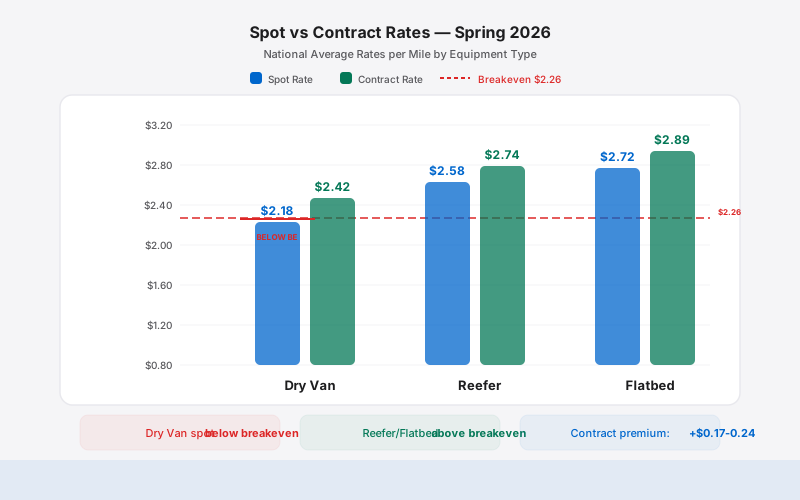
The single most important thing to understand about the current market is that the recovery is not uniform across equipment types. Reefer and flatbed have pulled ahead of dry van by a meaningful margin — and the gap is widening. Here are the national averages as of March 2026, sourced from DAT Trendlines and FreightWaves SONAR:
| Equipment | Spot Rate ($/mi) | Contract Rate ($/mi) | Spot vs Breakeven | YoY Change (Spot) |
|---|---|---|---|---|
| Dry Van | $2.18 | $2.42 | -$0.08 | +11.2% |
| Reefer | $2.58 | $2.74 | +$0.32 | +14.7% |
| Flatbed | $2.72 | $2.89 | +$0.46 | +9.3% |
| Step Deck | $2.85 | $3.05 | +$0.59 | +8.1% |
Breakeven benchmark: $2.26/mile (ATRI 2026 operational cost average). Spot rates include fuel. Contract rates exclude fuel surcharge. Sources: DAT Trendlines, FreightWaves SONAR, ATRI.
The critical number in that table is the "Spot vs Breakeven" column. Dry van spot is still running $0.08/mile below the average operating cost of $2.26/mile. That means the average dry van carrier running primarily spot freight is losing money on every mile — which is exactly why dry van carriers are exiting faster than any other segment.
Reefer, flatbed, and step deck have all crossed back above breakeven on the spot market. This matters enormously: it means specialized carriers can survive and even profit on spot freight today, while dry van carriers need contract freight to stay in the black. Use our Rate Per Mile Calculator to see where your operation stands against these benchmarks.
Context matters: these are national averages. Lane-specific rates vary wildly. Atlanta to Miami reefer is running $3.20-$3.80/mile right now. LA to Phoenix dry van is $1.65/mile. The national average tells you the trend. Your lane selection tells you your actual revenue. Run your numbers through our Profit Per Load Calculator before committing to any lane.
Carrier Attrition: The Engine of Recovery
Freight recessions don't end because demand suddenly spikes. They end because supply contracts — carriers exit, trucks get parked, and the remaining capacity can finally command rates above operating cost. That's the mechanism at work right now, and the pace is accelerating.
FMCSA authority data tells the story: over 20,000 carrier authorities were revoked or voluntarily surrendered in 2025, and the pace picked up in Q1 2026 with monthly net losses averaging 7,300 — roughly double the pre-pandemic baseline of 3,500/month. Active for-hire authorities have dropped from a peak of approximately 640,000 in mid-2023 to roughly 550,000 by March 2026.
Most of the exits are exactly who you'd expect: small operations with 1-5 trucks who entered during the 2021-2022 gold rush. They bought trucks at inflated prices (used sleeper cabs that were selling for $80,000-$120,000 in 2021 are worth $35,000-$50,000 now), signed leases they can't service at current rates, and are now either voluntarily surrendering authority or having it revoked when their insurance lapses.
For a comprehensive breakdown of the closure wave and what's driving it, see our carrier exodus analysis.
Why Carrier Exits Matter for Your Rates
Every carrier that exits removes trucks from the road permanently. Unlike parked trucks (which can return when rates improve), a revoked authority means that capacity is gone for good — the driver has moved on, the truck has been sold or repossessed, and the insurance policy has been cancelled.
Historical data shows that rates follow capacity exits with a 6-12 month lag. The carriers closing today are the ones that were suppressing your rates last quarter. The cumulative effect of 90,000+ authority losses since mid-2022 is just beginning to show up in rate data — and it will accelerate through 2026.
The Class 8 tractor population is also contracting independently. According to ACT Research, net build rates in 2025 ran approximately 15% below replacement levels. Trucks are being retired and scrapped faster than new ones are entering service. Even if every surviving carrier keeps running, the total fleet is getting smaller — which tightens the market further.
Regional Hotspots: Where the Recovery Is Showing Up First
The freight recovery is not arriving everywhere at once. Some regions are already experiencing genuine tightness while others remain oversupplied. If you have the flexibility to reposition, this information is worth real money.
| Region | Key Markets | Status | Avg Dry Van Spot | Trend |
|---|---|---|---|---|
| Southeast | Atlanta, Savannah, Charlotte | Tightening | $2.35-$2.55 | Strongest recovery |
| Texas / South Central | Dallas, Houston, Laredo | Improving | $2.25-$2.50 | NAFTA freight supporting |
| Northeast | NJ/NY, Philly, Baltimore | Mixed | $2.15-$2.35 | Port volume up, capacity balanced |
| West Coast | LA, Long Beach, Seattle | Mixed | $2.00-$2.30 | Drayage strong, long-haul soft |
| Midwest | Chicago, Indianapolis, Columbus | Soft | $1.95-$2.15 | Slowest recovery, excess capacity |
| Mountain West | Denver, Salt Lake City, Phoenix | Pockets of tightness | $2.10-$2.40 | Low carrier base amplifies swings |
The Southeast story: Atlanta and Savannah are where the recovery is most visible. The Port of Savannah has seen container volume grow 9% year-over-year, driven by importers diversifying away from West Coast ports. Simultaneously, the ongoing migration of distribution centers to Georgia, Tennessee, and the Carolinas is creating consistent outbound freight demand. Carrier attrition in the region has been above the national average (14% net reduction in active authorities since January 2025), creating a real supply-demand imbalance.
Texas corridors: Cross-border freight on the I-35 NAFTA corridor continues to support premium rates of $2.40-$3.00/mile depending on the lane. Dallas-Houston intermodal volume is strong. The Permian Basin oil patch is generating steady flatbed and hotshot demand, though at lower rates than the 2022 energy boom.
The Midwest lag: Chicago-area outbound dry van remains the weakest major market in the country, averaging $1.95-$2.10/mile. The Midwest has an oversupply problem: it historically hosts the highest concentration of carrier authorities per capita, and the attrition rate has been slower than other regions. If you're based in the Midwest, your best strategy is repositioning loads that get you into the Southeast or Texas, even at lower outbound rates.
The Diesel Wildcard: $4.60/Gallon Is a Double-Edged Sword
Diesel prices are the wild card nobody wants to talk about. At $4.60/gallon nationally (as of March 2026), fuel is adding approximately $0.08-$0.12/mile to operating costs compared to 2024 levels. For an owner-operator running 10,000 miles/month at 6.5 MPG, that translates to an extra $1,200-$1,850/month in fuel expense — money coming straight out of already-compressed margins.
For a deep breakdown of what $4.60 diesel means for your bottom line, see our diesel price impact analysis.
But here's the counterintuitive reality: high diesel is actually accelerating the rate recovery. Every carrier who parks a truck because they can't afford to fuel it is removing capacity from the market. Diesel at $4.60 is acting as a stress test — the weakest operators (those with the oldest, least fuel-efficient trucks, the worst lane selection, and the thinnest cash reserves) are being forced out faster than they would at $3.50/gallon diesel.
The fuel surcharge gap: On contract freight, fuel surcharges are supposed to offset diesel cost increases. In practice, most fuel surcharge schedules lag the actual price by 1-2 weeks and are calculated on a national average that may not reflect your regional reality. California diesel is running $5.15-$5.40/gallon — a full dollar above the national average — meaning West Coast carriers eating a surcharge calculated on the national $4.60 are losing $0.06-$0.09/mile on every contract load. On spot freight, there is no separate surcharge — the all-in rate is the rate, and it may or may not adequately reflect current diesel costs.
For carriers who can manage fuel costs aggressively — through fuel card discounts (typically $0.30-$0.50/gallon at truck stops), route optimization, idle reduction, and spec'ing fuel-efficient equipment — the net effect of high diesel is actually positive. You eat $0.08-$0.12/mile in extra cost, but you gain far more as competitors exit and rates rise. The math only works if you survive the transition period.
Contract vs Spot Strategy During the Recovery
The contract-vs-spot question has never been more important than right now — and the answer has changed compared to a year ago. In 2024, when spot rates were bottoming out, locking in contract freight at any rate above operating cost was the survival play. In spring 2026, with rates recovering, the calculus is more nuanced.
For a detailed comparison of both approaches, read our Spot Market vs Contract Freight guide. Here's the spring 2026 context:
Spring 2026 Contract vs Spot Framework
Lock In Contracts When:
- - You're running dry van (spot is still below breakeven)
- - You need consistent weekly revenue to service truck payments
- - Your operating region is the Midwest or West Coast (softest markets)
- - You're securing lanes you know well with reliable shippers
- - You're offered rates at $2.35+/mile for dry van
Lean Into Spot When:
- - You're running reefer (produce season will spike rates)
- - You operate in the Southeast or Texas (tightest markets)
- - You have strong cash reserves (60+ days of expenses)
- - Your dispatch team can consistently find premium loads
- - You can tolerate weekly revenue volatility
The timing trap: The biggest mistake carriers make during a recovery is locking in long-term contracts (12-18 months) at rates that reflect today's depressed market. If you sign a 12-month dry van contract at $2.42/mile in March 2026, and spot rates climb to $2.65-$2.80/mile by October 2026 (as most analysts project), you've left $0.23-$0.38/mile on the table for the remainder of your contract term. That's $23,000-$38,000 in lost revenue per truck on 100,000 annual miles.
The smarter play: short-term contracts (3-6 months) with re-negotiation clauses, or volume commitments rather than rate commitments. Secure 60-70% of your capacity on contract for stability, keep 30-40% flexible for spot, and re-bid your contract lanes quarterly as the market tightens.
Equipment Positioning: Specialized Carriers Are Recovering Faster
If the rate table above tells one story, it's this: equipment choice matters more in a tight market than it does in a loose one. During the 2021-2022 boom, everything paid well. In the recovery phase, the spread between equipment types is widening — and it's creating clear winners and losers.
Reefer is leading the recovery. At $2.58/mile spot and climbing, reefer carriers are already above breakeven and positioned to benefit from the produce season surge that starts in April. The Florida-to-Northeast produce corridor is already booking at $3.20-$3.80/mile for temperature-controlled loads. Reefer capacity has contracted faster than dry van because the equipment is more expensive to operate and maintain — the marginal reefer carrier gets squeezed out before the marginal dry van carrier. For details on seasonal freight patterns, check our produce season trucking guide.
Flatbed is steady. At $2.72/mile spot, flatbed has been above breakeven since late 2025. Construction and infrastructure spending (both federal and state-level) continues to support flatbed demand, though the market hasn't returned to the $3.50+/mile levels of 2022. Flatbed has a natural floor that dry van doesn't: the skill barrier (tarping, securement, heavy equipment) keeps casual entrants out, limiting the overcapacity problem.
Step deck and specialized are premium. Step deck at $2.85/mile spot reflects the combination of skill requirements, equipment cost, and limited capacity. If you have step deck or RGN capability, you're in the strongest position in the market right now.
Dry van is the laggard — but it's also the biggest opportunity. At $2.18/mile spot, dry van is still below breakeven, which is why dry van carriers are exiting at the fastest rate. But dry van represents roughly 60% of all truckload freight. When the capacity correction reaches critical mass (projected Q3-Q4 2026), dry van rates will snap back harder than specialized equipment precisely because the overcapacity was most severe. The carriers still running dry van when rates hit $2.50-$2.65/mile will benefit enormously — but surviving until then is the challenge.
What Smart Operators Are Doing Right Now
The carriers who will dominate the post-recession market are not the ones with the newest trucks or the most authority. They're the ones making disciplined decisions right now, in the hardest part of the cycle. Here's what separates the survivors from the casualties:
Building Broker Relationships
The carriers locking in reliable broker partnerships now — not transactional one-off loads, but genuine relationships with consistent volume — are the ones who will get first call when rates spike. Brokers remember who showed up when freight was hard. When capacity tightens and they need trucks urgently, they call their reliable carriers first and pay premium rates.
Securing Contract Freight Strategically
Not locking in 12-month contracts at bottom-of-market rates, but securing 3-6 month commitments on core lanes that keep trucks moving. The goal is coverage, not ceiling — enough contract freight to cover fixed costs, with spot capacity reserved for upside when the market turns.
Investing in Maintenance, Not Iron
This is not the time to buy a new truck. Used equipment prices have collapsed 30-40% from 2022 peaks, and they may fall further. Smart operators are investing in maintaining their current equipment — preventive maintenance, tire programs, fuel system efficiency — rather than taking on new debt in a soft market.
Avoiding Over-Leverage
The carriers who bought trucks at $100,000+ during the boom and financed at 8-10% interest rates are the ones closing now. Smart operators are keeping debt low, maintaining 60-90 days of cash reserves, and only adding equipment when they have confirmed freight commitments that justify the payment.
Dispatch quality is the differentiator. The spread between a well-dispatched carrier and a poorly-dispatched one is roughly $1,500-$2,200/week at current rates. That's the difference between running 85% loaded miles at $2.25/mile versus 76% loaded miles at $2.05/mile. In a market where the average margin is negative, dispatch quality is literally the difference between survival and closure. Our 2026 industry forecast covers why operational efficiency will matter more than ever as the market recovers.
Timeline Outlook: What to Expect for the Rest of 2026
Based on current trends, analyst projections from ACT Research, FTR Transportation Intelligence, and FreightWaves, here's what the rest of 2026 looks like:
| Period | Expected Rate Movement | Key Drivers | Risk Factors |
|---|---|---|---|
| Q2 2026 (Apr-Jun) | +5-8% from current | Produce season, carrier exits, spring freight surge | Diesel spike, economic slowdown |
| Q3 2026 (Jul-Sep) | +8-15% from current | Cumulative capacity exit, retail restocking, summer demand | Inventory correction, tariff impacts |
| Q4 2026 (Oct-Dec) | +12-20% from current | Peak season, tightest capacity since 2022, contract renewals | Recession concerns, weather disruptions |
Q2 2026: Produce season is the catalyst. The annual produce season (April through July) creates the single largest seasonal demand spike for reefer capacity in the US freight market. Florida produce starts shipping in volume by early April, moving north through Georgia, the Carolinas, and up the I-95 corridor. By May, the Pacific Northwest, California's Central Valley, and the Rio Grande Valley add volume. This seasonal demand layers on top of the structural capacity contraction — and the combination should produce the first genuinely tight market conditions since 2022. Read our produce season guide for lane-specific strategies.
Q3 2026: The consensus inflection point. Most analysts see Q3 2026 as when national dry van spot rates finally cross back above the $2.26/mile breakeven on a sustained basis. The math: continued carrier attrition (projected 3,000-5,000 additional authority losses in Q3) plus normal summer freight demand plus retail restocking ahead of peak season equals a market where remaining carriers can set rates, not take them.
Q4 2026: The payoff. If the capacity contraction holds (and there is no indication it won't), Q4 2026 could produce the tightest freight market since the pandemic-era boom. Peak season demand, holiday retail freight, and a carrier population that has shrunk by 15-20% from its peak — that combination historically produces rapid rate increases. The carriers still operating in Q4 2026 will have pricing power they haven't seen in four years.
For a broader view of where the industry is heading beyond 2026, see our 2026 Trucking Industry Forecast and Freight Rate Recovery Analysis.
The Bottom Line
The freight recession is not over. But it is ending. Spot rates are climbing. Carrier exits are accelerating. Regional markets are tightening. The question is no longer "will rates recover?" — it's "will you still be operating when they do?"
The data points toward meaningful improvement by Q3-Q4 2026, with reefer and flatbed carriers already benefiting and dry van carriers within striking distance of breakeven. The carriers who survive the next 6-9 months will inherit a market with 15-20% fewer competitors, stronger pricing power, and the best operating conditions since 2022.
Survival is not about optimism. It's about math: maximizing loaded miles, minimizing deadhead, locking in rates above operating cost, managing fuel expenses aggressively, and having dispatch quality that turns a $2.18/mile national average into $2.40-$2.60/mile on your actual lanes. That's what professional dispatch does — and it's why the best-run operations are not just surviving this downturn, they're positioning to dominate the recovery.
Related Reading
- The Great Carrier Exodus — How mass closures are reshaping freight in 2026
- Freight Rate Recovery Analysis — When rates will actually recover and why
- Spot Market vs Contract Freight — Choosing the right strategy for your operation
- Diesel Price Surge Impact — What $4.60 diesel means for your bottom line
- Produce Season Trucking Guide — Maximizing revenue during the seasonal surge
Truck Dispatch Experts
Published Mar 8, 2026