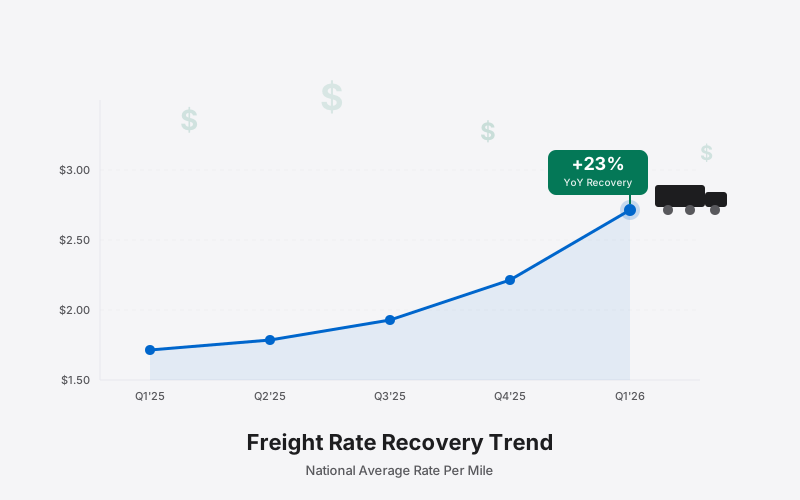
The Numbers: Spot Rates Hit $2.80/Mile
Let's start with what matters: the money. National average truckload spot rates surged to $2.80 per mile (all-in with fuel surcharge) in early 2026 — a 23% jump from Q4 2025 lows. That's not a typo. After nearly four years of watching rates bleed out, carriers are finally seeing numbers on load boards that look like they did in the good days.
The DAT Trendlines data tells the story clearly: the Outbound Tender Rejection Index (OTRI) pushed past 14% — the highest reading since mid-2022, before the freight recession crushed margins industry-wide. When tender rejections are at 14%, it means carriers are saying "no" to contracted freight at an increasing rate, because they can get paid better on the spot market. That's the textbook definition of a capacity-constrained market.
C.H. Robinson, the largest freight broker in North America, raised their dry van rate forecast from 4% to 6% year-over-year growth for 2026. When C.H. Robinson revises upward, it's because they're seeing it across hundreds of thousands of transactions daily. This isn't a prediction based on models — it's a reading of actual freight movement, actual tender behavior, and actual shipper budgets.
FreightWaves SONAR data confirms the trend: load-to-truck ratios on the van board have climbed above 5:1 on premium lanes, outbound tender volumes are up 8% year-over-year, and carrier capacity utilization is tightening across every equipment class. For our full market context, see our 2026 Trucking Industry Forecast.
The question isn't whether rates are up. They are. The question is: are you positioned to capture it, or are you leaving money on the table?
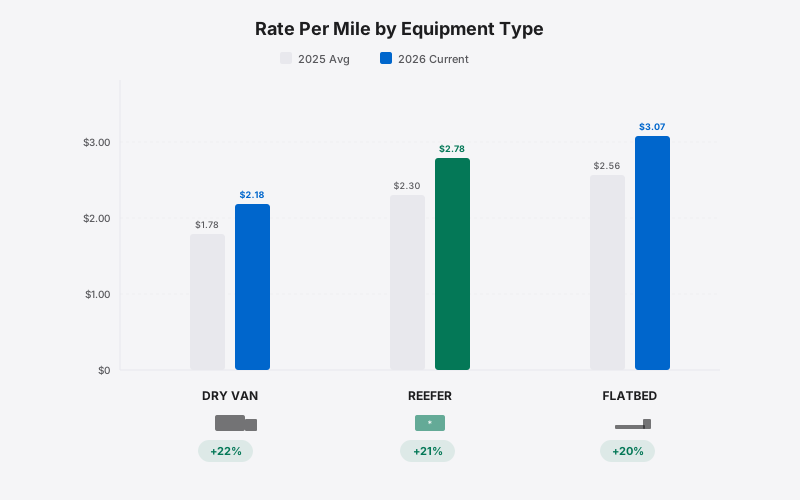
Rate Breakdown by Equipment Type
The rate recovery is not hitting every equipment class equally. Specialized freight is outpacing general dry van, and the gap is widening. Here's where rates stand by equipment type, compared to Q4 2025 and what the rest of 2026 looks like:
| Equipment Type | Q4 2025 Avg | Q1 2026 Avg | Full-Year Forecast | YoY Change |
|---|---|---|---|---|
| Dry Van (all-in) | $2.08/mi | $2.47/mi | $2.45-$2.65/mi | +18-23% |
| Reefer (linehaul) | $1.95/mi | $2.21/mi | $2.35-$2.60/mi | +13-18% |
| Flatbed (linehaul) | $1.82/mi | $2.07/mi | $2.20-$2.50/mi | +14-20% |
| Step Deck | $1.95/mi | $2.18/mi | $2.30-$2.60/mi | +12-18% |
| Power Only | $1.72/mi | $1.98/mi | $2.00-$2.25/mi | +15-20% |
| Hotshot | $1.55/mi | $1.78/mi | $1.80-$2.05/mi | +15-22% |
| Box Truck | $1.80/mi | $2.05/mi | $2.05-$2.30/mi | +14-19% |
Linehaul rates exclude fuel surcharge. All-in rates include fuel. National averages — regional rates vary significantly. Source: DAT Trendlines, FreightWaves SONAR, C.H. Robinson market data.
Dry van is leading this cycle: Unlike the 2021-2022 boom where reefer and flatbed outpaced dry van, this recovery is being led by general freight volume. Consumer spending remained resilient through the downturn, and the post-holiday restocking cycle hit harder than expected. Dry van spot rates at $2.47/mile all-in are still below the 2022 peak of $3.00+, but they're solidly above breakeven for most operators.
Reefer is heating up ahead of produce season: The $2.21/mile linehaul average is before the annual produce season surge. By April-May, expect reefer spot rates on Florida-to-Northeast and California outbound lanes to push $3.50-$4.50/mile. If you're running reefer, check our Seasonal Freight Calendar to time your positioning.
Flatbed and step deck benefit from infrastructure: The Bipartisan Infrastructure Law is pumping billions into road, bridge, and utility construction — all of which moves on flatbeds. The $2.07/mile average understates premium lanes, where oversized and permitted loads are paying $3.00-$4.00/mile in construction corridors across the Southeast and Texas.
Use our Rate Per Mile Calculator to benchmark your current rates against these numbers and see where you stand.
Spot vs Contract: Where to Focus Your Truck
In a rising market, the spot-vs-contract decision can mean the difference between a good year and a great one. Here's how the two markets are behaving right now:
+15-25%
Spot Rate Premium
Spot rates are running 15-25% above equivalent contract rates on most lanes. This premium widens during peak weeks.
14%+
Tender Rejection Rate
Carriers are rejecting contracted loads at the highest rate since 2022. Above 10% signals carrier pricing power.
Q2-Q3 2026
Contract Renegotiation Window
Most annual contracts renegotiate mid-year. Shippers will be forced to offer 5-10% increases to retain capacity.
60/40 to 70/30
Optimal Spot/Contract Split
Use contract freight as income floor for fixed costs. Chase spot loads above your target RPM for margin upside.
When to chase spot: Right now, spot rates are delivering significantly more revenue per mile than most contracts signed in 2024-2025. If your operating cost is $1.60-$1.80/mile, every spot load at $2.80/mile is putting $1.00+/mile in your pocket before dispatcher fees. That math is hard to argue with.
When to lock contracts: The smart move is not to go 100% spot. Spot markets can reverse in 2-3 weeks if demand softens. A base of contract freight at $2.20-$2.40/mile covers your truck payment, insurance, and fuel — so you're never running below breakeven even in a soft week. Then you layer spot loads on top during rate spikes for margin.
The dispatcher advantage: This is exactly where a professional dispatcher earns their fee. A good dispatcher doesn't just find you a load — they read the market in real time. They know when spot rates are peaking on a lane, when to lock a 30-day mini-contract at an elevated rate, and when to reposition your truck 200 miles to catch a rate spike that load boards haven't fully reflected yet. In a market moving this fast, the difference between self-dispatching and professional dispatch is often $0.30-$0.50/mile — which at 10,000 miles/month is $3,000-$5,000 in additional revenue. See our Dispatch ROI Calculator to run the numbers for your operation.
Why This Recovery Is Different: Structural, Not Cyclical
Every freight recovery has skeptics who say "this won't last." In most cycles, they're partially right — rates spike, new carriers flood in, capacity rebalances, and rates settle back down. That's the normal freight cycle. But 2026 is different, and here's why:
100,000+ Carrier Exits Are Not Coming Back
According to FMCSA data and FreightWaves analysis, over 100,000 carrier authorities were revoked or deactivated during the 2023-2024 freight recession. The vast majority were small operators — 1 to 5 trucks — who entered the market during the 2021 boom, financed equipment at inflated prices, and burned through cash reserves during 18+ months of sub-breakeven rates.
In previous cycles, these carriers would come back when rates recovered. Not this time. Insurance costs have risen 25-40% since 2022. New authority carriers face premiums of $15,000-$25,000/year — and many insurers won't even quote a new authority without 2+ years of CDL experience. Equipment financing rates are 8-12%, compared to 4-6% in 2021. And lenders now require 3-6 months of operating capital ($30,000-$60,000) as reserves.
The math is simple: to re-enter the market today, a single-truck operator needs $100,000-$150,000 between the truck, insurance, deposits, and reserves. The carriers who exited don't have it. Their equipment was repossessed or sold at auction. Their credit was damaged. The re-entry barrier is structural — and it's protecting the carriers who survived.
Insurance Is the Hidden Moat
If there's one factor that separates this recovery from previous cycles, it's insurance. Commercial trucking insurance has become the single biggest barrier to market entry. Nuclear verdicts (jury awards exceeding $10 million in trucking accident cases) have driven premiums through the roof. The average cost of liability insurance for a new-authority single truck went from $8,000-$12,000/year in 2019 to $15,000-$25,000/year in 2026.
Several major insurers have exited the trucking market entirely. Those that remain are cherry-picking: experienced operators with clean CSA scores and 2+ years of authority get the best rates. New entrants — especially those with less than 2 years of CDL experience — face either astronomical premiums or outright denial of coverage. You literally cannot operate a truck without insurance, making this an insurmountable barrier for many would-be re-entrants.
C.H. Robinson's Analysis Confirms It
C.H. Robinson's market intelligence team — which processes over $28 billion in freight annually — explicitly called this a "structural rebalancing" rather than a cyclical swing. Their Q1 2026 market update noted that carrier capacity is not just below 2022 levels, but that the barriers to re-entry are higher than at any point in the last 15 years.
The American Trucking Associations (ATA) Driver Shortage Report projects a shortfall of 80,000+ drivers by end of 2026, compounding the capacity issue. It's not just trucks that are missing — it's qualified drivers. Training pipeline throughput is down, and the average age of a long-haul driver continues to climb above 55.
Regional Rate Hotspots: Where the Money Is
National averages are useful, but you don't haul freight "nationally" — you haul it on specific lanes between specific markets. Here's where the highest-paying freight is concentrated in early 2026:
| Region / Lane | Equipment | Avg Rate (All-In) | Peak Season | Driver |
|---|---|---|---|---|
| FL/GA to Northeast | Reefer | $3.50-$4.50/mi | Jan-May | Produce season outbound |
| Laredo/El Paso Northbound | Dry Van/Reefer | $3.00-$4.00/mi | Year-round | Cross-border imports (USMCA) |
| SE Construction Corridors | Flatbed/Step Deck | $2.80-$3.40/mi | Mar-Nov | Infrastructure spending |
| CA Outbound (LA/LB) | Dry Van | $3.00-$3.50/mi | Feb-Jun | Port congestion + CARB rules |
| TX Permian Basin | Flatbed/Hotshot | $2.80-$3.60/mi | Year-round | Energy sector equipment |
| Midwest to SE/SW | Dry Van | $2.40-$2.80/mi | Q2-Q4 | Manufacturing + consumer goods |
| Central Valley CA Outbound | Reefer | $3.20-$4.00/mi | Mar-Oct | Agricultural produce |
| Pacific NW to Midwest | Reefer/Dry Van | $2.60-$3.20/mi | Jul-Oct | Fruit/timber season |
All-in rates include fuel surcharge. Rates represent averages on premium loads — individual load rates vary by day, shipper, and booking lead time. Source: DAT Trendlines, TDE internal data.
Southeast produce is the standout: Every year from January through May, Florida and Georgia produce generates the highest reefer rates on the East Coast. In 2026, the combination of tight reefer capacity (from downturn exits) and normal seasonal demand is pushing rates even higher than usual. If you're running reefer and not positioning for produce season, you're leaving the biggest money of the year on the table.
Texas cross-border is booming: USMCA trade volumes continue to grow, and Laredo remains the #1 land port for US-Mexico trade by value. Northbound import freight from Laredo pays premium rates because of customs delays, border congestion, and limited local carrier capacity. The catch is the backhaul — southbound rates to Laredo are typically 40-50% lower, so you need a dispatcher who can chain loads to minimize the deadhead hit.
The deadhead trap warning: Some of these high-paying markets (Florida inbound, Laredo, rural construction sites) are deadhead traps — they pay well going in, but there's limited outbound freight. A $4.00/mile load into South Florida sounds great until you realize you're deadheading 300 miles to Orlando or Jacksonville for your next load. Always calculate the round-trip economics, not just the one-way rate. Our state-by-state freight guides cover regional lane dynamics in detail.
Intermodal Split: Why Trucking Wins in 2026
Here's a number that doesn't get enough attention: intermodal spot rates averaged $1.39 per mile in early 2026 — down 5% year-over-year. While truckload rates are surging 23%, intermodal is actually getting cheaper. That creates a split market with important implications for both carriers and shippers.
$1.39/mi
Intermodal Spot Rate
Down 5% YoY. Rail capacity is abundant, but service quality issues persist.
$2.80/mi
Truckload Spot Rate
Up 23% YoY. Tight capacity and rising demand driving sustained increases.
2.01x
TL/IM Ratio
Trucking costs 2x intermodal. But speed, reliability, and flexibility justify the premium.
Why shippers aren't switching to intermodal en masse: On paper, intermodal at $1.39/mile should be stealing truckload freight hand over fist. But three factors keep shippers on trucks. First, rail transit times are 2-3 days longer than truck on equivalent lanes — for time-sensitive freight (retail restocking, just-in-time manufacturing, perishables), that delay costs more than the rate savings. Second, drayage capacity at intermodal ramps is itself tight, creating reliability issues at the first and last mile. Third, chassis availability remains inconsistent at major ramps, causing dwell time that erases the cost advantage.
What this means for trucking carriers: The intermodal-truckload split is widening, but it's not a threat to your rates. For lanes under 1,000 miles, trucking's speed advantage is overwhelming — no shipper is putting a 600-mile load on rail when a truck delivers it next day. For lanes over 1,500 miles, some cost-sensitive shippers will shift volume to intermodal, but the freight they keep on trucks is the high-value, time-sensitive stuff that commands premium rates.
The opportunity: If you're running lanes where intermodal competes (Chicago-LA, Atlanta-Dallas, major port corridors), focus on service differentiation — on-time delivery, driver communication, load tracking, and flexibility for appointment changes. Shippers who use trucks on intermodal-competitive lanes are paying for reliability, not just transportation. Deliver reliability and they'll keep paying the premium.
How to Maximize Revenue in a Rising Market
A rising market lifts all boats — but some boats rise a lot faster. The difference between an owner-operator grossing $180,000 and one grossing $240,000 in 2026 isn't the truck, the equipment type, or even the region. It's strategy. Here are five approaches that separate the top earners:
Set a Rate Floor and Never Break It
Know your cost per mile — insurance, fuel, truck payment, maintenance, tires, permits, and your target income. For most owner-operators, the all-in breakeven is $1.50-$1.80/mile. Set your rate floor at breakeven + 20% minimum margin ($1.80-$2.15/mile) and never accept a load below it. In a rising market, the temptation to 'just take something to avoid deadhead' disappears when you have discipline. Dead miles at $0/mile are bad, but a $1.50/mile load that ties up your truck for 6 hours when $2.80 loads are available is worse. Use our rate calculator to dial in your exact floor.
Specialize in 3-5 Lanes, Not 50
The carriers making the most money don't run everywhere — they run the same 3-5 high-paying lanes repeatedly. Lane specialization means you know the shippers, you know the receivers, you know the timing of load availability, and you know the backhaul options. A dry van operator who runs Charlotte-to-Atlanta and Atlanta-to-Charlotte 20 times a month knows exactly when rates spike, which brokers pay fast, and where to fuel. That knowledge compounds into thousands of dollars in additional revenue versus a generalist who takes random loads nationwide.
Leverage a Dispatcher for Rate Capture
This is not a sales pitch — it's market math. In a fast-moving recovery, rates can change $0.30-$0.50/mile between Monday and Thursday on the same lane. A professional dispatcher monitors rate movements across multiple load boards, broker relationships, and shipper tender boards in real time. They know when DAT spot rates on your lane jumped $0.40 overnight, and they negotiate accordingly. Self-dispatching on a phone while you're driving means you're checking load boards at rest stops and accepting whatever's posted. In a flat market, the gap is small. In a recovery, the gap is $3,000-$5,000/month.
Match Your Equipment to the Hottest Freight
If you're running a reefer unit, don't waste produce season hauling dry freight as a dry van. If you have a flatbed, Q2-Q4 infrastructure freight is your money season — don't get locked into a low-rate annual contract for commodity steel when construction site deliveries are paying 30% more. Equipment matching also means knowing when to reposition: if reefer rates are $4.00/mile out of Florida and dry van rates are $2.20/mile out of Ohio, driving 600 miles empty to Florida for the reefer load might net more than 3 Ohio dry van loads. Run the round-trip math every time.
Position Ahead of Seasonal Surges
The highest rates go to carriers who are already in the right market when demand spikes — not the ones who scramble to get there after rates peak. Produce season (April-October), holiday shipping (September-December), construction season (March-November), and hurricane season (June-November) are all predictable. If you know Florida produce pays $4.00+/mile in March, position your truck in South Florida by late February. If construction flatbed rates spike in Texas every April, be in Dallas or Houston by March 25. Our Seasonal Freight Calendar breaks down every major freight surge by month and region.
Is This the End of the Freight Recession?
The freight recession that began in mid-2022 was the longest sustained downturn in modern trucking. Nearly four years of declining spot rates, compressed margins, and carrier exits. So the natural question is: are we finally out of it?
The bullish case (and it's strong): Every major recovery indicator is flashing green. Spot rates up 23%. Tender rejections at 14%. Load-to-truck ratios climbing. Carrier capacity contracted by 100,000+ authorities. C.H. Robinson and major brokers revising forecasts upward. Consumer spending holding steady. Infrastructure spending accelerating. These are not ambiguous signals — they're the textbook preconditions for a sustained rate recovery.
The cautious case (and you should listen): Rate recoveries don't move in a straight line. There will be weeks in 2026 where spot rates dip 5-10% from peaks — that's normal seasonal and weekly volatility, not a reversal. The risk factors that could stall the recovery are real:
Economic recession kills freight demand
High ImpactIf consumer spending contracts significantly, freight volumes drop regardless of capacity tightening. A GDP contraction of 1%+ would likely pause the recovery for 6-12 months. Current indicators don't suggest this, but it's the biggest tail risk.
Rapid carrier re-entry floods capacity
Low ImpactThis is what killed the 2021 boom. But as detailed above, re-entry barriers (insurance, financing, capital requirements) are dramatically higher than in 2021. The rate of new MC applications in early 2026 is 40% below the 2021 pace. Unlikely to be a problem this cycle.
Oil price shock from geopolitical event
Medium ImpactA major disruption pushing diesel above $5.50/gallon would erode margins even as gross rates increase. The net effect would be neutral-to-negative for carrier profitability despite higher top-line rates.
Intermodal capacity surge steals volume
Low-Medium ImpactRail carriers could aggressively price intermodal to capture share. Possible on long-haul lanes (1,500+ miles), but unlikely to impact the sub-1,000-mile truckload market where most owner-operators operate.
Our assessment: Yes, the freight recession is ending. The recovery is real, it's structural, and it has legs. We expect spot rates to remain elevated through 2026, with Q2-Q3 being the strongest period as seasonal demand (produce, construction, pre-holiday inventory building) stacks on top of the base recovery. Contract rates will follow with a lag, with meaningful increases showing up in Q2-Q3 renegotiations.
But "recovery" doesn't mean "2021 all over again." We're not going back to $4.00/mile national average dry van rates. This is a normalization — rates returning to sustainable, profitable levels after four years of pain. For carriers who survived the downturn, kept their equipment maintained, and kept their authority active, 2026 is the year it pays off.
The carriers who thrive won't be the ones who got lucky — they'll be the ones who have a plan. Rate discipline. Lane strategy. Cost control. Professional dispatch. If you're ready to capture this recovery instead of watching from the sidelines, talk to our team about how we position trucks for maximum revenue in a rising market.
Related Resources
- Trucking Industry Forecast 2026 — Full market forecast: freight volume, capacity, diesel, and equipment outlooks
- Seasonal Freight Calendar — When and where rates peak throughout the year
- Rate Per Mile Calculator — Benchmark your rates against 2026 market averages
- Dispatch ROI Calculator — See what professional dispatch is worth for your operation
- Driver Shortage Crisis 2026 — The capacity crunch driving rate recovery
- Spot vs Contract Freight — Which strategy wins in a recovering market
- Tariff Ruling Impact — How cross-border trade changes affect rates
Truck Dispatch Experts
Published Mar 4, 2026