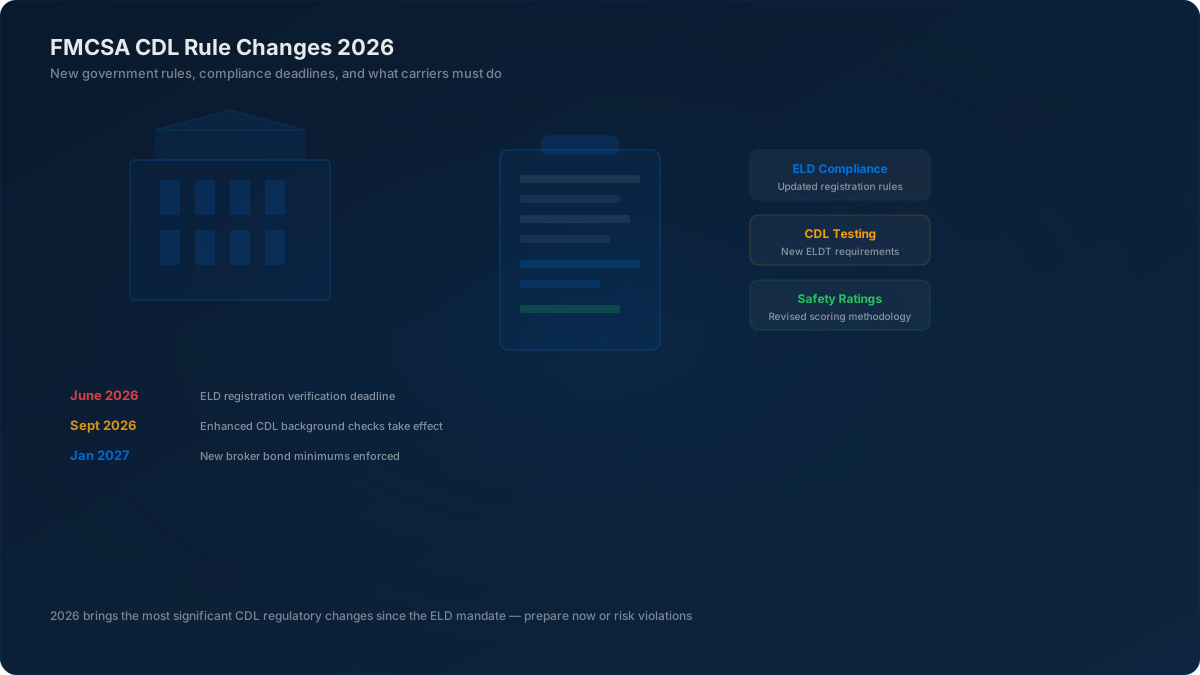
The Non-Domiciled CDL Rule: 200,000 Drivers Affected
On March 16, 2026, one of the most significant CDL regulatory changes in decades went into effect. The FMCSA non-domiciled CDL final rule fundamentally changed who is eligible to hold a commercial driver's license without being permanently domiciled in a US state.
Under the new rule, only three visa categories remain eligible for non-domiciled CDLs: H-2A (temporary agricultural workers), H-2B (temporary non-agricultural workers), and E-2 (treaty investor visa holders). Everyone else — and that's a lot of drivers — needs to either establish domicile in a US state or face losing their CDL.
The numbers are staggering. FMCSA estimates that approximately 200,000 CDL holders currently operate under non-domiciled status. Of those, 97% — roughly 194,000 drivers — do not hold H-2A, H-2B, or E-2 visas. That means they will not meet the new requirements as the rule is written.
Let that sink in. In an industry already facing a driver shortage that the American Trucking Associations (ATA) estimates at 60,000-80,000 drivers, a rule change that potentially affects 194,000 CDL holders is seismic. Combined with the 88,000 trucking authorities revoked in 2023 and the 5,000-8,000 carriers that exited the market in 2025, the available driver pool is shrinking from multiple directions.
For the broader regulatory picture, see our earlier FMCSA Rules 2026 overview. This article focuses on the March developments — the non-domiciled rule going live and the CDL training crackdown escalating.
Who's Affected: Breaking Down the Numbers
The non-domiciled CDL rule doesn't affect all drivers equally. Here's who it hits, who it doesn't, and what the transition looks like:
| Category | Estimated Drivers | Status Under New Rule | Required Action |
|---|---|---|---|
| H-2A Visa Holders | ~2,000 | Eligible | None — continue operating |
| H-2B Visa Holders | ~3,000 | Eligible | None — continue operating |
| E-2 Visa Holders | ~1,000 | Eligible | None — continue operating |
| Other Visa Types (non-domiciled) | ~194,000 | Not Eligible | Establish state domicile or obtain eligible visa |
| US Citizens (domiciled) | N/A | Not Affected | None — standard CDL rules apply |
| Green Card Holders (domiciled) | N/A | Not Affected | None — standard CDL rules apply |
Estimates based on FMCSA rulemaking data and Federal Register notice. Actual numbers may vary as enforcement and compliance data becomes available.
Not all 194,000 will leave the road. Some will successfully establish domicile in a US state — a process that involves obtaining a state-issued ID, establishing a physical address, and applying for a CDL transfer. Others may adjust their visa status. But the process takes time, and the rule is effective now. During the transition period, expect confusion at the carrier level as companies audit their driver rosters and determine compliance status.
Large carriers will feel it first. Fleet operators with significant numbers of non-domiciled drivers — common in agricultural hauling, cross-border freight, and seasonal operations — face immediate workforce planning challenges. Some are already scrambling to help affected drivers establish domicile. Others are preparing for driver shortfalls and looking to fill gaps with owner-operators and independent contractors.
For owner-operators already in compliance, this is bullish. Fewer available drivers means more freight per truck. The load-to-truck ratio was already at 7.73 in March before the rule took effect. Every driver who exits the market tightens capacity further. If you hold a valid, state-issued CDL and have a clean record, you're in the strongest negotiating position you've had in years.
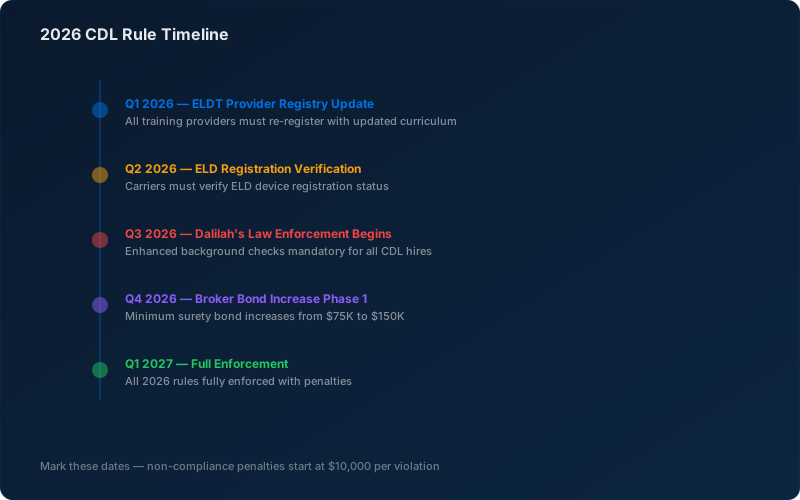
Dalilah's Law: The CDL Mill Crackdown Escalates
Two days after the non-domiciled CDL rule went live, another major CDL development hit: Dalilah's Law passed the House Transportation and Infrastructure Committee with a bipartisan 35-26 vote on March 18, 2026.
The bill is named after Dalilah Ramos, who was killed in a crash involving a driver who obtained their CDL from a fraudulent training provider — a so-called "CDL mill." CDL mills are training schools that issue CDL certifications without providing adequate behind-the-wheel training. Some operate entirely on paper — drivers pay for a certification and receive it without ever sitting in a truck. Others provide minimal training far below the required hours, then falsify records to show compliance.
FMCSA has not waited for the legislation. The agency has already been conducting aggressive audits of the Training Provider Registry (TPR), and the results are alarming:
~3,000
CDL Training Providers Removed
Audited and removed from the Training Provider Registry for falsifying data
35-26
Committee Vote
Bipartisan margin in the House T&I Committee on March 18, 2026
200K+
Drivers Potentially Affected
CDL holders who may have trained at now-removed providers
Nearly 3,000 CDL training providers removed. That number is worth repeating. FMCSA has audited and pulled the registration of approximately 3,000 CDL training schools for falsifying data — fabricating student records, inflating completion rates, issuing certifications to drivers who never completed required training hours. The scope of the fraud is enormous, and it raises serious questions about how many active CDL holders on the road today were trained at these schools.
What Dalilah's Law would add: The bill gives FMCSA stronger enforcement tools — higher penalties for fraudulent providers, criminal referral authority, stricter verification requirements for training completion, and mandatory third-party auditing of training providers. It also creates a public database of removed providers so carriers and drivers can verify training legitimacy before hiring.
The safety angle is real. This isn't just paperwork. A driver who "graduated" from a CDL mill without real training is a danger on the road. They don't know how to handle a jackknife situation, they haven't practiced mountain driving, and they may not understand hours-of-service rules. For owner-operators, sharing the road with inadequately trained drivers is a safety risk. For carriers hiring drivers, it's an insurance and liability nightmare. If you're hiring, verify every driver's training provider on the FMCSA Training Provider Registry.
Market Impact: How CDL Changes Affect Rates and Capacity
Every regulatory change that reduces the number of available drivers tightens capacity. And in 2026, the CDL changes are hitting a market that's already squeezed. The convergence of multiple factors is creating one of the tightest capacity environments since 2021:
| Capacity Factor | Drivers/Carriers Affected | Timeline | Rate Impact |
|---|---|---|---|
| Non-Domiciled CDL Rule | Up to 194,000 drivers | Effective March 16, 2026 | Moderate-High: tightens driver pool |
| CDL Mill Crackdown | ~3,000 providers removed | Ongoing (accelerating) | Moderate: reduces new CDL entrants |
| Authority Revocations (2023) | 88,000 authorities | Completed — permanent exits | High: structural capacity reduction |
| Carrier Exits (2025) | 5,000-8,000 carriers | Completed — barriers to re-entry | Moderate: continued attrition |
| Insurance Barriers | New entrants blocked | Ongoing — premiums at $0.102/mi | High: prevents capacity replacement |
| ATA Driver Shortage Estimate | 60,000-80,000 shortfall | Ongoing — structural | High: baseline deficit |
Sources: FMCSA, ATA, FreightWaves. Insurance data from ATRI 2024 operational costs report. Authority data from FMCSA SAFER system.
The cumulative effect is what matters. No single factor would reshape the market alone. But when you stack non-domiciled CDL exits on top of 88,000 authority revocations, on top of insurance barriers that block new entrants, on top of a CDL training pipeline that just got 3,000 providers shorter — you get a capacity environment that cannot self-correct quickly. New carriers can't enter fast enough to replace what's leaving.
Spot rates reflect this. The spot van rate at $2.41/mile and a load-to-truck ratio of 7.73 are not just cyclical recovery numbers. They reflect a market where structural capacity has been permanently removed. Even if demand softens, there are fewer trucks available to carry it. That puts a floor under rates that didn't exist during the 2023-2024 recession.
The insurance connection: Insurance premiums hitting a record $0.102 per mile in 2024, with median nuclear verdicts at approximately $51 million, means the cost of putting a truck on the road keeps climbing. The federal minimum insurance requirement of $750,000 hasn't changed since 1985 — but the actual cost to get insured has never been higher. For our full breakdown, see Trucking Insurance Rates 2026 and Nuclear Verdicts in Trucking.
What Owner-Operators Should Do Now
Whether the CDL changes affect you directly or indirectly, the regulatory environment is creating both risks and opportunities. Here's your action plan:
If You Hold a Non-Domiciled CDL
Check your visa status immediately. If you hold an H-2A, H-2B, or E-2 visa, you are eligible to continue operating — but verify your documentation is current. If you hold any other visa type, you need to establish domicile in a US state before enforcement escalates. The domicile process involves obtaining a state-issued ID, establishing a physical address (not a PO Box), and applying for a CDL transfer to your new state. Start this process now. Processing times vary by state — some take 2-3 weeks, others take 2-3 months. Don't wait until you get pulled over to find out you're non-compliant.
If You're Hiring Drivers
Two verification steps are now essential. First, verify CDL domicile status — non-domiciled CDLs that don't meet the new visa requirements are no longer valid. Hiring a driver with an invalid CDL creates massive liability exposure. Second, check every prospective driver's training provider against the FMCSA Training Provider Registry. If their school is among the ~3,000 removed for falsifying data, that's a red flag for the quality of their training — and for your insurance coverage if they're involved in an incident.
If You're a Compliant Owner-Operator
Capitalize on the tightening market. Every driver who exits due to CDL compliance issues is one less competitor for loads. The capacity squeeze is real and it's not resolving quickly — with 3,000 training providers removed, the pipeline for new CDL holders is narrower than it's been in years. This is the time to push for higher rates, be selective about lanes, and invest in your operation. Make sure your own compliance paperwork is airtight — DOT compliance checklist, medical certificate current, ELD properly registered. In a crackdown environment, any compliance gap becomes a bigger risk.
Get Rate-Negotiation Help
A market with a load-to-truck ratio of 7.73 and tender rejections at 18% in the Midwest is a market where rate negotiation matters enormously. The difference between taking the first load you see on DAT and having a dispatcher who knows which shippers are desperate for capacity can be $0.30-$0.50/mile — that's $3,000-$5,000/month at 10,000 miles. Our team monitors capacity shifts caused by regulatory changes in real time and routes our carriers to the lanes where driver shortages are most acute. Talk to us about how the CDL changes are creating premium rate opportunities. Also see our Rate Negotiation Tips for proven strategies.
The Bigger Picture: Regulatory Tightening Is the New Normal
The non-domiciled CDL rule and Dalilah's Law are not isolated events. They're part of a broader regulatory tightening trend that has been accelerating since 2023. FMCSA is under intense political pressure — from both parties — to improve trucking safety. The agency is responding with enforcement that touches every corner of the industry.
Consider the full regulatory landscape in 2026: the non-domiciled CDL rule removes drivers. The CDL mill crackdown reduces new entrants. Authority revocations continue for carriers with safety violations. Insurance requirements, while unchanged since 1985 at $750K, are being pushed toward an increase that would further raise barriers to entry. The nuclear verdict crisis — with median verdicts around $51 million — makes insurers less willing to underwrite new or small carriers at any price.
For compliant, experienced owner-operators, this is actually the best operating environment in years. The barriers to entry are higher, the competition is thinner, the rates are recovering, and the demand for reliable capacity is strong. But it only works if you stay on the right side of compliance — because FMCSA is looking more closely than ever.
Stay current with regulatory changes through our FMCSA Rules 2026 resource, and make sure your operation meets every requirement on our New Authority Checklist. For the full market picture, read our 2026 Trucking Industry Forecast and Driver Shortage Crisis analysis.
Related Resources
- FMCSA Rules 2026 — Full regulatory landscape for the year ahead
- Driver Shortage Crisis 2026 — How capacity reduction is reshaping the market
- Carrier Exodus Reshaping Freight — 88,000 authorities revoked and what it means
- Trucking Insurance Rates 2026 — Insurance barriers blocking new market entrants
- DOT Compliance Checklist — Make sure your operation is fully compliant
- CDL Training Complete Guide — How to verify training quality and choose the right program
Truck Dispatch Experts
Published Mar 21, 2026