11 min read

Electric Trucks for Owner-Operators: What You Need to Know in 2026

Tesla Semi, Freightliner eCascadia, Volvo VNR Electric — are they ready for independent owner-operators? Here's the honest answer with real numbers.

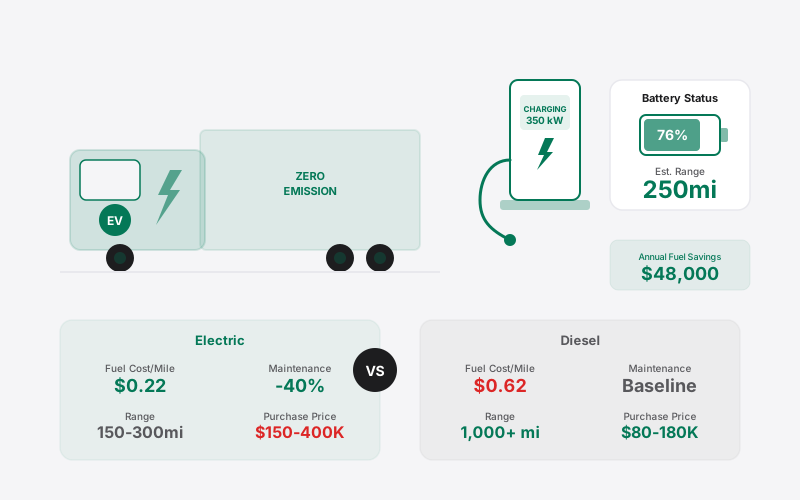
Electric truck comparison showing Tesla Semi, Freightliner eCascadia, and Volvo VNR Electric specifications
EV trucks are in production but range and price limit owner-operator viability in 2026

The Electric Truck Landscape in 2026

Electric trucks have gone from concept to production. There are real trucks, on real roads, moving real freight. But the gap between what you read in press releases and what matters for an independent owner-operator is enormous. Let's cut through the marketing and look at what actually exists, what it costs, and whether it makes financial sense for you right now.

Available Models: Head-to-Head

ModelPriceRangeCharge TimeStatus
Tesla Semi$250-280K420-480 mi30-45 minProduction
eCascadia$200-240K190-310 mi60-90 minProduction
Volvo VNR-E$180-220K220-260 mi60-90 minProduction
Kenworth T680E$200-250K150-200 mi60-90 minLimited
Peterbilt 579EV$200-250K150-200 mi60-90 minLimited

Range figures are real-world at 80% load. Charge times are 20% to 80% SoC. Prices are MSRP before incentives.

TCO: Electric vs Diesel — Real Numbers

Total cost of ownership is where the EV pitch sounds best. Here is the math for two scenarios:

Scenario A: Regional (150 mi/day, depot charging) — Over 5 years at 150,000 mi/year: EV fuel cost ~$0.14/mi ($105,000 total) vs diesel ~$0.65/mi ($487,500 total). EV maintenance ~$0.08/mi ($60,000) vs diesel ~$0.18/mi ($135,000). That is $457,500 in operating savings. Against a $100K purchase premium, the EV pays for itself in year 2. This is the bull case, and it is real — if you have the right route and depot charging.

Scenario B: Long-haul (500 mi/day, public charging) — Public DC fast charging at truck stops costs $0.35-$0.50/kWh, translating to $0.28-$0.40/mile. The fuel savings over diesel shrink to $0.25-$0.37/mile. Add 60-90 minutes of daily charging downtime (reduced revenue), limited route flexibility, and range anxiety in winter (cold weather reduces range 15-25%), and the TCO advantage evaporates. For long-haul, diesel wins in 2026. Use our Fuel Cost Calculator to model your specific route.

EV Makes Sense If

  • Daily route under 200 miles round-trip
  • Access to depot charging at <$0.15/kWh
  • Dedicated regional contract freight
  • Can secure $40K+ in incentives
  • Operating in CA, OR, WA (state programs)

Stick With Diesel If

  • Running OTR or long-haul
  • No access to depot charging
  • Running varied/spot market routes
  • Budget under $200K for equipment
  • Need maximum route flexibility

The Bottom Line for Owner-Operators

Electric trucks are real, they work, and for the right operation, they save money. But "the right operation" in 2026 is narrow: short-to-medium regional routes, depot charging, and access to purchase incentives. For the 80%+ of owner-operators running OTR, varied routes, or spot market freight, diesel remains the practical choice.

Do not let FOMO drive a $250,000 equipment decision. Watch the market, track charging infrastructure development in your region, and revisit the math in 2028-2029 when second-generation EVs arrive with better range and competitive pricing. In the meantime, focus on what actually drives your bottom line today: good rates, low deadhead, and smart dispatch. Talk to our dispatch team about maximizing revenue with whatever equipment you run.

Related Resources

TDE

Truck Dispatch Experts

Published Mar 6, 2026

Frequently Asked Questions

Can owner-operators buy an electric truck in 2026?

Yes, but options are limited and expensive. The Tesla Semi is available for order with deliveries primarily going to fleet customers (PepsiCo, Walmart, Sysco). Freightliner eCascadia and Volvo VNR Electric are in production with roughly 3,000 units deployed across North America, but most are leased to large fleets. An owner-operator can order any of these, but the purchase price ($180,000-$280,000 vs $130,000-$170,000 for diesel) and the 12-18 month wait list make it impractical for most independents in 2026. Used electric trucks are essentially nonexistent since the first production units are still under fleet leases.

How far can an electric truck go on one charge?

Real-world range depends on load weight, terrain, temperature, and speed. The Tesla Semi claims 500 miles at 82,000 lbs GVW, with verified independent testing showing 420-480 miles under typical conditions. The Freightliner eCascadia offers 230 miles (standard battery) or 350 miles (extended range) with real-world performance of 190-310 miles depending on load. Volvo VNR Electric provides 275 miles rated range with 220-260 real-world. For context, the average long-haul truck covers 500-600 miles per day. Only the Tesla Semi approaches that range, and even then, it requires a 30-45 minute Megacharger stop during the day. For regional routes under 200 miles round-trip with overnight charging, current EVs work well. For long-haul, they are not practical yet.

Is the total cost of ownership lower for electric trucks?

It depends on your routes and utilization. At current prices, the TCO math works in favor of EVs for high-mileage regional routes with depot charging. Fuel savings are significant: electricity costs roughly $0.12-$0.18/mile vs $0.55-$0.75/mile for diesel. Maintenance is 40-60% lower (no oil changes, no DPF regen, fewer brake replacements due to regenerative braking). However, the higher purchase price ($50,000-$110,000 premium), battery degradation risk, and limited resale market offset these savings. For an owner-operator running 150,000 miles/year on regional routes with access to depot charging at $0.10/kWh, the TCO breaks even around year 4-5. For long-haul operators relying on public charging at $0.35-$0.50/kWh, the TCO never breaks even with current pricing.

Where can you charge an electric truck?

Public charging infrastructure for Class 8 trucks is still sparse. Tesla Megacharger stations number roughly 50 locations along major corridors (I-5, I-10, I-95, I-80) as of early 2026. The national network of truck-compatible DC fast chargers (350kW+) includes about 200 locations, primarily at truck stops operated by Pilot/Flying J and TravelCenters of America through the NEVI (National Electric Vehicle Infrastructure) federal program. However, charging a Class 8 truck from 20% to 80% takes 30-60 minutes on a Megacharger or 60-90 minutes on a 350kW charger — and there are often queues. The most practical approach is depot charging: installing a Level 2 or DC fast charger at your home base where the truck charges overnight. This costs $5,000-$30,000 for equipment and installation, but provides the cheapest per-kWh rates and eliminates charging downtime during the workday.

Will diesel trucks be banned?

No federal ban exists or is proposed. California's Advanced Clean Fleets rule requires manufacturers to sell an increasing percentage of zero-emission trucks starting in 2024, reaching 100% for certain categories by 2036. However, this applies to new truck sales, not existing vehicles — you can continue operating a diesel truck in California. Several other states (Oregon, Washington, New York, New Jersey, Massachusetts) have adopted or are considering similar rules. For owner-operators running nationwide, diesel trucks purchased in 2026 will be legal to operate for their full useful life (15-20 years). The practical concern is not bans but resale value: if diesel phase-outs accelerate, trucks purchased today may depreciate faster in the 2030s. That is speculative though, and the used truck market shows no pricing impact yet.

Should I wait for electric trucks or buy diesel now?

For most owner-operators in 2026, diesel is still the right choice. The math is straightforward: a used Freightliner Cascadia or Kenworth T680 costs $60,000-$90,000 and can run any route in America. An electric equivalent costs $180,000+, limits you to regional routes, and locks you into uncertain charging infrastructure. The exception is if you run a dedicated regional route under 200 miles round-trip, have access to depot charging, and can secure one of the federal or state incentives that reduce the purchase premium by $40,000-$80,000 (IRA Section 45W credit, CARB HVIP vouchers, state programs). In that narrow scenario, EV TCO can work. For everyone else: buy the right diesel truck for your operation now, and watch the EV market develop. By 2028-2029, expect more competitive pricing, better range, and significantly more charging infrastructure.

Maximize Revenue — Whatever You Drive

Diesel, electric, or hybrid — our dispatchers find the highest-paying freight for your equipment and routes. Get started with no contracts and no setup fees.

(682) 978-8641Get Started