What's Driving the Diesel Surge
Three forces hit the diesel market at the same time, and the result is the fastest price spike since the post-invasion surge of early 2022. Understanding what's behind it matters because it tells you how long this lasts and how bad it could get.
The Middle East is the biggest driver. Escalating conflict near the Strait of Hormuz — the narrow waterway between Iran and Oman that handles roughly 20% of the world's oil supply — has forced tankers to reroute around the Cape of Good Hope. That adds 10-14 days to every voyage from the Persian Gulf to U.S. and European refineries. It does not just slow delivery; it effectively removes millions of barrels from the market at any given moment because they are sitting on ships taking the long way around Africa. Crude oil prices have jumped $12-$18/barrel since January on Hormuz disruption fears alone, and every $10 increase in crude translates to roughly $0.25/gallon at the diesel pump. We break down the full geopolitical picture in our Middle East crisis trucking impact analysis.
The Northeast winter is pulling from the same barrel. Diesel and heating oil are both distillate fuels — they come from the same refining process. When temperatures in the Northeast dropped to their lowest sustained levels in over a decade, heating oil demand surged. PADD 1 (East Coast) distillate inventories fell to their lowest since 2015. Every barrel that goes to heat a home in Connecticut is a barrel that does not end up at a truck stop in New Jersey. This seasonal pull typically eases by mid-April, but while it lasts, it creates a supply squeeze that hits truck diesel prices hardest in the Northeast and Midwest.
Refinery capacity is the structural problem underneath everything else. The U.S. lost approximately 1.1 million barrels per day of refining capacity between 2019 and 2023 as facilities closed during COVID and never reopened. Those barrels have not been replaced. When demand spikes — from a cold winter, a geopolitical crisis, or both at once — refineries that are already running at 92-94% utilization simply cannot ramp up enough to meet it. This is not a temporary problem. Until new refining capacity comes online (and none is under construction at scale), the diesel market will remain structurally tight and vulnerable to exactly this kind of price spike. The EIA's weekly diesel fuel update is the best source for tracking where prices go from here.
Regional Diesel Price Breakdown
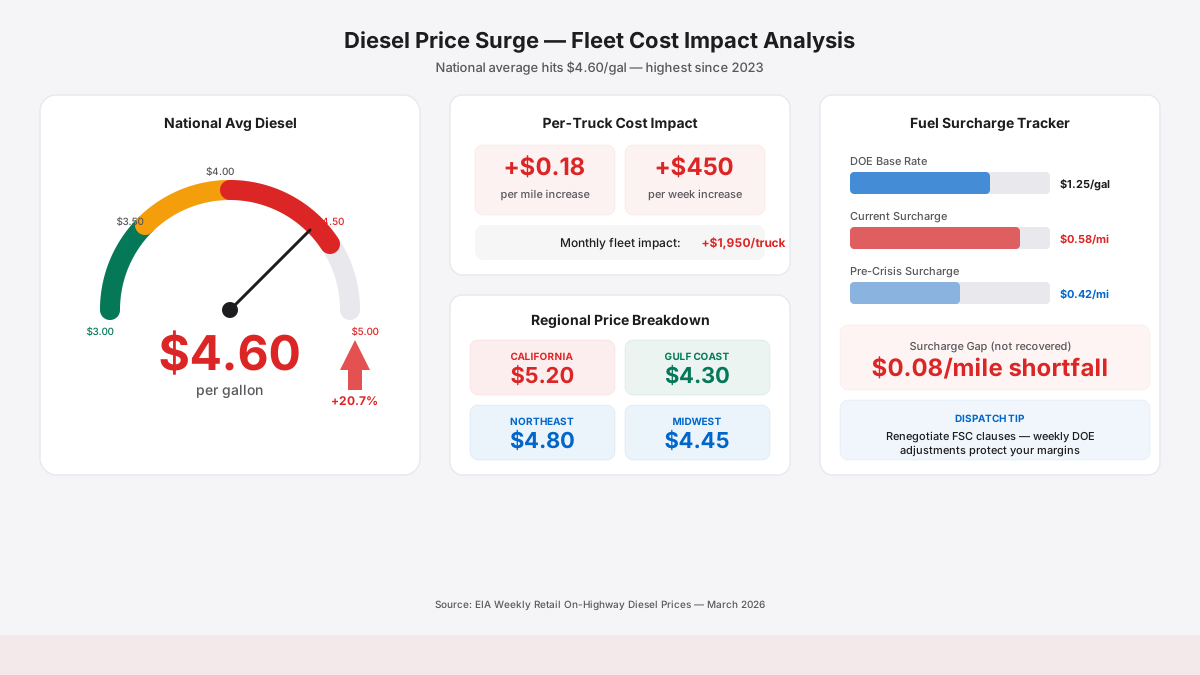
Diesel prices are not uniform across the country, and the regional differences matter for route planning and fuel strategy. The West Coast and Northeast are getting hit hardest, while the Gulf Coast — closer to refinery output — is seeing a smaller premium. Here's where prices stand as of the first week of March 2026 compared to where they were in late December 2025:
| Region | Dec 2025 Avg | Mar 2026 Avg | Increase | % Change |
|---|---|---|---|---|
| West Coast (PADD 5) | $4.12 | $5.18 | +$1.06 | +25.7% |
| East Coast (PADD 1) | $3.68 | $4.79 | +$1.11 | +30.2% |
| Midwest (PADD 2) | $3.41 | $4.52 | +$1.11 | +32.6% |
| Gulf Coast (PADD 3) | $3.28 | $4.21 | +$0.93 | +28.4% |
| Rocky Mountain (PADD 4) | $3.54 | $4.63 | +$1.09 | +30.8% |
| National Average | $3.50 | $4.60 | +$1.10 | +31.4% |
Prices reflect EIA PADD-level averages for retail on-highway diesel. Actual pump prices vary by location, brand, and card discounts. Source: U.S. Energy Information Administration.
California is the worst place to fuel right now. Between the state's $0.68/gallon diesel tax (the highest in the nation), cap-and-trade program costs, and CARB low carbon fuel standard fees, California diesel is running $5.10-$5.40 at many truck stops. If you run West Coast lanes, fueling in Oregon, Nevada, or Arizona before entering California can save you $0.40-$0.70/gallon — that is $24-$42 on a single 60-gallon fill.
The Gulf Coast is your cheapest option. Proximity to refineries in Texas and Louisiana keeps PADD 3 prices $0.30-$0.60 below the national average even during spikes. If you run North-South lanes through Texas, fill your tanks before heading north. Carriers running I-45 (Houston to Dallas), I-35 (San Antonio to Oklahoma City), and I-10 (Houston to Jacksonville) have a structural fuel cost advantage right now.
The Midwest spike is unusually harsh. PADD 2 prices jumped 32.6% — the biggest percentage increase of any region. The culprit is the double hit of heating oil demand pulling distillate out of the market and pipeline logistics from the Gulf Coast not keeping pace with the demand surge. FreightWaves reported that several Midwest terminals had diesel allocation restrictions in late February — meaning truck stops were limiting how much fuel they would sell per customer. That has eased but the prices have not come down yet.
The Real Cost: How $4.60 Diesel Hits Your Bottom Line
Let's put real numbers on this. Fuel is typically 30-40% of an owner-operator's total operating cost, so when diesel jumps 22%, your entire cost structure shifts. Here's what it looks like for a typical O/O running 2,500 miles per week:
| Metric | At $3.50/gal | At $4.60/gal | Difference |
|---|---|---|---|
| Weekly Fuel Cost (6.5 MPG) | $1,346 | $1,769 | +$423/week |
| Monthly Fuel Cost | $5,385 | $7,077 | +$1,692/month |
| Annual Fuel Cost | $69,992 | $91,908 | +$21,916/year |
| Fuel Cost Per Mile | $0.538 | $0.708 | +$0.170/mile |
| Total CPM (all costs) | $1.65 | $1.82 | +$0.170/mile |
| Breakeven Rate (per mile) | $1.85 | $2.02 | +$0.170/mile |
Assumes 2,500 miles/week, 6.5 MPG, 10% profit margin on all-in CPM. Your numbers will vary — run yours with our Cost Per Mile Calculator.
The breakeven rate shift is what kills you. When your total cost per mile jumps from $1.65 to $1.82, every load under $2.02/mile (assuming a 10% margin) is now either unprofitable or barely breaking even. Loads that were acceptable at $2.00/mile in January are money-losers at current fuel prices. If you are still booking loads based on December's math, you are losing money on every single trip and may not even realize it until the end of the month when the bank account tells the truth.
The weekly impact is a truck payment. An extra $423/week in fuel cost is $1,692/month — more than most truck payments, more than insurance, and roughly equal to what many O/Os set aside for maintenance and repairs. That money has to come from somewhere. Either your rates go up, your expenses go down elsewhere, or your take-home pay absorbs the hit. There is no fourth option. Run your actual numbers through our Fuel Cost Calculator and our Cost Per Mile Calculator to see exactly where you stand right now — not where you stood last month.
Fuel Surcharge Reality: Are You Actually Covered?
The fuel surcharge is supposed to protect you from exactly this scenario. In theory, when diesel goes up, your FSC goes up to match and your net revenue stays stable. In practice, most owner-operators are losing money right now because their fuel surcharge is not keeping pace with the actual price increase. Here is why.
The base rate problem. Most FSC programs calculate the surcharge as the difference between the current EIA diesel price and a "base rate" set in the contract. If your contract base is $2.50/gallon, you get FSC credit for the spread from $2.50 to $4.60, which works out to roughly $0.32/mile at 6.0 MPG (the assumed standard). That sounds like it covers you. But here is the catch: the $0.32/mile FSC is calculated at the standard 6.0 MPG, while most trucks actually run 5.5-6.5 MPG. If your truck is on the lower end, you are burning more fuel per mile than the formula compensates for. And many contracts have not been updated since diesel was under $3.00 — the FSC increments may use $0.04/gallon steps that were fine for small price moves but under-compensate during rapid spikes.
The EIA lag problem. FSC calculations use the EIA's weekly national average diesel price, published every Monday for the prior week. During a rapid surge, this average trails the actual pump price by $0.10-$0.20. On 385 gallons per week, that lag costs you $38-$77 every single week — money you spend at the pump that your surcharge does not reimburse.
The broker retention problem. This is the one nobody talks about openly. Many brokers retain a portion of the fuel surcharge as margin instead of passing 100% through to the carrier. Industry estimates suggest brokers keep 20-40% of the shipper-paid FSC on average. If a shipper pays $0.55/mile in fuel surcharge and the broker passes $0.35/mile to you, that $0.20/mile gap represents $500/week on a 2,500-mile schedule. During a diesel spike, that retained FSC becomes a much bigger absolute number — and a much bigger problem for you.
What to do about it: Ask every broker for the shipper's FSC schedule. Push for FSC to be broken out as a separate line item on rate confirmations so you can verify the math. If you are on contract rates, request an FSC base rate adjustment to reflect current market conditions. And if you are consistently seeing FSC that does not cover your actual fuel cost increase, it is time to either renegotiate or find loads that pay better all-in rates. DAT Trendlines publishes average fuel surcharges by lane — use it as a benchmark for what you should be getting.
10 Immediate Actions to Cut Fuel Costs
You cannot control the price of diesel. You can control how much of it you burn and how much you pay for it. These 10 actions are not theoretical — they are things you can do this week that will save real money at $4.60/gallon. Combined, they can reduce your effective fuel cost by 15-25%.
Drop Your Cruise Speed to 62-65 MPH
Aerodynamic drag increases exponentially with speed. Dropping from 70 MPH to 63 MPH improves fuel economy by 10-15% — that is 38-58 fewer gallons per week. At $4.60/gallon, you save $177-$265/week just by easing off the throttle. Yes, it adds 2-3 hours of drive time per week. But $177 for 3 hours is $59/hour — better than most loads pay. This is the single highest-impact change you can make immediately.
Check Tire Pressure Every Morning
Every 10 PSI of under-inflation costs approximately 1% in fuel economy across your 18 wheels. Cold weather deflates tires faster — a tire loses about 1 PSI for every 10-degree Fahrenheit drop in temperature. If you have not checked since November, you could be running 15-20 PSI low on multiple tires. That is a 2-3% fuel economy penalty — $35-$53/week at current prices — for something that takes 15 minutes with a pressure gauge.
Cut Idle Time to Under 15% of Engine Hours
Idling burns 0.8-1.0 gallons per hour. At $4.60/gallon, every hour of idling costs $3.68-$4.60. If you idle 6-8 hours per day during winter (for heat, APU not installed), that is $22-$37/day or $154-$259/week. An APU costs $7,000-$12,000 installed and burns 0.2 gallons/hour — the payback period at $4.60 diesel is 4-7 months. If you do not have an APU, invest in a good quality diesel bunk heater ($1,500-$3,000 installed) that burns 0.04 gallons/hour. Either option pays for itself in months, not years, at current fuel prices.
Use Fuel Optimizer Apps for Every Fill-Up
GasBuddy, Trucker Path, and Mudflap show real-time diesel prices along your route. The price spread between the cheapest and most expensive stop within a 20-mile radius is typically $0.30-$0.50 during price spikes. On a 60-gallon fill, that is $18-$30 per stop. Fill three times per week and you save $54-$90/week — $2,808-$4,680/year. It takes 2 minutes to check. There is no excuse for fueling blind at $4.60 diesel.
Stack Fuel Card Discounts with Loyalty Programs
Fleet fuel cards (TCS, EFS, Comdata, RTS) offer network discounts of $0.05-$0.08/gallon. Pilot/Flying J, Love's, and TA/Petro loyalty programs add another $0.03-$0.05. Stack them and you are saving $0.08-$0.13/gallon on every fill. That is $31-$50/week on 385 gallons. Some cards also offer cash-back or rebate tiers that increase with volume — if you are not maxing these out, you are leaving money on the table.
Plan Fuel Stops in Low-Tax States
State diesel tax varies from $0.20/gallon (Texas) to $0.74 (Pennsylvania) and $0.68 (California). On a 60-gallon fill, the difference between fueling in Texas vs. Pennsylvania is $32.40. If your route crosses multiple states, fill your tanks in the cheapest one and run light through the expensive ones. Running I-10? Fill in Texas. Running I-80? Fill in Wyoming ($0.24) instead of Pennsylvania. Running I-95? Fill in Virginia ($0.262) instead of New York ($0.414). Your IFTA credits even out at the end of the quarter either way.
Reduce Deadhead Miles Ruthlessly
Every empty mile at $4.60 diesel costs $0.71 in fuel alone (at 6.5 MPG). If you are deadheading 15% of your miles — which is the industry average — that is 375 empty miles per week costing $266 in fuel that produces zero revenue. Cutting deadhead from 15% to 8% saves 175 miles and $124/week in fuel. A good dispatcher finds backhauls that eliminate unnecessary repositioning. Use our Deadhead Miles Calculator to quantify your actual cost.
Keep Your Air Filter and Fuel Filter Fresh
A clogged air filter can reduce fuel economy by 3-5%. A partially blocked fuel filter restricts flow and makes the engine work harder. At $4.60 diesel, a 3% fuel economy penalty on 385 gallons/week costs $53. A new air filter costs $40-$80. A fuel filter costs $30-$60. If you are past your change interval, the ROI on a filter swap is measured in days, not weeks.
Use Progressive Shifting and Avoid Hard Acceleration
Progressive shifting — upshifting before the engine reaches peak RPM — saves 1-3% on fuel by keeping the engine in its most efficient power band. Hard acceleration from stops burns significantly more fuel than gradual acceleration. Combined with cruise control usage on flat terrain, these driving habits can save $18-$53/week. They cost nothing but attention and discipline.
Avoid Fuel Islands During Peak Hours
Sitting in a fuel island line with your engine idling at peak hours (6-9 AM, 4-7 PM) wastes fuel and time. Fueling during off-peak hours (10 PM - 5 AM) means shorter lines, faster fills, and zero idle waste. Some truck stops also offer off-peak discounts of $0.02-$0.05/gallon. It is a small edge, but at $4.60/gallon, every edge matters.
Combined savings potential: Implementing all 10 actions can reduce your effective fuel cost by $400-$700/week at $4.60 diesel — nearly offsetting the entire price surge. You will not implement all of them perfectly, but even hitting 5-6 of these consistently makes a meaningful difference to your monthly take-home.
Rate Negotiation: Getting Paid Enough to Cover Fuel
Cutting fuel costs is half the equation. The other half is getting paid enough to cover the higher cost of operating. When diesel jumps $1.10/gallon in six weeks, every load you quoted last month is now under-priced. Here is how to approach rate conversations in a $4.60 diesel market.
Know your number before you negotiate. You need to know — to the penny — what your current cost per mile is at $4.60 diesel. Not what it was in January. Not what you think it is. The actual number, including fuel, insurance, truck payment, maintenance, permits, and your own pay. If you do not know your CPM, you cannot negotiate effectively because you do not know your floor. Use our Cost Per Mile Calculator to get your real number in 5 minutes.
Lead with data, not complaints. Brokers and shippers hear "fuel is killing me" twenty times a day. What they respond to is specifics. Tell them: "My fuel cost per mile has increased from $0.54 to $0.71 since January — that's a $0.17/mile increase. My all-in operating cost is now $1.82/mile. I need $2.15 minimum to maintain a 10% margin on this lane." That kind of conversation gets results because it shows you understand your business and you are not just complaining.
Renegotiate contract rates immediately. If you have contract rates that were set when diesel was $3.40-$3.60, those rates are underwater right now. Most contracts have fuel surcharge adjustments, but as we covered above, FSC formulas often do not fully compensate for rapid spikes. Request a base rate adjustment or an emergency fuel supplement. Shippers know diesel is up — they are getting hit with surcharges from every carrier. The ones who refuse to adjust are the ones who will not have capacity when they need it in April.
Be willing to walk away from bad loads. This is the hardest discipline in trucking, but it matters most during fuel spikes. A load that pays $1.90/mile and looked marginal at $3.50 diesel is a money-loser at $4.60 diesel. Every time you haul a load below your breakeven rate, you are literally paying to work. Let those loads sit until the rate comes up or let someone else lose money on them. The spot market adjusts faster than contracts — DAT Trendlines shows spot rates already climbing $0.08-$0.15/mile nationally in response to the diesel surge.
This is where professional dispatch earns its keep. A good dispatcher tracks fuel cost impacts in real time, adjusts rate targets lane by lane, and will not book a load that does not cover your costs. They negotiate with brokers using the same data-driven approach described above, but they do it 30-40 times per week. If you are self-dispatching and spending hours on load boards trying to find loads that cover $4.60 diesel, that time has a cost too. Read our guide on rate negotiation strategies for more detailed tactics, or talk to our dispatch team about how we handle fuel-adjusted rate targeting for our carriers.
The Bottom Line
Diesel at $4.60 is not the end of the world, but it is a $400-$600/week hit to your bottom line that you cannot ignore. The carriers who survive fuel spikes are not the ones who complain about the price — they are the ones who adjust their operations immediately. Slow down. Check your tires. Use fuel apps. Stack your discounts. Cut your deadhead. And get paid enough to cover the increase.
The structural factors driving this spike — Middle East instability, constrained refinery capacity, and seasonal heating demand — are not going away overnight. Plan for $4.00-$4.30 as the new baseline for the next 6-12 months, with spikes above $4.60 possible if the geopolitical situation escalates further. Build your rates, your route planning, and your fuel strategy around that reality. For a deeper look at where diesel goes from here, read our 2026 diesel price outlook, and for the broader rate picture, see our freight rate recovery analysis.
We will update this article as diesel prices evolve through Q2 2026. Bookmark it and check back. In the meantime, if you want help finding loads that actually cover your fuel costs and a dispatch team that adjusts rate targets in real time based on current diesel prices, reach out to us. No contracts, no setup fees — just smart dispatch that accounts for the real cost of running your truck today, not last month.
Related Resources
- Fuel Cost Calculator — Calculate your exact weekly and monthly fuel expense at current prices
- Cost Per Mile Calculator — Know your true operating cost with $4.60 diesel factored in
- Deadhead Miles Calculator — Quantify what empty miles are costing you at current fuel prices
- Rate Negotiation Tips — Strategies for getting rates that cover your actual costs
- 2026 Trucking Industry Forecast — Full market outlook including fuel price projections
- Truck Dispatch Fees Explained — Understanding dispatch costs vs. the value of fuel-optimized load planning
Truck Dispatch Experts
Published Mar 8, 2026