
2026 Diesel Forecast: $3.50/Gallon Average
For the first time since the pandemic, diesel prices are moving meaningfully in truckers' favor. The U.S. Energy Information Administration (EIA) projects the national average on-highway diesel price to average approximately $3.50 per gallon in 2026 — down from $3.75 in 2025 and well below the $5.50+ peaks of mid-2022 that crushed owner-operator margins.
The primary driver is crude oil. Brent crude is projected to average $55 per barrel in 2026, a significant decline from $69 in 2025. OPEC+ production increases, combined with rising U.S. shale output and weaker-than-expected global demand growth (particularly from China's slowing economy), have created a supply glut that's pushing crude prices lower. The EIA's weekly diesel price tracker already shows the downward trend accelerating through late 2025 into early 2026.
What makes this meaningful for trucking is the timing. As we covered in our 2026 Trucking Industry Forecast, spot and contract freight rates are climbing simultaneously. Lower fuel costs combined with rising rates means expanding profit margins — the first genuine margin improvement most owner-operators have seen since mid-2022. That's not wishful thinking; it's arithmetic.
But averages don't tell the full story. Diesel prices vary by quarter, by region, and by state. Where you fuel up matters as much as what you haul. Let's break it down.
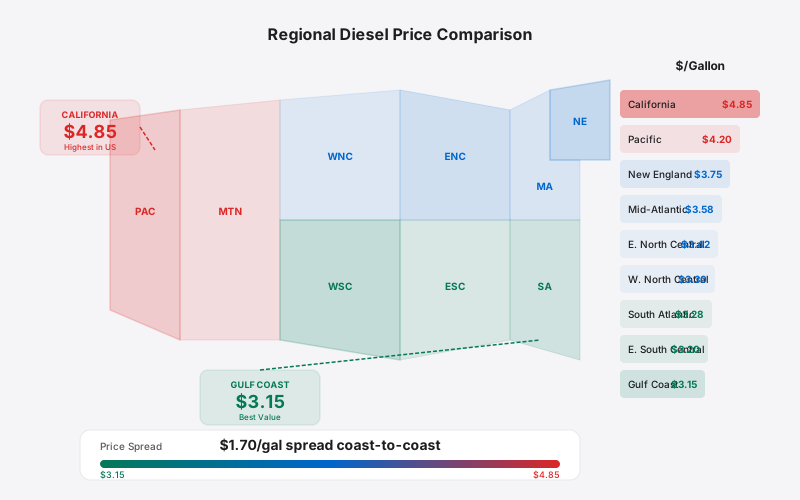
Quarterly Price Breakdown by Region
Diesel prices follow seasonal patterns — higher in Q1 (winter heating oil demand overlaps with diesel refining), lower through summer and fall as refinery output increases and demand normalizes. Here's the quarterly projection by region for 2026:
| Region | Q1 2026 | Q2 2026 | Q3 2026 | Q4 2026 |
|---|---|---|---|---|
| National Avg | $3.60 | $3.50 | $3.45 | $3.42 |
| Gulf Coast (TX, LA, MS, AL) | $3.35 | $3.25 | $3.20 | $3.18 |
| Midwest (IL, OH, IN, MO) | $3.55 | $3.45 | $3.40 | $3.38 |
| Southeast (GA, FL, TN, NC) | $3.50 | $3.40 | $3.35 | $3.32 |
| Northeast (PA, NJ, NY, MA) | $3.80 | $3.70 | $3.65 | $3.60 |
| West Coast (WA, OR) | $3.90 | $3.80 | $3.75 | $3.70 |
| California | $4.50 | $4.35 | $4.25 | $4.20 |
Projections based on EIA Short-Term Energy Outlook, state tax rates, and historical regional price differentials. Actual prices may vary with geopolitical events or refinery disruptions.
The seasonal pattern to plan around: Q1 is typically the most expensive quarter for diesel. Heating oil and diesel share refinery capacity, so winter heating demand in the Northeast pushes diesel prices up nationally. By Q2, refineries shift to maximum diesel output, supply increases, and prices drop. Q3-Q4 are typically the cheapest quarters, with a minor uptick in September-October as harvest season increases agricultural freight demand.
For owner-operators planning their year, this seasonal pattern means Q1 is when fuel surcharges matter most — and when you should be most aggressive about verifying your FSC calculations match actual pump prices. By Q3, the delta between your surcharge income and actual fuel costs should be working in your favor.
Regional Price Differences: Where You Fuel Matters
The difference between fueling in Texas versus California can mean $1.00+ per gallon — that's $150-$180 per fill-up on a typical 150-180 gallon tank. Over a year, strategic fueling location decisions can save an owner-operator $5,000-$10,000 in fuel costs without changing a single mile of routing.
| State/Region | 2026 Avg Diesel | vs National Avg | Why |
|---|---|---|---|
| Texas | $3.22 | -$0.28 | Refinery proximity, low state tax ($0.20/gal) |
| Louisiana | $3.25 | -$0.25 | Refinery row along I-10, low tax ($0.20/gal) |
| Mississippi | $3.28 | -$0.22 | Low tax ($0.184/gal), Gulf refinery access |
| Alabama | $3.30 | -$0.20 | Low tax, Gulf Coast pipeline infrastructure |
| Oklahoma | $3.30 | -$0.20 | Oil-producing state, low tax ($0.19/gal) |
| Ohio | $3.48 | -$0.02 | Moderate tax, mid-continent refinery access |
| Illinois | $3.65 | +$0.15 | Higher state tax + Chicago area surcharges |
| New York | $3.85 | +$0.35 | High state tax ($0.337/gal) + metro surcharges |
| Pennsylvania | $3.90 | +$0.40 | Highest state diesel tax ($0.741/gal) in US |
| California | $4.35 | +$0.85 | CARB, cap-and-trade, high tax ($0.539/gal) |
State averages based on EIA data and state tax rates. Metro areas within states may differ. Source: EIA, DOE Alternative Fuels Data Center.
The California problem: California's CARB regulations require ultra-low-emission diesel formulations and renewable diesel blending that add $0.20-$0.40/gallon in production costs. Layer on the state excise tax ($0.539/gallon), cap-and-trade carbon pricing ($0.15-$0.25/gallon), and sales tax on top of everything, and you're paying $0.80-$1.20 more per gallon than the national average. The practical strategy: fuel up before entering California (Reno, NV or Primm, NV on I-15; Ehrenberg, AZ on I-10) and build the California premium into your rate negotiations for CA-bound loads.
Route planning impact: If you're regularly running I-10 across the southern corridor, fueling in Texas and Louisiana versus waiting until you hit California can save $150+ per tank. For carriers running the Northeast, fueling in Virginia or South Carolina before heading into Pennsylvania (which has the highest state diesel tax in the nation at $0.741/gallon) makes economic sense. Our guide to avoiding deadhead miles covers how to plan routes that minimize both empty miles and fuel costs.
Lower Fuel + Rising Rates = Better Margins
Here's the math that matters. For the first time since 2022, the two biggest variables in owner-operator profitability are moving in the right direction simultaneously: freight rates are climbing while fuel costs are declining. Let's put real numbers to it.
$2.08/mi rate
2025 Scenario
Dry van spot avg $2.08/mi. Diesel $3.75/gal. At 6.5 MPG = $0.577/mi fuel cost. After fuel: $1.50/mi. After other costs (~$0.65/mi): $0.85/mi net. At 2,500 mi/week = $2,125/week gross margin.
$2.35/mi rate
2026 Scenario
Dry van spot avg $2.35/mi. Diesel $3.50/gal. At 6.5 MPG = $0.538/mi fuel cost. After fuel: $1.81/mi. After other costs (~$0.65/mi): $1.16/mi net. At 2,500 mi/week = $2,900/week gross margin.
+$775/week
Weekly Improvement
The combination of $0.27/mi higher rates and $0.039/mi lower fuel costs = $0.31/mi margin improvement. Over 2,500 miles/week = $775 additional weekly income.
+$40,300/year
Annual Impact
Over 52 weeks, the margin improvement adds up to roughly $40,300 in additional annual income. That's the difference between surviving and thriving.
These numbers assume national averages and a single dry van truck. Reefer and flatbed operators will see even larger improvements, given that their rate recovery is projected at 10-12% versus dry van's 8-10%. The key variable is loaded-mile percentage — the more miles you run loaded versus deadhead, the more of this margin improvement you actually capture. Running 85% loaded at $2.35/mi is dramatically better than running 75% loaded at the same rate, because those empty miles still burn fuel.
Use our Fuel Cost Calculator and Cost Per Mile Calculator to model these scenarios with your actual numbers. The point isn't the exact projections — it's the direction. Both arrows are pointing toward better margins, and smart operators who minimize costs while capturing rate improvements are the ones who'll come out ahead.
Fuel Surcharge: Don't Leave Money on the Table
Fuel surcharges (FSC) are supposed to protect carriers from diesel price volatility — but too many owner-operators accept whatever FSC a broker offers without verifying the math. In a market where every cent per mile matters, that's money left on the table.
How FSC works: The standard DOE-based fuel surcharge formula is: (Current DOE diesel price - Base price) / Base MPG = FSC per mile. The DOE publishes national average diesel prices every Monday. Most FSC schedules use a base price between $1.10-$1.25/gallon and a base MPG of 5.5-6.0.
| Diesel Price | FSC @ 6.0 MPG | FSC @ 5.5 MPG | Weekly FSC (2,500 mi) | Annual FSC |
|---|---|---|---|---|
| $3.20 | $0.333 | $0.364 | $833-$909 | $43,300-$47,300 |
| $3.40 | $0.367 | $0.400 | $917-$1,000 | $47,700-$52,000 |
| $3.50 | $0.383 | $0.418 | $958-$1,045 | $49,800-$54,400 |
| $3.60 | $0.400 | $0.436 | $1,000-$1,091 | $52,000-$56,700 |
| $3.80 | $0.433 | $0.473 | $1,083-$1,182 | $56,300-$61,500 |
| $4.00 | $0.467 | $0.509 | $1,167-$1,273 | $60,700-$66,200 |
FSC calculated using $1.20/gallon base price. Weekly/annual ranges reflect 5.5-6.0 MPG assumptions. Actual FSC depends on broker's rate confirmation terms.
Common broker tricks to watch for:
- Stale DOE numbers — Some brokers use a DOE price from 2-3 weeks ago when diesel was cheaper. Always verify against the current week's EIA published price.
- Inflated base MPG — Using 7.0 MPG as the base when your truck actually gets 6.0 reduces the FSC calculation. A higher MPG denominator = lower surcharge. The industry standard base is 5.5-6.0 MPG.
- FSC only on loaded miles — Some rate confirmations specify FSC applies only to loaded miles, not total miles. If you're deadheading to the pickup, those miles burn fuel but earn no surcharge.
- Bundled rates hiding FSC — An "all-in" rate that doesn't break out FSC separately means you can't verify whether the fuel component is fair. Always request line-item rate confirmations showing linehaul + FSC separately.
At $3.50/gallon diesel, the difference between a fairly calculated FSC and a broker using outdated numbers or inflated MPG can be $0.05-$0.10 per mile — that's $125-$250 per week or $6,500-$13,000 per year. Verify every rate confirmation.
Fuel Cost Per Mile Breakdown
Fuel is typically 25-35% of an owner-operator's total operating cost. At projected 2026 diesel prices, here's exactly what fuel costs you at every MPG level and price point. This is the table to bookmark and reference when evaluating loads.
| Diesel Price | 5.5 MPG | 6.0 MPG | 6.5 MPG | 7.0 MPG | 7.5 MPG |
|---|---|---|---|---|---|
| $3.20 | $0.582 | $0.533 | $0.492 | $0.457 | $0.427 |
| $3.30 | $0.600 | $0.550 | $0.508 | $0.471 | $0.440 |
| $3.40 | $0.618 | $0.567 | $0.523 | $0.486 | $0.453 |
| $3.50 | $0.636 | $0.583 | $0.538 | $0.500 | $0.467 |
| $3.60 | $0.655 | $0.600 | $0.554 | $0.514 | $0.480 |
| $3.80 | $0.691 | $0.633 | $0.585 | $0.543 | $0.507 |
| $4.00 | $0.727 | $0.667 | $0.615 | $0.571 | $0.533 |
| $4.35 (CA) | $0.791 | $0.725 | $0.669 | $0.621 | $0.580 |
Fuel cost per mile = Diesel price / MPG. Highlighted column (6.5 MPG) represents the fleet average for modern Class 8 trucks. Source: Bureau of Transportation Statistics.
The MPG gap is worth more than you think: The difference between 5.5 MPG and 7.0 MPG at $3.50 diesel is $0.136 per mile. On a truck running 130,000 miles per year, that's $17,680 in annual fuel savings — or roughly the equivalent of getting a $0.14/mile rate increase on every load without negotiating anything. If you're still running older equipment with pre-2017 aerodynamics, the single highest-ROI investment you can make may be fuel efficiency upgrades rather than chasing rate improvements.
Run your own numbers with our Fuel Cost Calculator to see exactly how fuel price and MPG changes impact your specific operation.
Fuel Strategy: Efficiency Over Price-Chasing
Too many owner-operators obsess over finding diesel $0.05-$0.10 cheaper at the next truck stop. While fuel cards and discount programs matter, the biggest fuel savings come from operational changes that reduce total fuel consumption — not from saving pennies at the pump.
Here's the hierarchy of fuel savings, ranked by annual dollar impact for a truck running 2,500 miles/week at 6.5 MPG:
1. Reduce Deadhead Miles (Save $5,000-$15,000/year)
Running empty burns almost as much fuel as running loaded (about 85-90% of loaded fuel consumption). If you're currently running 75% loaded miles and improve to 90%, you're eliminating 37.5 miles of deadhead for every 250 miles driven. Over a year, that's roughly 9,750 fewer empty miles — saving approximately 1,500 gallons of diesel ($5,250 at $3.50/gallon). The revenue side is even more impactful: those 9,750 miles become loaded, revenue-generating miles instead.
This is where working with a professional dispatch service pays for itself many times over. A good dispatcher plans your next load before you deliver the current one, minimizing gaps between loads. Check our complete guide to avoiding deadhead miles for tactical strategies.
2. Speed Management (Save $3,000-$5,000/year)
Aerodynamic drag increases exponentially with speed. Every 1 MPH over 55 costs approximately 0.1 MPG. Running at 65 vs 55 costs roughly 1.0 MPG — from 7.0 MPG down to 6.0 MPG. At $3.50/gallon on 130,000 annual miles, that's the difference between $65,000 and $75,833 in annual fuel costs. Dropping from 68 to 63 MPH alone can save $3,000-$5,000/year while adding only 8-10 minutes per 100 miles. Set your cruise at 62-63 on open highway and let the fuel savings compound.
3. Idle Reduction (Save $2,000-$4,500/year)
A Class 8 diesel engine burns 0.8-1.0 gallons per hour at idle. A driver idling 6 hours per day for 300 days per year burns 1,800 gallons — $6,300 at $3.50/gallon — producing zero revenue miles. An auxiliary power unit (APU) costs $3,000-$8,000 installed and uses 0.2-0.3 gallons/hour, reducing idle fuel consumption by 60-70%. Most APUs pay for themselves within 6-12 months. Battery-electric APUs eliminate fuel consumption entirely during rest periods.
4. Tire Pressure & Maintenance (Save $1,500-$3,000/year)
Under-inflated tires by just 10 PSI can reduce fuel economy by 1%. Across 18 tires on a Class 8 truck, inconsistent tire pressure is a constant fuel drain. A tire pressure monitoring system (TPMS) costs $300-$800 and alerts you to pressure drops in real time. Low rolling resistance tires can improve fuel economy by 3-5% over standard retreads. Combined with proper wheel alignment (misalignment causes drag), tire management alone can save $1,500-$3,000 annually.
5. Route Optimization (Save $1,000-$2,500/year)
The shortest route isn't always the most fuel-efficient. Hills, stop-and-go traffic, construction zones, and elevation changes all affect fuel consumption. Modern GPS systems designed for trucking (Rand McNally, Garmin dezl, CoPilot) can optimize for fuel efficiency rather than just fastest arrival. Avoiding mountain passes when a flat alternative adds minimal miles, timing arrivals to avoid rush-hour congestion in metro areas, and planning fuel stops at the cheapest regional prices along your route all add up.
Electric Trucks: The 2026 Reality Check
Electric trucks are the most-discussed topic in trucking media but the least-relevant change for most owner-operators in 2026. Let's separate hype from reality.
What's actually happening: Tesla Semi production is ramping in 2026, with PepsiCo, Walmart, and UPS taking deliveries for regional routes. Tesla claims $160,000 in lifetime fuel savings over 1 million miles compared to diesel. Freightliner's eCascadia and Volvo's VNR Electric are in limited production for short-haul and regional applications. Battery-electric trucks are proving effective on routes under 250 miles with return-to-base charging.
The numbers that matter: Electric trucks represent approximately 0.56% of new Class 8 registrations in 2026. That's up from 0.2% in 2024, but it's still a rounding error in a fleet of 3.6 million registered Class 8 trucks. The barriers are real:
- Purchase price: $180,000-$250,000 for a battery-electric Class 8 vs $150,000-$180,000 for a comparable diesel. The federal tax credits help, but don't close the gap for owner-operators.
- Range: 300-500 miles per charge vs 1,000+ miles for diesel. This limits electric trucks to regional and short-haul operations.
- Charging infrastructure: Fewer than 100 DC fast-charging stations nationwide designed for Class 8 trucks. The DOE Alternative Fuel Station Locator shows the gaps are enormous, particularly in the Midwest and Mountain West.
- Charging time: 30-45 minutes at a DC fast charger vs a 10-minute diesel fill-up. That's lost revenue time.
- Weight penalty: Battery packs add 4,000-8,000 lbs, reducing payload capacity on weight-sensitive loads.
The bottom line for owner-operators: If you run a dedicated regional route under 250 miles with a home base where you can install Level 2 or DC fast charging, electric starts to pencil out — especially with fuel savings of $0.10-$0.15 per mile versus diesel (electricity costs roughly $0.15-$0.20/mile vs $0.50-$0.58/mile for diesel). For everyone else — long-haul, irregular routes, multi-stop — diesel remains the practical choice through at least 2028-2030. Don't let headlines about the future distract you from optimizing your diesel operation today.
What Owner-Operators Should Do: 5 Fuel Strategies for 2026
Lower diesel prices are a tailwind, but tailwinds only help if you're positioned to catch them. Here are five concrete strategies to maximize fuel economics in 2026:
Lock In Fuel Surcharge Terms Now
With diesel trending downward, brokers and shippers may push to renegotiate FSC schedules or switch to "all-in" rates that eliminate separate fuel surcharges. Resist this. When diesel inevitably spikes again (refinery disruption, hurricane season, OPEC cuts), you want a transparent FSC mechanism that adjusts with the market. Lock in FSC terms using the current DOE weekly average, a $1.20 or lower base price, and 6.0 MPG or lower base — and get it in writing on every rate confirmation.
Invest Fuel Savings Into Efficiency Upgrades
The margin improvement from lower fuel is real — but don't spend it. Invest it. Aerodynamic fairings ($1,500-$3,000), low rolling resistance tires ($200-$400/tire premium over standard), APU installation ($3,000-$8,000), and TPMS ($300-$800) all pay for themselves within a year through reduced fuel consumption. These upgrades compound: if diesel goes back up, your improved MPG protects your margins. Think of it as fuel price insurance.
Plan Routes Around Fuel Cost Zones
Know the regional fuel map. If you're running west on I-10, fill up in Texas before you hit New Mexico and Arizona — the price difference can be $0.20-$0.30/gallon. If you're California-bound, fuel in Nevada or Arizona before crossing the state line. On Northeast runs, Virginia and the Carolinas are consistently cheaper than Pennsylvania and New York. Apps like GasBuddy, TruckSmart, and fuel card networks with real-time pricing help you plan fuel stops strategically rather than fueling when the gauge hits a quarter tank.
Use a Fuel Card with Volume Discounts
Fuel cards from networks like TCS, Comdata, EFS, and RTS offer $0.10-$0.40/gallon discounts at participating truck stops. At 130,000 miles per year and 6.5 MPG, you're buying roughly 20,000 gallons of diesel annually. Even a $0.15/gallon average discount saves $3,000/year. Some cards also offer IFTA reporting integration, which saves time on quarterly filings. The key is choosing a card network that has discount locations along your most common routes — a great discount at truck stops you never visit is worthless.
Focus on Loaded-Mile Percentage Over Rate Per Mile
Here's the counter-intuitive truth: a $2.20/mile load that keeps you loaded for the return trip is more profitable than a $2.50/mile load that leaves you deadheading 200 miles to the next pickup. At $3.50 diesel and 6.5 MPG, those 200 deadhead miles cost $108 in fuel alone — plus 3+ hours of unpaid drive time, wear on your truck, and an HOS clock that's ticking. This is why working with a dispatch service that plans multi-leg trips — booking your next load before you deliver the current one — makes such a dramatic difference in net revenue per mile.
Related Resources
- Fuel Cost Calculator — Model your fuel costs at any diesel price and MPG
- Cost Per Mile Calculator — See how fuel fits into your total operating cost
- 2026 Trucking Industry Forecast — Freight rates, capacity, and full market outlook
- How to Avoid Deadhead Miles — Reduce empty miles to cut fuel waste and boost revenue
- EV Trucks for Owner-Operators — Diesel vs electric TCO comparison
- Freight Rate Recovery 2026 — Lower fuel + rising rates = better margins
- Tariff Ruling Impact — Trade policy changes affecting fuel and parts costs
- Fuel Saving Tips for Truck Drivers — Practical strategies to cut fuel costs regardless of diesel prices
Truck Dispatch Experts
Published Mar 4, 2026