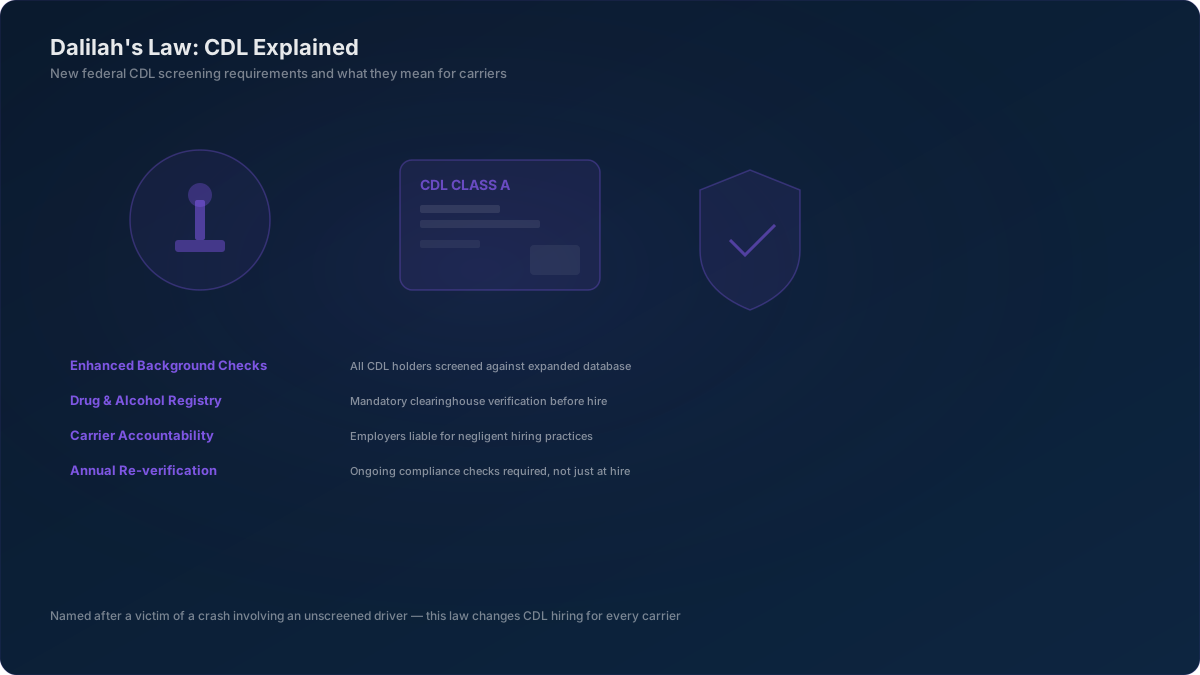
What Is Dalilah's Law?
On March 18, 2026, the House Transportation and Infrastructure Committee passed Dalilah's Law by a vote of 35-26. It is one of the most significant pieces of CDL-related legislation in years, and it is aimed squarely at a problem that has been festering in the trucking industry for a long time: fraudulent CDL training schools that put unqualified drivers behind the wheel of 80,000-pound trucks.
The law is named after Dalilah Coleman, a young girl from California who was seriously injured in 2024 when she was hit by a commercial truck. The driver, it turned out, was illegally present in the United States and had obtained his CDL through a training program that federal investigators later determined was fraudulent — the driver had never completed the required behind-the-wheel training hours. It was exactly the kind of case that makes every legitimate trucker cringe, because it gives the entire profession a black eye.
Dalilah's story is heartbreaking. But the systemic problem it exposed is what drove the legislation. The bill does three main things: it requires the DOT to issue final rules on CDL school self-certification within 18 months, it strengthens English proficiency requirements for CDL applicants, and it gives FMCSA stronger enforcement tools to shut down training providers that falsify records. Let's break down each one.
The CDL Mill Problem: 3,000 Schools Already Shut Down
Before we get into what Dalilah's Law changes, you need to understand how bad the existing system is. Under the current FMCSA Entry-Level Driver Training (ELDT) requirements, CDL training providers are supposed to register with the Training Provider Registry (TPR) and meet minimum standards for curriculum, instruction hours, and behind-the-wheel training. The key word is "supposed to."
The system relies heavily on self-certification. Training providers tell FMCSA they meet the requirements, submit completion records for their students, and get listed in the registry. For years, oversight was minimal. And where oversight is minimal, fraud thrives.
FMCSA has already removed approximately 3,000 training providers from the Training Provider Registry for falsifying data. Three thousand. That is not a typo. These were schools that were issuing ELDT completion certificates to students who:
These "CDL mills" operated as businesses that sold credentials, not education. A student would pay $2,000-$5,000, spend a few days (or no days) at the facility, and walk out with an ELDT completion certificate that they could take to their state DMV to sit for the CDL exam. Some of these mills had pass-through rates that should have been red flags — completion percentages of 98-100% with training durations that were physically impossible given the required hours.
The result: drivers on the road with CDLs who lack basic skills. Drivers who cannot back a trailer safely. Drivers who have never practiced mountain driving, night driving, or adverse weather handling. Drivers who are a danger to themselves and everyone around them. This is not an abstract policy problem — it is a safety crisis that affects every trucker sharing the road with these unqualified drivers.
FMCSA's removal of 3,000 providers was a start, but it was done under existing enforcement authority. Dalilah's Law would codify stronger oversight requirements into federal law, making it harder for future administrations to ease enforcement and harder for bad actors to re-enter the system.
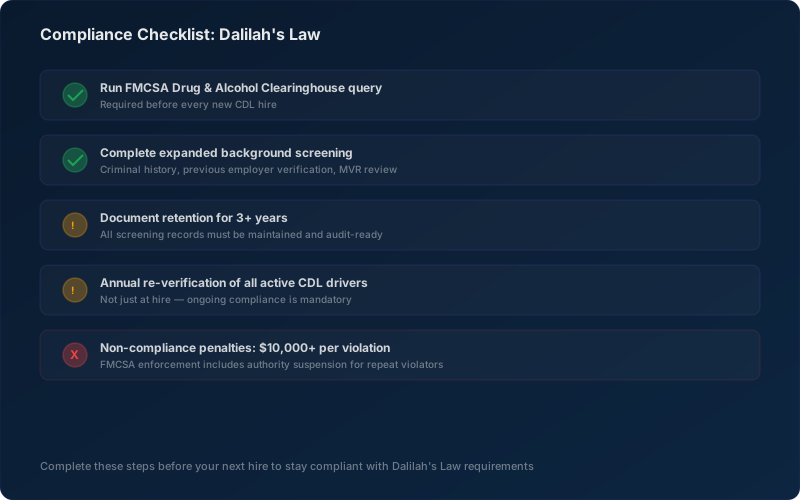
What Dalilah's Law Actually Requires
The bill has several key provisions. Here's what each one means for the trucking industry:
1. DOT Must Issue Final Rules on CDL School Self-Certification (18-Month Deadline)
The bill requires the Department of Transportation to issue a final rule — not a proposed rule, not a notice of rulemaking, but a final rule — on CDL school self-certification within 18 months of enactment. This is significant because DOT rulemaking typically moves at a glacial pace. FMCSA has been talking about improving training provider oversight for years without finalizing comprehensive rules. The 18-month mandate forces action. The final rule would establish clear, auditable standards for what training providers must actually demonstrate — not just certify — about their programs.
2. Strengthened English Proficiency Requirements
Federal regulations under 49 CFR 391.11 already require commercial drivers to read and speak English sufficiently to understand signs, communicate with law enforcement, and make log entries. In practice, enforcement has been inconsistent — some states offer CDL testing in other languages, and many training providers never verify English competency. Dalilah's Law directs DOT to clarify these standards and integrate English proficiency verification into the training provider certification process. This does not mean you need to be a native speaker — it means you need functional ability to read road signs, communicate with dispatchers and shippers, interact with DOT officers during inspections, and complete required documentation.
3. Stronger Penalties for Fraudulent Training Providers
Currently, when FMCSA removes a training provider from the TPR, the owner can often reapply under a different business name and get back on the registry. Dalilah's Law would close this loophole by barring individuals — not just businesses — associated with fraudulent operations from registering new training programs. It also increases civil penalties for training providers that issue false completion certificates. The goal is to make running a CDL mill a career-ending decision, not just a speed bump.
4. Mandatory Auditing and Record-Keeping
Training providers would be required to maintain detailed records of actual training hours delivered, student attendance, behind-the-wheel training sessions (including instructor identification), and skills test results. These records would be subject to audit by FMCSA — not just self-reported. Random and targeted audits would replace the current honor-system approach that allowed 3,000 schools to falsify records before anyone caught on.
The Bigger Picture: CDL Credentialing Is Getting an Overhaul
Dalilah's Law does not exist in a vacuum. It is part of a broader tightening of CDL credentialing that includes the FMCSA non-domiciled CDL final rule, which took effect on March 16, 2026 — just two days before Dalilah's Law passed committee.
The non-domiciled CDL rule restricts which visa holders can obtain a CDL without being a permanent U.S. resident. Under the new rule, only holders of H-2A (temporary agricultural workers), H-2B (temporary non-agricultural workers), and E-2 (treaty investor) visas are eligible for non-domiciled CDLs. That means approximately 97% of the 200,000 current non-domiciled CDL holders will not qualify for renewal when their credentials expire. Oregon has already permanently stopped issuing non-domiciled CDLs, affecting about 900 drivers. For a full breakdown of the non-domiciled CDL rule, see our FMCSA Rules 2026 guide.
Together, these two regulatory actions represent a fundamental shift in how the United States manages commercial driver credentials. The non-domiciled rule addresses who can hold a CDL. Dalilah's Law addresses how CDL training is delivered and verified. The combined effect is the most significant overhaul of CDL credentialing standards in decades.
| Regulation | Focus | Status | Impact on Drivers |
|---|---|---|---|
| Non-Domiciled CDL Rule | Who can hold a CDL | Effective Mar 16, 2026 | ~97% of 200K non-domiciled CDL holders won't qualify |
| Dalilah's Law | How CDL training works | Passed committee Mar 18, 2026 | 3,000+ CDL mills shut down; stricter school standards |
| ELDT Requirements | Training curriculum standards | In effect (since Feb 2022) | Baseline training hours and curriculum requirements |
What This Means for Legitimate CDL Holders
If you are a professional truck driver who earned your CDL through a legitimate training program and passed your tests the proper way, Dalilah's Law is good news. Here's why:
Safety improves for everyone. Every unqualified driver removed from the road makes your job safer. Fraudulent CDL holders are the ones causing the accidents that lead to nuclear verdicts, insurance rate increases, and public hostility toward truckers. When CDL mills are shut down and training standards are enforced, the caliber of drivers sharing the road with you goes up. That protects your safety, your CSA score, and your livelihood.
Your credentials become more valuable. When it is harder to get a CDL through fraudulent means, the supply of qualified drivers tightens. Fewer qualified drivers means more demand for the ones who are qualified — that is you. Tighter driver supply supports better pay, better benefits, and more leverage in negotiations with carriers and dispatchers. The driver shortage that has been reshaping the industry gets more acute as unqualified drivers are filtered out.
Insurance costs could stabilize. Trucking insurance rates have been climbing for years, driven in part by increasing accident severity and nuclear verdicts. If Dalilah's Law and the non-domiciled CDL rule succeed in removing unqualified drivers from the road, the industry's overall safety record should improve over time. Better safety records mean lower actuarial risk, which should eventually translate to more stable insurance premiums. This is a multi-year trend, not an overnight fix — but it is a trend in the right direction.
The profession gets the respect it deserves. One of the most frustrating things about trucking is how one bad actor — one unqualified driver causing a headline-grabbing accident — can damage the reputation of millions of professionals who do the job safely every day. Dalilah's Law is the industry and Congress saying: we take qualifications seriously. That matters for how the public perceives trucking, how regulators treat the industry, and how the next generation of potential drivers views the profession.
What to Watch For: Next Steps and Timeline
Dalilah's Law has cleared its first major hurdle — passing the House Transportation and Infrastructure Committee. But there is still a long road ahead before it becomes law. Here's the legislative path and what to watch for:
Full House Vote (Expected Spring-Summer 2026)
The bill needs to be scheduled for a vote by the full House of Representatives. The 35-26 committee vote suggests strong bipartisan support — CDL safety is one of the few issues that both parties tend to agree on. A floor vote could come within the next few months, though Congressional scheduling is unpredictable.
Senate Commerce Committee and Senate Vote
If the House passes the bill, it moves to the Senate. The Senate Commerce, Science, and Transportation Committee would review it, potentially make amendments, and then the full Senate would vote. A companion bill in the Senate would speed this process, but as of March 2026, no Senate companion has been formally introduced.
DOT Rulemaking (18 Months After Enactment)
Even after the President signs the bill into law, the actual regulatory changes require DOT rulemaking. The bill mandates a final rule within 18 months. If the law is signed in late 2026, the final rule could come by mid-2028. Meanwhile, FMCSA can continue using its existing enforcement authority to remove fraudulent training providers — which it has been doing aggressively.
Ongoing FMCSA Enforcement (Happening Now)
You do not need to wait for Dalilah's Law to become law to see its effects. FMCSA is already actively cleaning up the Training Provider Registry. The 3,000 schools removed so far are likely not the end — additional audits are ongoing. If you are choosing a CDL school for yourself or recommending one to someone, verify that the school is currently listed on the FMCSA Training Provider Registry and has not been flagged.
Related Resources
- FMCSA Rules 2026 — Full regulatory landscape including the non-domiciled CDL rule
- CDL Training Complete Guide — Everything you need to know about getting your CDL the right way
- Driver Shortage Crisis 2026 — How tighter CDL standards affect driver supply
- Nuclear Verdicts in Trucking — How unqualified drivers drive up litigation costs for the entire industry
- Trucking Insurance Rates 2026 — The connection between safety standards and insurance costs
Truck Dispatch Experts
Published Mar 21, 2026