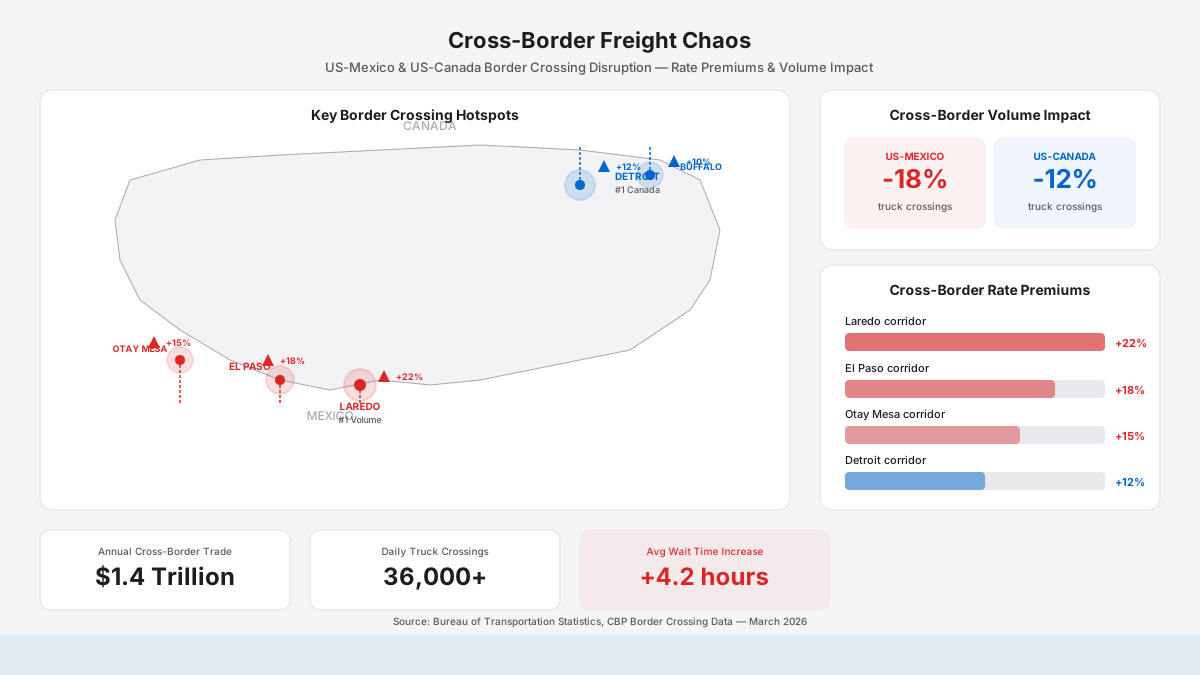
What's Happening at the Borders Right Now
If you run freight anywhere within 500 miles of the Canadian or Mexican border, you already feel it. The phones are ringing, load boards are lighting up, and rates on cross-border lanes are doing things nobody predicted six weeks ago. Let's cut through the noise and talk about what's actually happening.
The first week of March 2026 hit cross-border freight like a tornado. On March 4, the administration briefly reimposed tariffs on Canadian and Mexican goods using the same IEEPA authority the Supreme Court had already struck down. The tariffs lasted less than a day before being pulled, but the shockwave ripped through the supply chain. Importers who had been cautiously moving goods suddenly went into full panic mode. Mexico-origin load postings on DAT spiked 34% in 24 hours. Canadian shippers started dumping inventory across the border before the next policy surprise.
The IEEPA tariffs got replaced by a 15% Section 122 surcharge — the same mechanism that came out of the SCOTUS tariff ruling in February. That surcharge expires in mid-July 2026. But here's what matters for your bottom line right now: the behavioral damage is done. Importers on both borders have learned that trade policy can flip overnight. So they're shipping everything they can, as fast as they can, while they still know the rules. That's creating a demand surge that's pushing cross-border rates 15-25% above domestic equivalents — and it's pulling domestic feeder lanes up with it.
The result is chaos. Productive, profitable chaos for carriers who understand what's happening and know where to position. Expensive, confusing chaos for everyone else. Let's break down the two borders separately, because the dynamics are completely different.
US-Canada Lanes: Rate Spikes, Volume Drops
The Canada situation is a paradox. Rates are up, but volumes are actually down. That combination tells a specific story: capacity is leaving the market faster than freight is.
Toronto-to-Chicago spot rates jumped 18% in the first week of March — from an already healthy $2.60/mi baseline to $3.05-$3.15/mi for dry van. At the same time, total cross-border truck volumes at major Canada crossings dropped roughly 20% compared to the same week last year. That's not because fewer goods are moving. It's because Canadian carriers are pulling back. The policy uncertainty, combined with a strong Canadian dollar and rising insurance costs for cross-border operations, is making it unprofitable for smaller Canadian fleets to run US-bound freight. When they exit, the remaining trucks command premium rates.
| Lane | Feb Avg Rate | Mar Wk 1 Rate | Change | Volume Trend |
|---|---|---|---|---|
| Toronto → Chicago | $2.60/mi | $3.05-$3.15/mi | +18% | ↓ 20% |
| Detroit → Windsor (southbound) | $2.30/mi | $2.65-$2.80/mi | +15% | ↓ 12% |
| Buffalo → Toronto | $2.40/mi | $2.70-$2.85/mi | +13% | ↓ 8% |
| Montreal → NYC/NJ | $2.80/mi | $3.20-$3.40/mi | +16% | ↓ 15% |
| Vancouver → Seattle | $2.20/mi | $2.45-$2.55/mi | +12% | ↓ 10% |
| Winnipeg → Minneapolis | $2.35/mi | $2.60-$2.70/mi | +11% | ↓ 18% |
Rate data from DAT and FreightWaves SONAR. Volume trends based on CBP truck crossing data compared to same week prior year. Rates reflect all-in spot including fuel surcharge.
Detroit-Windsor is the bellwether. The Ambassador Bridge and Detroit-Windsor Tunnel handle more bilateral trade value than any other land crossing in North America. Auto parts, steel, chemicals, and manufactured goods flow across this corridor 24/7. When Canadian truck supply tightens, Detroit feels it first. Right now, shippers at the Big Three automakers are paying $2.80-$3.20/mi for dry van loads to Chicago — rates that were $2.30-$2.50/mi in January. If you run Michigan freight, this is your window.
Buffalo-Niagara is the sleeper play. It doesn't get the attention of Detroit or Laredo, but Buffalo handles 4,000-5,000 truck crossings per day — paper products, dairy, and manufactured goods from Ontario and Quebec. With Montreal-to-NYC rates hitting $3.20-$3.40/mi, the overflow is creating opportunities on secondary lanes like Buffalo to Boston ($2.90-$3.10/mi reefer) and Buffalo to Philadelphia ($2.60-$2.80/mi dry van). Smaller crossings mean shorter wait times and less competition for loads.
The Canadian carrier exodus is real. According to FreightWaves data, Canadian carrier registrations for US-bound authority dropped 14% in February alone. The combination of IEEPA uncertainty, surcharge paperwork, and rising Canadian insurance premiums is pushing small Canadian fleets (1-10 trucks) out of transborder freight entirely. For US carriers with FAST credentials, every Canadian truck that exits is one less competitor for premium cross-border loads.
US-Mexico Lanes: The Volume Surge
Mexico is the opposite story from Canada. Where Canada is seeing rates up and volumes down, Mexico is seeing both rates and volumes climbing simultaneously. Mexico-origin shipments are up 12% week over week as of the first week of March, and they're still accelerating.
The driver is pure fear. After the March 4 tariff scare, Mexican exporters and US importers decided they'd rather pay the current 15% surcharge and move goods now than risk a higher tariff tomorrow. That's creating a demand surge at every major Mexico crossing, with Laredo, El Paso, and Nogales bearing the brunt.
| Crossing | Daily Trucks | Top Freight | NB Rate (Mar) | WoW Volume |
|---|---|---|---|---|
| Laredo, TX | 14,000-16,000 | Auto parts, produce, electronics | $3.60-$4.40/mi | +14% |
| El Paso, TX | 6,000-8,000 | Machinery, plastics, copper wire | $3.20-$3.80/mi | +11% |
| Pharr, TX | 3,000-3,500 | Fresh produce (80%+), frozen foods | $4.00-$4.60/mi | +18% |
| Nogales, AZ | 2,500-3,000 | Produce, wine, automotive glass | $3.40-$3.90/mi | +9% |
| Otay Mesa, CA | 3,500-4,500 | Medical devices, aerospace, beer | $3.00-$3.50/mi | +7% |
| Eagle Pass, TX | 1,500-2,000 | Coal, minerals, auto components | $3.30-$3.70/mi | +12% |
Northbound (NB) rates reflect reefer/dry van spot averages including fuel surcharge. Volume is week-over-week change as of Mar 7. Source: DAT, FreightWaves SONAR, CBP trade statistics.
Laredo is absolute chaos right now. The busiest commercial land port in the Western Hemisphere is running at surge capacity. Wait times for non-FAST trucks hit 6-8 hours on March 5-6 — that's an entire shift sitting at the border instead of earning miles. FAST card holders are getting through in 45-90 minutes and commanding rate premiums of $0.40-$0.60/mi over non-credentialed carriers. If you don't have a FAST card, the domestic relay from Laredo to Dallas ($3.00-$3.40/mi reefer) or Laredo to Houston ($2.80-$3.10/mi dry van) is where the money is — no border crossing required.
Pharr is the produce goldmine. Over 80% of fresh produce from Mexico enters through Pharr and the Rio Grande Valley. With produce season ramping up alongside the tariff-driven volume surge, reefer carriers in South Texas are seeing rates they haven't seen since the pandemic era. Pharr-to-Dallas reefer is paying $4.00-$4.60/mi. Pharr to Chicago is $3.20-$3.50/mi with consistent availability. The catch: produce loads are time-sensitive and the dwell time at the border is eating into delivery windows. Late deliveries mean rejected loads and chargebacks.
El Paso is the flatbed play. Machinery, construction materials, and copper wire imports from Juarez are fueling flatbed rates of $3.20-$3.80/mi northbound. The I-10 corridor between El Paso and Phoenix is one of the tightest capacity markets in the country right now. If you run flatbed and can get to El Paso, there's work waiting.
The SCOTUS Tariff Ruling: What It Changed
All of this chaos traces back to one Supreme Court decision. On February 20, 2026, SCOTUS ruled 6-3 in United States v. National Foreign Trade Council that IEEPA cannot be used to impose tariffs. We covered the full ruling and its trucking impact in our detailed analysis. Here's the quick version of what matters for cross-border freight specifically:
The ruling killed 25-54% tariffs on Canadian, Mexican, Chinese, and EU goods. The administration replaced them with a 15% Section 122 surcharge — lower rate, but with a hard 150-day expiration around mid-July 2026. That created a countdown clock that's now driving importer behavior on both borders.
Then came March 4. The administration briefly tried to reimpose IEEPA tariffs anyway. They were withdrawn within hours, but the message was clear: the government wants tariffs and will keep trying to find legal authority for them. That single day of policy whiplash is why we're seeing the volume surge on Mexico lanes and the supply contraction on Canada lanes. Importers are acting rationally — moving goods now because they genuinely don't know what the rules will be next month.
The July 2026 expiration is the next big catalyst. Section 122 surcharges are limited to 150 days by law. When that clock runs out, three things can happen: the surcharge expires (goods flow tariff-free), Congress passes new legislation (unlikely in an election year), or the administration finds another legal mechanism (likely facing immediate court challenges). Each scenario produces a different freight pattern. Smart carriers are planning for all three. Read our tariff ruling breakdown for the full scenario analysis.
For now, the 15% surcharge is baked into cross-border freight costs. Shippers are passing it through as line items on rate confirmations. Some brokers are absorbing it to stay competitive and eating the margin. Either way, it's inflating cross-border rates above domestic — and that premium is what's making border lanes so attractive for carriers right now.
Should You Chase Cross-Border Freight?
The premiums are real. The opportunity is real. But cross-border freight is not domestic freight with a border in the middle. Before you chase the 15-25% rate premium, understand what you're signing up for.
Why Cross-Border Pays More
- •Spot rates 15-25% above comparable domestic lanes
- •FAST/C-TPAT carriers face less competition (credential barrier)
- •Surcharge pass-throughs inflate all-in rates
- •Importer urgency = less rate negotiation, faster booking
- •Consistent demand through July 2026 (surcharge expiration window)
The Risks You Need to Know
- •Border wait times of 2-8 hours (unpaid detention at many crossings)
- •ACE manifest errors can delay you 24+ hours
- •Secondary inspection risk — random holds with no ETA
- •Policy can change overnight (March 4 proved it)
- •Requires FAST card, C-TPAT, and broker with ACE experience
If you already have FAST credentials and cross-border experience: This is your market. The Canadian carrier exodus and importer urgency are creating the best cross-border rate environment since 2021. Run it hard through July while the premium lasts. Focus on building shipper relationships now — when the surcharge expires and rates normalize, those relationships will keep you on preferred carrier lists.
If you're new to cross-border: Do not jump in blind. FAST card applications take 8-14 weeks. C-TPAT certification takes longer. ACE manifest filing requires a licensed customs broker. The learning curve is real, and one mistake at the border — a paperwork error, a missed seal number, a wrong commodity code — can cost you a day of revenue plus a CBP penalty. Start your FAST application now, but for the next 4 months, play the domestic feeder lanes instead.
The smart middle ground: Work with a dispatch service that has cross-border relationships. A good dispatcher can get you loads that originate at the border but deliver domestically — drayage from Laredo yards, relay legs from border warehouses, and repositioning moves that pay premium rates without requiring you to physically cross. That's the approach that gives you cross-border economics with domestic simplicity. It's how smart carriers get loads in a volatile market.
Domestic Lanes That Benefit from Border Chaos
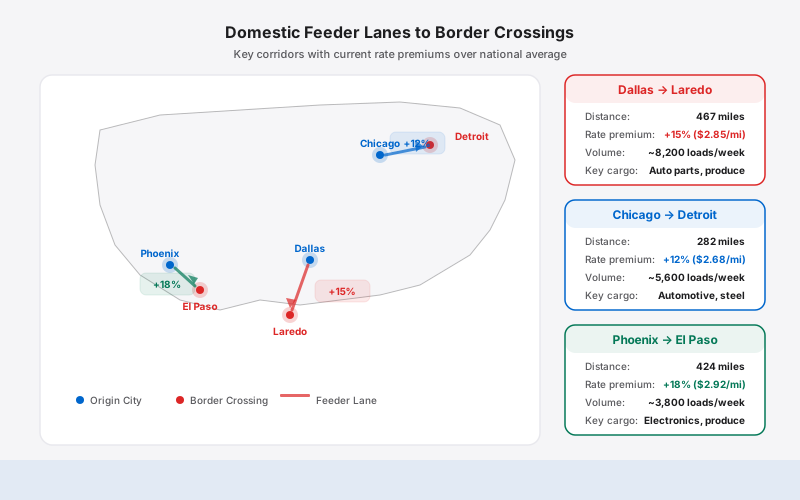
Here's the part most people miss: you don't need to cross a border to profit from cross-border chaos. When 14,000 trucks a day funnel through Laredo, every lane within 500 miles gets pulled into the orbit. The same goes for Detroit, Buffalo, El Paso, and Nogales. These border hubs need trucks to distribute goods inland — and that's domestic freight paying premium rates.
South Texas Feeder Lanes
The Laredo-Dallas-Houston triangle is the hottest domestic market in the country right now.
- Laredo → Dallas: $3.00-$3.40/mi (reefer)
- Laredo → Houston: $2.80-$3.10/mi (dry van)
- Dallas → Laredo: $2.20-$2.80/mi (southbound repo)
- San Antonio → Laredo: $2.40-$2.70/mi (machinery)
Great Lakes Corridor
Auto parts and manufactured goods from Canada are driving Michigan and Illinois lanes.
- Detroit → Chicago: $2.80-$3.20/mi (auto parts)
- Chicago → Detroit: $2.40-$2.80/mi (manufacturing)
- Detroit → Indianapolis: $2.50-$2.80/mi (dry van)
- Buffalo → NYC/NJ: $2.80-$3.20/mi (reefer)
Southwest Corridor
El Paso and Nogales overflow is creating flatbed and reefer opportunities across the I-10 belt.
- El Paso → Phoenix: $3.20-$3.60/mi (flatbed)
- Nogales → Phoenix: $3.00-$3.40/mi (reefer)
- Phoenix → LA: $2.60-$2.90/mi (mixed)
- El Paso → Albuquerque: $2.60-$3.00/mi (dry van)
The repositioning play is key. Cross-border freight is overwhelmingly northbound — goods coming into the US from Mexico and Canada. That means southbound lanes toward border hubs are tight on capacity because every truck wants to deadhead south to chase the northbound premium. Smart dispatchers find paying southbound loads — machinery to maquiladoras, raw materials to Canadian manufacturers, empty containers returning to Mexican ports. A carrier who books both legs makes $1,500-$2,500 more per round trip than one who deadheads south. That's the difference between running at $3.50/mi average and $2.60/mi average on the same route. Rate negotiation matters more than ever when the market is this hot.
Don't ignore the second-order effects. When trucks reposition toward border hubs, they leave capacity gaps on other lanes. Right now, Midwest-to-Southeast lanes (Chicago to Atlanta, Indianapolis to Charlotte) are seeing spot rates tick up 5-8% because carriers have drifted toward Texas and Michigan. If you prefer predictable, moderate-premium lanes over chasing border chaos, these interior lanes offer solid returns with less volatility.
The bottom line: cross-border chaos creates a ripple effect that touches every major freight market in the contiguous US. Whether you position near the border or exploit the capacity gaps left behind, there's money to be made if you understand the flow. Use our deadhead calculator to map out repositioning costs before committing to a border play — knowing your break-even changes the math on which feeder lanes are worth chasing. A dispatcher who tracks border volumes daily — not weekly, not monthly — can position you ahead of the demand curve instead of chasing it. That's what our dispatch team does.
Border Wait Times and the HOS Math
The rate premium on cross-border lanes looks incredible on paper. But you need to factor in what happens at the crossing itself, because border wait times are eating into driver productivity in ways that change the effective pay rate dramatically.
Right now, non-FAST trucks at Laredo are waiting 4-8 hours. El Paso is running 3-6 hours. Detroit-Windsor varies from 2-4 hours depending on time of day. Those hours count against your 14-hour on-duty window under FMCSA HOS rules. A driver who waits 6 hours at Laredo has 8 hours left to drive — that's roughly 400 miles of revenue-generating movement instead of the usual 550-600.
Effective Pay Rate by Wait Time
| Border Wait | Drivable Miles Left | Revenue @ $3.50/mi | Effective $/hr | vs. Domestic Run |
|---|---|---|---|---|
| 1 hr (FAST) | 550 | $1,925 | $128/hr | +28% |
| 2 hrs | 500 | $1,750 | $109/hr | +9% |
| 4 hrs | 420 | $1,470 | $84/hr | -16% |
| 6 hrs | 350 | $1,225 | $61/hr | -39% |
| 8 hrs | 280 | $980 | $41/hr | -59% |
Domestic baseline assumes $2.70/mi at 600 miles/day = $100/hr over 16-hour duty window. Cross-border assumes $3.50/mi with reduced miles due to border wait.
The math is clear: at 4+ hours of border wait time, the cross-border rate premium gets eaten by lost driving time. A FAST card changes the equation entirely. At 1 hour wait time, the $3.50/mi rate on 550 drivable miles puts you at $128/hr effective — 28% above domestic. Without FAST credentials, you need to be getting $4.00+/mi to justify a 4-hour wait, and even then the math is tight.
This is exactly why the domestic feeder lanes are so attractive for carriers without FAST cards. Running Dallas to Laredo at $2.80/mi with zero wait time and a full 600-mile day actually produces more daily revenue than crossing at $3.50/mi with a 6-hour hold. Run the numbers on our rate per mile calculator before committing to any cross-border lane.
Where to Position Your Truck in Q2 2026
The cross-border chaos window has a defined timeline: the 15% surcharge expires mid-July 2026. Between now and then, importer behavior will intensify, not calm down. Here's how to think about positioning month by month.
March-April: Volume Surge Phase
- •Mexico volumes peak as importers front-load before potential policy changes
- •Produce season compounds reefer demand out of South Texas
- •Canadian carrier exodus accelerates — premium rates on Great Lakes lanes
- •Best positioning: Laredo, Detroit, El Paso hubs or their feeder lanes
May-July: Expiration Anxiety Phase
- •Importers panic-ship ahead of July surcharge expiration deadline
- •Cross-border rates spike again as volumes compress into shorter window
- •Domestic feeder premiums peak — highest they'll be all year
- •Start building shipper relationships now for post-expiration contract rates
The reefer strategy: If you run temperature-controlled, South Texas is the center of the universe right now. Produce season is ramping up just as tariff-driven volume surges. Pharr and McAllen reefer rates are the highest in the country. Even if you don't cross the border, Laredo-to-Dallas and Pharr-to-Houston reefer relay legs are paying $3.00-$4.00/mi consistently. Read our produce season guide for the seasonal playbook.
The dry van strategy: Auto parts and manufactured goods from both borders funnel through Detroit and Laredo. The Midwest corridor (Detroit-Chicago-Indianapolis) and the Texas Triangle (Dallas-Houston-San Antonio) are your highest-volume plays. Consistent freight, minimal produce-related complications, and 10-15% above domestic averages.
The flatbed strategy: Construction materials, steel, and machinery imports from Mexico are driving El Paso flatbed rates above $3.00/mi. The I-10 corridor from El Paso to Phoenix is flatbed's best market right now. If you run the I-10 corridor regularly, reposition toward El Paso and ride the northbound surge.
After July: When the surcharge expires, cross-border premiums will narrow from 15-25% to roughly 5-10%. Rates won't collapse — nearshoring trends and underlying trade volumes will sustain demand — but the windfall margins disappear. The carriers who built shipper relationships during the chaos will have contract rates locked in. Everyone else will be chasing spot again. Our freight rate recovery analysis breaks down the broader rate trajectory for the rest of the year.
The Bottom Line
Cross-border freight is in the most volatile state since the pandemic. US-Canada lanes are paying spike rates on declining volumes as Canadian carriers exit. US-Mexico lanes are surging on panic-driven imports. The SCOTUS tariff ruling and March 4 scare created a fear cycle that's pushing importers to ship everything now. And the 15% surcharge expiration in July 2026 is the next catalyst waiting to hit.
For carriers with FAST credentials and cross-border experience, this is a generational rate window — run it hard through July. For everyone else, the domestic feeder lanes offer 10-20% premiums without the border complexity. Either way, the carriers making money right now are the ones with dispatchers reading border data daily and positioning ahead of demand.
We'll continue updating our tariff analysis and cross-border coverage as the situation evolves. If you want to talk through how to position your specific operation — your equipment, your lanes, your credentials — reach out to our dispatch team. No contracts, no pressure. Just real data and real strategy from people who watch these lanes every day.
Related Resources
- Supreme Court Tariff Ruling: Trucking Impact 2026 — Full legal breakdown and carrier strategy
- 2026 Freight Rate Recovery — How the rate rebound intersects with cross-border dynamics
- Interstate Corridor Guide — I-10, I-94, and other key corridors feeding border hubs
- How to Avoid Deadhead Miles — Minimize empty miles on southbound repositioning
- Texas & South Central Freight Guide — Laredo, El Paso, Dallas — the epicenter of cross-border freight
- Midwest Freight Guide — Detroit-Windsor corridor and Great Lakes freight patterns
- Deadhead Miles Calculator — Calculate repositioning costs for border feeder lanes
- Rate Per Mile Calculator — Run the numbers before committing to cross-border freight
Truck Dispatch Experts
Published Mar 8, 2026