The Numbers: How Many Carriers Are Actually Closing
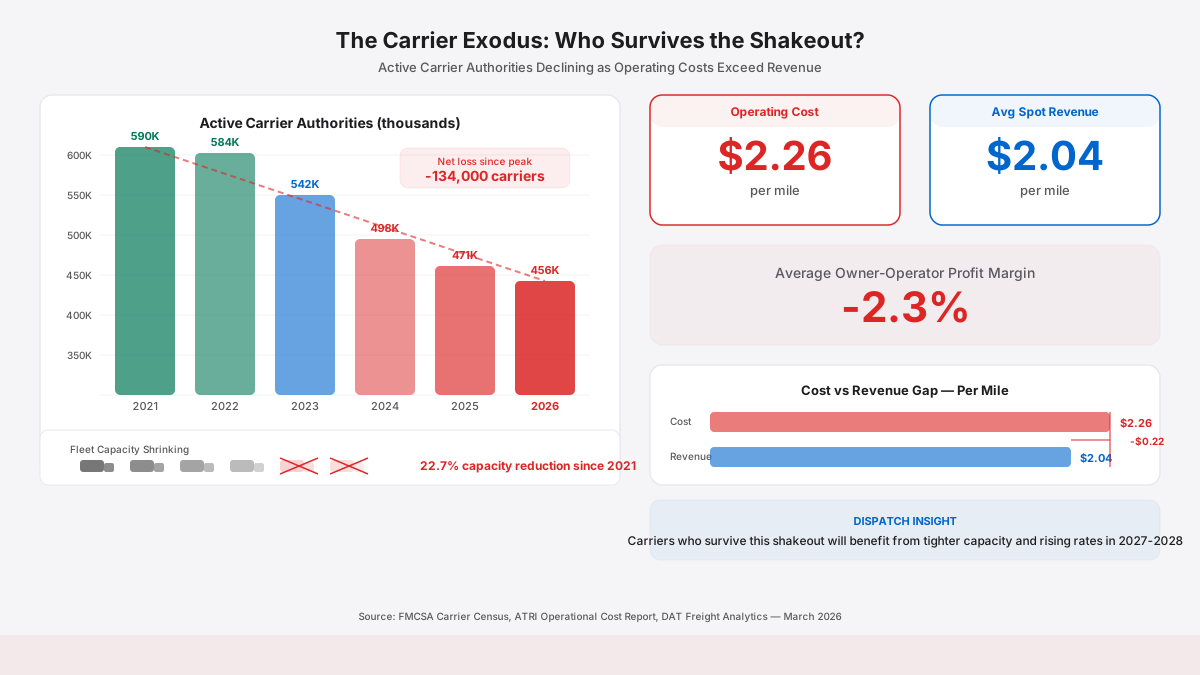
Let's cut through the noise and look at the actual data. According to FMCSA authority records, the US trucking industry has seen a net loss of approximately 88,000 carrier authorities between January 2025 and February 2026. That's not 88,000 trucks — it's 88,000 operating authorities, many representing small fleets of 1-5 trucks that entered during the 2021-2022 gold rush when spot rates were hitting $3.50-$4.00/mile for dry van.
Those rates are gone. The carriers who built business plans around them are following.
The peak was mid-2023: over 640,000 active for-hire carrier authorities in FMCSA's database. By February 2026, that number is heading toward 550,000 — and still falling. We're not at historical norms yet (the pre-pandemic average was roughly 500,000-520,000), but we're getting there fast.
| Period | Active Authorities (Est.) | Net Change | Monthly Avg Loss | Context |
|---|---|---|---|---|
| Mid-2023 (Peak) | ~640,000 | — | — | Post-pandemic boom peak |
| Dec 2023 | ~618,000 | -22,000 | ~3,700 | Freight recession deepening |
| Jun 2024 | ~595,000 | -23,000 | ~3,800 | Spot rates below $2.00/mi |
| Dec 2024 | ~572,000 | -23,000 | ~3,800 | Insurance costs spike 18% |
| Feb 2026 | ~552,000 | -20,000 | ~7,300 | Accelerating exits, $2.26/mi costs |
| Projected Dec 2026 | ~510,000-530,000 | -22,000 to -42,000 | ~2,200-4,200 | Recovery begins slowing exits |
Authority counts estimated from FMCSA MCMIS data, FreightWaves SONAR carrier metrics, and ACT Research fleet population reports. Projections based on current exit rate trends and historical recovery patterns.
Here's what the raw numbers miss: the Class 8 tractor population is contracting independently of authority counts. Even carriers that keep their authority are parking trucks, downsizing fleets, and deferring replacement purchases. According to ACT Research, Class 8 net build rates in 2025 ran roughly 15% below replacement levels. That means the active truck fleet is shrinking even faster than the authority data suggests. Depressed build rates plus elevated retirements plus carrier exits equals a capacity contraction that is real, accelerating, and — eventually — bullish for the carriers who survive it.
The question isn't whether the market will tighten. It's whether you'll still be operating when it does. For a deeper look at where the industry is heading, read our 2026 Trucking Industry Forecast.
Why They're Closing: The Perfect Storm of Costs
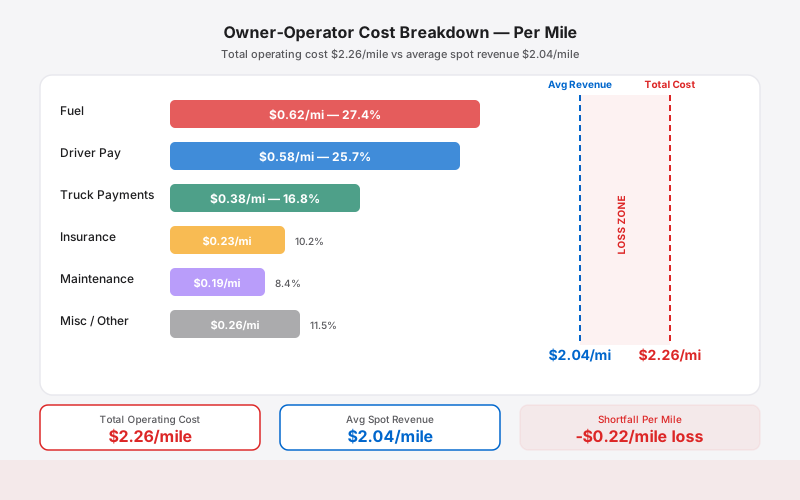
Nobody goes out of business for one reason. The carriers closing right now are getting hit from every direction simultaneously — and the math simply stopped working. The American Trucking Associations (ATA) calls it the worst cost-revenue squeeze since 2019. Based on ATRI's latest operational cost analysis, here's where your $2.26/mile is going:
| Cost Category | $/Mile (2026) | % of Total | YoY Change | What's Driving It |
|---|---|---|---|---|
| Fuel | $0.62 | 27.4% | +2.6% | Diesel averaging $3.85-$4.10/gal nationally |
| Driver Wages/Pay | $0.58 | 25.7% | +3.1% | Wage floor elevated despite soft freight |
| Truck/Trailer Payments | $0.38 | 16.8% | +7.2% | 2022-2023 purchases at inflated prices |
| Insurance | $0.23 | 10.2% | +18.4% | Nuclear verdicts, rising premiums industry-wide |
| Repair & Maintenance | $0.19 | 8.4% | +5.8% | Parts inflation, aging fleet avg 7.2 years |
| Permits, Tolls, Misc | $0.26 | 11.5% | +3.9% | Toll increases, 2290 HVUT, IFTA admin |
Source: ATRI 2026 Operational Costs of Trucking analysis, TDE internal benchmarking data, insurance industry reports. Owner-operator costs typically run $2.40-$2.65/mile due to lower volume discounts.
Insurance is the silent killer. Up 18.4% year-over-year and showing no signs of slowing down. Nuclear verdicts — jury awards exceeding $10 million in trucking accident cases — have tripled in frequency over the past decade according to the ATA. Even if your safety record is perfect, you're paying for the industry's aggregate risk. Owner-operators with new authorities are seeing quotes of $18,000-$28,000/year for basic liability coverage. That's $1,500-$2,300/month before you turn a wheel. Read our trucking insurance guide for strategies to manage this cost.
Equipment payments are the hangover from the boom. Carriers who bought trucks in 2022-2023 paid 15-30% premiums above normal market pricing. A sleeper cab that should have cost $155,000 went for $180,000-$195,000. Those monthly payments ($3,200-$4,500/month for a 5-year note) don't adjust when rates drop. The truck you bought at peak pricing is now worth $30,000-$50,000 less than what you owe on it. That's the definition of being underwater, and it's the single biggest reason small carriers can't survive the downturn — they can't sell the truck without taking a massive loss, and they can't make the payments at current rates.
The margin math is brutal. Average revenue per mile for dry van spot freight in Q1 2026 is running $2.04/mile. Average operating cost is $2.26/mile. That's a -$0.22/mile deficit — a negative 9.7% margin on every spot load. Contract rates are slightly better at $2.15-$2.25/mile, but even contract carriers are operating at or below breakeven. At -2.3% average operating margin industry-wide, the only carriers making money are those running significantly below average costs or significantly above average rates. Use our Cost Per Mile Calculator to see exactly where you stand.
Regional Impact: Where Capacity Is Tightest
Carrier closures don't affect the country evenly. The regions that absorbed the most new entrants during the boom are now seeing the sharpest exits — and the freight networks that depended on that excess capacity are scrambling. Here's the regional breakdown of where the pain is most acute and where opportunities are emerging:
Southeast
Authority loss: -14% since Jan 2025
Florida, Georgia, and the Carolinas are ground zero. Atlanta, the freight crossroads of the Southeast, is seeing spot rate premiums of 12-18% on I-85 and I-75 lanes as capacity drains. Jacksonville-to-Atlanta reefer rates hit $3.10/mi in February — up from $2.40/mi a year ago. The I-95 corridor from Savannah to Charlotte is similarly tight. Georgia and Florida carriers who survive are in a strong position.
Texas & South Central
Authority loss: ~11,000 since Jan 2025
Texas had the highest concentration of new-authority carriers in 2022-2023 — and now it's leading in exits. Houston-to-Dallas, the busiest domestic lane in the state, is tightening noticeably. San Antonio and Laredo are seeing compounding effects: carrier exits plus cross-border volume shifts from the tariff ruling. The Texas freight market is restructuring in real time.
Midwest
Authority loss: -9% since Jan 2025
Ohio, Indiana, and Illinois are experiencing a slow-burn capacity drain. These states sit at the I-70/I-80 crossroads handling a disproportionate share of national freight, so even modest carrier reductions ripple outward. Chicago outbound rates are firming. Columbus and Indianapolis, two of the top 10 freight hubs nationally, are seeing 8-12% rate increases on key lanes. The pattern here is steady tightening rather than sudden dislocation.
Mountain West
Authority loss: -8% since Jan 2025
Colorado, Utah, and Montana started with fewer carriers, so even small percentage losses create acute tightness. Denver is the hub — and I-70 westbound through the Rockies is one of the most capacity-constrained corridors in the country. Salt Lake City's growing warehouse district is generating more freight with fewer local carriers to move it. Flatbed carriers serving Colorado construction and energy sectors have real pricing power right now.
| Region | Key Lanes Tightening | Spot Rate Change (YoY) | Equipment in Demand |
|---|---|---|---|
| Southeast | ATL-JAX, ATL-CLT, SAV-CLT | +15-22% | Reefer, Dry Van |
| Texas | HOU-DFW, SA-LRD, DFW-OKC | +12-18% | Dry Van, Reefer, Flatbed |
| Midwest | CHI-IND, CMH-DET, CHI-STL | +8-14% | Dry Van, Reefer |
| Mountain West | DEN-SLC, DEN-ABQ, SLC-BOI | +10-16% | Flatbed, Dry Van |
| Northeast | PHL-BOS, NYC-PIT, BUF-NYC | +6-10% | Dry Van, Reefer |
| West Coast | LA-PHX, LA-SAC, SEA-PDX | +5-9% | All types |
Rate changes reflect Q1 2026 vs Q1 2025 spot rate averages. Sources: DAT RateView, FreightWaves SONAR, TDE internal dispatch data. Lane codes use standard airport/city abbreviations.
The Silver Lining: What Tighter Capacity Means for Survivors
Here's the part that doesn't get enough attention: every carrier that exits is one less competitor for the loads that remain. This is not a demand problem — freight volumes are roughly flat to slightly up in 2026. It's a supply problem that is correcting itself through the most painful mechanism possible: weaker operators going out of business. But the correction is happening.
FreightWaves SONAR data shows the carrier-to-load ratio (how many trucks are chasing each available load) has dropped from 8.2 in mid-2024 to 4.7 in February 2026. That's still above the 2.5-3.5 range that historically produces rate increases, but the trend line is unmistakable. At the current pace of carrier exits, we should see that ratio dip below 4.0 by Q3 2026 — and that's when rates start moving meaningfully.
Pricing Power Returns
When carrier-to-load ratios drop below 4.0, carriers stop competing against each other for every load. Brokers have fewer options. Rate negotiations shift from "take it or leave it" to actual negotiations. Carriers who maintained relationships and service quality during the downturn will be first in line for premium freight as the market turns.
Lane Selection Improves
Fewer carriers means less competition for the best-paying lanes and the best backhaul options. Instead of fighting for a $1.90/mile load on I-95, you'll have the leverage to hold out for $2.40-$2.60. The carriers who know their lanes and have dispatch teams watching the market will capture the upside first.
Shipper Relationships Deepen
Shippers are watching their carrier base shrink. The smart ones are locking in capacity now through dedicated contracts and preferred carrier programs. If you have a clean safety record, reliable service, and capacity available when the market tightens, shippers will pay a premium to guarantee your trucks are running their freight.
The historical precedent is clear. The last comparable carrier exit wave was 2019, when roughly 50,000 authorities were revoked in 12 months. Within 18 months of that bottoming out (accelerated by COVID stimulus), spot rates jumped 45% and carriers who survived saw revenue increases of 30-60%. The 2025-2026 exit wave is larger — 88,000 and counting — which suggests the eventual recovery will be proportionally stronger. Whether it takes the same form depends on macro factors, but supply-side math doesn't lie.
Curious whether dispatch is worth the investment during a downturn? Read our honest breakdown: Is Truck Dispatch Worth It? For the broader rate picture, see our Spring 2026 Freight Recession Update.
How to Be a Survivor: Cost-Cutting Without Cutting Corners
The carriers closing aren't all bad operators. Many are decent drivers who made reasonable decisions that didn't survive an unreasonable market. But there are specific, practical moves that separate the survivors from the exits. None of this is revolutionary — it's blocking and tackling. The carriers who do these things consistently survive. The ones who don't, don't.
Kill Your Deadhead Miles
The average owner-operator runs 15-20% empty miles. Cutting that to 10-12% is worth $800-$1,200/month at current rates. This is the single highest-ROI move you can make, and it's almost entirely a dispatch function. A dispatcher who books your next load before you deliver the current one — who understands triangular routing, relay points, and backhaul markets — is the difference between 82% loaded miles and 90%. That 8% gap is the difference between losing money and breaking even. Calculate your deadhead cost to see the impact on your bottom line.
Shop Your Insurance — Aggressively
Insurance is the fastest-growing cost category at +18.4% year-over-year. But that's the average. Carriers with clean CSA scores, dash cam footage, and 2+ years of authority can often find rates 20-30% below what they're currently paying by shopping annually. Get quotes from at least 4 providers. Consider joining a purchasing group or association that negotiates group rates. If your deductible is $1,000, consider raising it to $2,500 or $5,000 — the premium savings can be $2,000-$4,000/year if your cash reserves can handle the higher deductible. Our insurance guide walks through every strategy.
Renegotiate Your Factoring Rate
If you're factoring receivables at 3-5%, you're overpaying in the current market. Factoring companies are competing for clients as carrier counts drop — use that leverage. Rates of 1.5-2.5% are achievable for carriers with 6+ months of history and decent credit. On $15,000/week in revenue, dropping from 4% to 2% saves $300/week — $15,600/year. That is a meaningful margin swing. Call your factor and tell them you have competing offers. If they won't match, switch.
Optimize Fuel — Beyond the Discount Card
Fuel is 27.4% of your costs. A $0.03/gallon savings across 20,000 gallons/year is $600. But the real fuel savings come from routing and behavior: maintaining 62-65 mph vs 70+ mph saves 12-18% on fuel consumption. That's $6,000-$9,000/year on a truck burning 18,000-22,000 gallons. Route planning that avoids mountain passes, congested metro areas during peak hours, and unnecessary detours saves another 3-5%. These aren't theoretical numbers — they're what separates profitable carriers from the ones parking their trucks.
Build a 90-Day Cash Reserve
This is the unglamorous truth: the carriers who survive downturns are not always the most efficient operators. They're the ones with cash in the bank. A 90-day reserve at $12,000-$15,000/month in fixed costs means $36,000-$45,000 sitting in a savings account. That sounds like a lot — and it is. But it's the difference between weathering a bad month and filing for revocation. Every dollar you save from the moves above should go into reserves until you hit that number. The market will recover. Your job is to still be here when it does.
The Opportunity Ahead: Positioning for a Smaller Market
Let's be real about what's happening: the trucking industry overexpanded during 2021-2023, and now it's contracting back toward equilibrium. That contraction is painful — nobody should celebrate carriers going out of business. But if you accept the reality of where we are, you can position for what comes next.
The carriers still standing in Q4 2026 will operate in a fundamentally different market. Fewer competitors. Stronger pricing power. Better lane selection. Shippers who learned the hard way that squeezing carriers on rate leads to capacity deserts when they need trucks most. The question is whether you're positioning for that market or just surviving day-to-day.
Lock In Shipper Relationships Now
Shippers are losing carriers. That creates anxiety — and anxiety creates opportunity. Approach your best shippers about dedicated capacity agreements. Even informal "you get first call on my truck" arrangements build loyalty that pays dividends when the market turns. The carriers who come out of the downturn with 3-5 strong shipper relationships will have the foundation for a profitable 2027-2028.
Invest in Your Safety Score
When capacity tightens, shippers and brokers get pickier about who they work with. A clean CSA score, current FMCSA record, and dash cam documentation put you at the front of the line for premium freight. Carriers with safety violations get filtered out by broker algorithms before a human ever sees their bid. The time to clean up your record is now, while freight is available — not when the market tightens and you're competing for every load.
Get Dispatch Help If You Don't Have It
This is a market where dispatch quality is the difference between survival and closure. The gap between a well-dispatched truck and a poorly-dispatched truck is roughly $1,500-$2,500/week in revenue — the difference between losing money and making it. If you're spending 2-3 hours per day on load boards, negotiating rates, and planning routes yourself, that's time you're not driving. And in a market where every loaded mile counts, driving time is money. A professional dispatch service pays for itself multiple times over. That's not a sales pitch — it's math. Starting fresh? Read our complete trucking business guide.
Consider Acquiring Distressed Assets
If you have the cash reserves and the credit, the current market is producing buying opportunities that won't last. Trucks that sold for $180,000-$195,000 in 2022 are available for $120,000-$140,000 now — and the floor may not have arrived yet. Trailer prices are similarly depressed. For carriers with the financial foundation to expand, buying equipment at cycle-low pricing and deploying it when rates recover in late 2026 or 2027 is a proven wealth-building strategy. It's not for everyone — you need cash and conviction — but the opportunity is real.
The Bottom Line
The Great Carrier Exodus is real, it's accelerating, and it's not over. Thousands more authorities will be revoked before the market finds equilibrium. Operating costs at $2.26/mile with average margins at -2.3% means the math doesn't work for carriers who are underdispatched, overpaying on insurance, or carrying boom-era debt. That is not going to change in the next 60 days.
But the same forces driving carriers out of business are building the foundation for a genuine recovery. Every truck that parks, every authority that gets revoked, every carrier that turns in their plates is removing supply from a market where demand hasn't fallen. The tipping point — where rates consistently exceed operating costs — is coming. ACT Research and FreightWaves both project Q3-Q4 2026 as the inflection point.
Your job between now and then is straightforward: cut every unnecessary cost, maximize every loaded mile, maintain your equipment and your safety record, and keep enough cash in the bank to weather the remaining storm. The carriers who do that will inherit a market with fewer competitors, better rates, and more leverage than they've had since 2021. That's not optimism. That's supply and demand.
If you need help getting there, talk to our dispatch team. No contracts, no setup fees. Just a team that understands this market and knows how to find the loads that keep your wheels turning and your authority active. Not sure if dispatch is right for you? Compare the options in our dispatch vs self-dispatch breakdown, or run the numbers with our Dispatch ROI Calculator.
Related Resources
- Trucking Industry Forecast 2026 — Full rate, volume, and capacity projections
- Trucking Insurance Guide for Owner-Operators — Every coverage type, real 2026 premiums, money-saving strategies
- Trucking Insurance Rates 2026 — Premium trends, nuclear verdict data, cost-reduction strategies
- Cost Per Mile Calculator — Know your real operating cost per mile
- How to Start a Trucking Business — Complete guide from authority to first load
- Is Truck Dispatch Worth It? — Honest ROI breakdown for owner-operators
- Tariff Ruling Impact on Trucking — How trade policy adds to the cost pressure
Truck Dispatch Experts
Published Mar 8, 2026