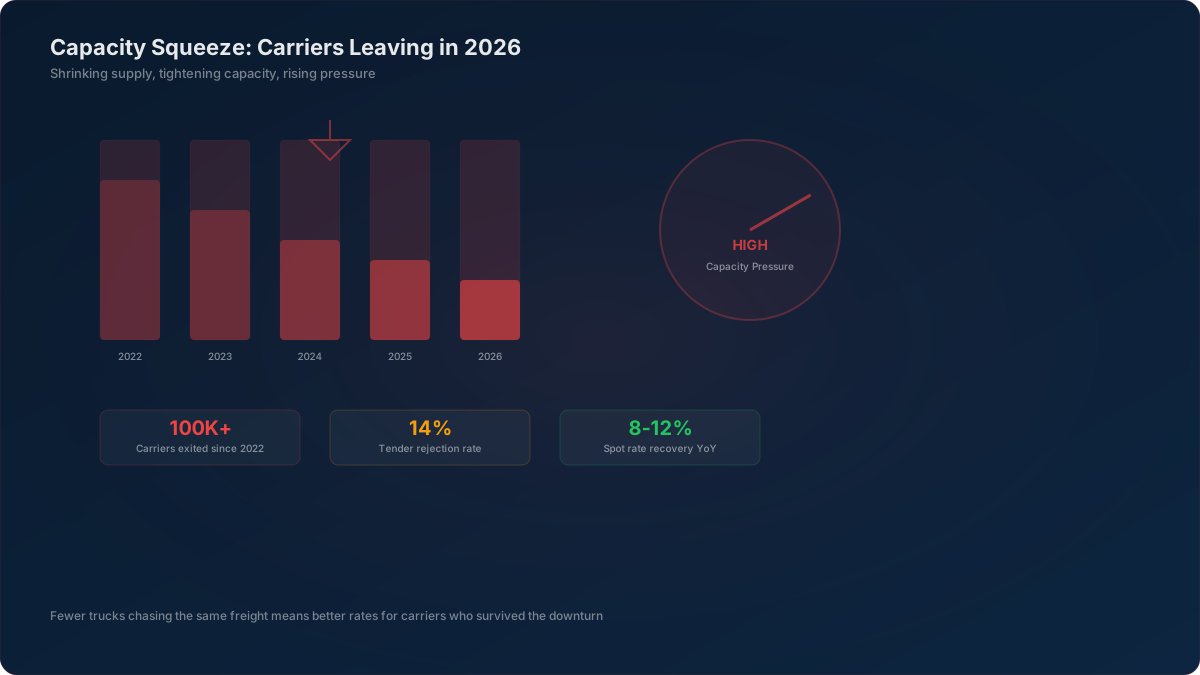
The Scale of the Exodus: 88,000 Authorities and Counting
The number that keeps showing up in every freight market report is 88,000. That's how many trucking authorities the FMCSA revoked in 2023 alone. Not suspended. Not temporarily inactive. Revoked. Gone.
But that was just the beginning. The contraction accelerated through 2024, with a net loss of roughly 10,000 motor carriers in the first half alone. By early 2025, the pace had settled into a grim rhythm: 1,000 to 1,500 carrier shutdowns per week. Through the full year, another 5,000 to 8,000 carriers exited. And on January 12, 2026, STG Logistics — a major intermodal carrier with over $1 billion in assets — filed Chapter 11, proving that even the big players aren't immune.
These aren't just statistics. Each revoked authority represents someone who bet their livelihood on trucking and lost. But if you're still running — still hauling, still making your insurance payments, still keeping your wheels turning — the other side of this contraction looks very different from where we've been.
| Period | Authority Exits | Key Events |
|---|---|---|
| 2023 (Full Year) | ~88,000 revoked | Yellow Corp liquidation, Convoy collapse |
| H1 2024 | ~10,000 net contraction | Freight recession deepens, insurance spikes 12.5% |
| H2 2024 | ~5,000-7,000 exits | Insurance hits record $0.102/mile |
| Early 2025 | 1,000-1,500/week | 5,000-8,000 total exits for the year |
| Jan 2026 | Ongoing | STG Logistics Chapter 11 ($1B+) |
The cumulative impact is massive. The loss of roughly 5,500 operators means significantly less buffer for weather disruptions, seasonal surges, and supply chain shocks. When the next hurricane season hits or produce demand spikes, there are simply fewer trucks available to absorb the volume. That is the capacity squeeze — and it's already starting to show up in rates.
Why They Left: The Four-Way Cost Squeeze
Carriers didn't leave because they wanted to. They left because the math stopped working. Four cost pressures hit simultaneously, and for tens of thousands of small operators, the combination was unsurvivable.
Insurance Costs Exploded
Insurance premiums hit a record $0.102 per mile in 2024, following a 12.5% spike in 2023 and a 3% increase in 2024. By Q1 2025, year-over-year increases reached 5.8%. Nuclear verdicts — where jury awards exceed $10 million — have increased 235% since 2012, with the median nuclear verdict now sitting at approximately $51 million. The federal minimum insurance of $750,000, unchanged since 1985, covers less than 1.5% of that median award. Auto-liability premiums range from $9,000 in low-risk states to over $20,000 in New Jersey, Georgia, and Louisiana. For a small carrier already running thin margins, a single insurance renewal could add $3,000-$5,000 in annual costs overnight.
Rates Fell Below Operating Cost
The freight recession that began in mid-2022 pushed spot rates below operating costs for 18 or more consecutive months. Carriers who relied on spot market freight — especially those who entered during the boom — saw their per-mile revenue drop from $3.00-$3.50 to $1.70-$2.00 while their costs stayed at $2.20 or higher. Every load run at a loss depletes cash reserves. After 12-18 months of negative margins, even disciplined operators run out of runway. Contract rates held up better, but carriers without established shipper relationships were stuck on the spot market.
Equipment Debt From the Boom
Carriers who purchased trucks during the 2021-2022 boom paid $85,000-$110,000 for used Class 8 sleepers that are now worth $60,000-$80,000. Many financed at 80-90% LTV with payments of $2,000-$3,000 per month. When revenue dropped, they were upside down on equipment they couldn't sell without taking a loss and couldn't afford to keep running. The debt trap is one of the most common causes of carrier failure — and it was entirely predictable for anyone who's been through a freight cycle before.
Fuel Volatility and Rising Costs
Diesel price swings of $0.30-$0.50 per gallon within a quarter made it impossible for small carriers to budget fuel costs accurately. Fuel surcharges from brokers rarely kept pace with actual price movements, leaving carriers absorbing the gap. A truck burning 18,000-22,000 gallons per year absorbs $5,400-$11,000 in unexpected fuel costs on a $0.30-$0.50 swing. For a single-truck operation grossing $180,000-$200,000, that's 3-6% of revenue evaporating before it reaches the bottom line.
What made 2023-2025 different from previous downturns was the simultaneity. In 2019, rates dropped but insurance was manageable. In 2020, insurance climbed but rates boomed. This time, every cost line item moved against carriers at the same time while revenue cratered. The American Trucking Associations has called it the most challenging operating environment for small carriers since deregulation in 1980.
For context on how insurance is reshaping the industry, read our deep dive into 2026 trucking insurance rates and the nuclear verdicts crisis.
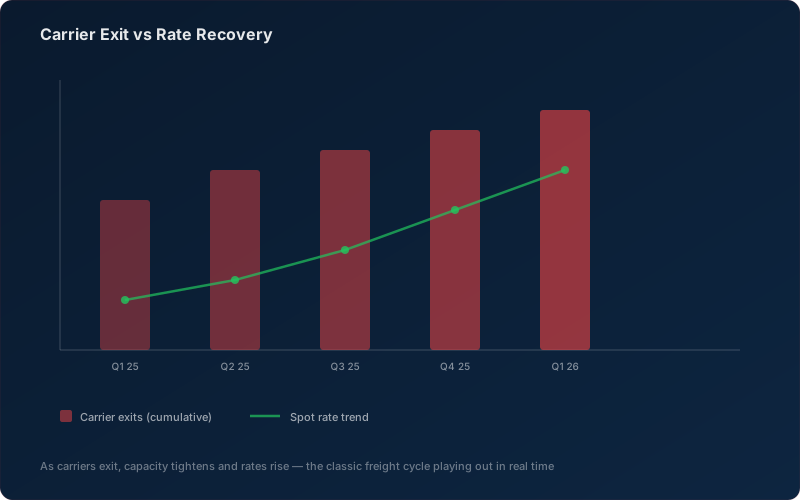
Why They Can't Come Back: The Re-Entry Wall
Here's the detail that most market analyses miss: the carrier exits are largely permanent. Unlike previous cycles where mothballed trucks could be brought back to service relatively quickly, the barriers to re-entry in 2026 are substantially higher than when most of these carriers first started.
Insurance Is Nearly Impossible to Get
A carrier who revoked their authority and wants to restart faces insurance premiums 40-60% higher than their last policy. Insurance companies treat a lapsed authority as a new entrant with a red flag — why did this carrier stop operating? Annual premiums of $12,000-$18,000 or more for a single truck, paid largely upfront, create a cash barrier that most exited carriers simply cannot clear. Add to that the FMCSA insurance filing requirements and the shrinking number of underwriters willing to write new trucking policies, and re-entry becomes a genuine obstacle course.
Equipment Costs Remain Elevated
Many exited carriers sold their trucks — often at a loss — or had them repossessed. To re-enter, they need to purchase or lease equipment at today's prices: $60,000-$80,000 for a used Class 8 sleeper, $170,000+ for new with a 15% tariff surcharge. Even with financing, the down payment, first and last month's lease, and cash reserves required total $25,000-$40,000 before hauling a single load. For carriers who depleted their savings during the downturn, that capital simply doesn't exist. See our full breakdown in the 2026 equipment price guide.
Depleted Cash and Damaged Credit
Operating at a loss for 12-18 months doesn't just empty bank accounts — it destroys credit scores. Missed truck payments, maxed-out credit lines, and factoring advance repayments all hit the credit report. When these carriers try to finance equipment or get insurance premium financing, they face higher rates or outright denials. The financial damage from the downturn creates a years-long recovery timeline that makes quick re-entry impossible for most.
Lost Broker and Shipper Relationships
Relationships in trucking take months to years to build and days to lose. Carriers who went dark on brokers, failed to complete contracted loads, or had insurance lapses during their exit are flagged in carrier vetting systems like DAT, Highway, and RMIS. Rebuilding that trust is a 6-12 month process of hauling smaller, lower-paying loads to prove reliability — exactly the conditions that drove them out the first time.
The bottom line: the capacity that has left is not coming back quickly. Industry analysts estimate fewer than 15% of exited carriers will return within 3 years. The trucks were sold, the savings were spent, and the insurance market has moved on. This is what makes the current contraction different from a seasonal slowdown — the supply reduction is structural, not temporary.
What It Means for Survivors: The Tighter Market Ahead
If you're reading this, you're probably still operating. You survived 18 months of rates below operating cost. You figured out the insurance. You kept your wheels turning when 88,000 of your competitors couldn't. That position is more valuable than most people realize.
Here's what the supply-demand math looks like heading into the second half of 2026:
| Market Indicator | Trough (2024) | Current (Mar 2026) | Projected H2 2026 |
|---|---|---|---|
| Spot Van Rate ($/mi) | $2.03 | $2.41 | $2.50-$2.80 |
| SE Produce Reefer ($/mi) | $2.60-$3.00 | $3.50-$4.50 | $3.80-$5.00 |
| TX Cross-Border ($/mi) | $2.20-$2.80 | $3.00-$4.00 | $3.20-$4.50 |
| SW Flatbed ($/mi) | $2.00-$2.50 | $2.80-$3.40 | $3.00-$3.80 |
| Dispatch Market CAGR | — | 5.6% | Growing to $1B by 2031 |
Less Competition = Better Rates
Every carrier that exits removes capacity from the market. With 88,000+ authorities gone, there are simply fewer trucks competing for the same loads. Spot van rates have already climbed from $2.03/mile to $2.41/mile — a 19% increase. As the market continues tightening through 2026, surviving carriers have pricing leverage they haven't had since 2021. The carriers running today are bidding against a smaller pool, which means better rates and less pressure to take loads below cost.
Shippers Need You More Than Ever
Shippers are watching their carrier base shrink in real time. The smart ones are already locking in capacity with preferred carrier agreements and dedicated lanes. If you have a clean safety record, reliable service history, and equipment in good condition, you are now in a position to negotiate from strength. Shippers will pay premium rates to guarantee capacity from carriers they trust — especially as produce season and peak shipping approach with significantly less market buffer.
Specialized Lanes Are Leading
The rate recovery is not uniform. Southeast produce lanes are already commanding $3.50-$4.50/mile for reefer. Texas cross-border freight is running $3.00-$4.00/mile. Southwest flatbed is hitting $2.80-$3.40/mile. Carriers positioned in these lanes — especially with professional dispatch that understands seasonal freight patterns — are seeing returns they haven't seen in two years. Check our produce season guide for how to capitalize on seasonal lanes.
Less Buffer for Disruptions
With roughly 5,500 fewer operators providing surge capacity, the market has less cushion to absorb disruptions. When a hurricane hits, when produce season peaks, when port congestion spikes — the rate spikes will be sharper and longer than in a market with surplus capacity. Carriers who are operationally ready with maintained equipment, current authority, and dispatch support can capture outsized rates during these surge events. The next disruption is a revenue opportunity, not just a hassle.
How to Position Yourself: Five Moves for the Recovery
Surviving the downturn was the hard part. Positioning for the recovery is where the money is made. The carriers who come out of 2026 strongest will be the ones who took deliberate action during the transition — not the ones who just waited for rates to come back.
Maximize Every Loaded Mile
In a tightening market, the difference between running 78% and 90% loaded miles is massive. At $2.41/mile spot rate over 10,000 miles/month, that 12% improvement adds $2,890 in monthly revenue. Professional dispatch focused on backhaul planning, triangular routing, and deadhead elimination is the single highest-ROI investment a carrier can make right now. Use our Deadhead Calculator to see what empty miles are actually costing you.
Lock In Contract Rates Before the Market Tips
Contract rates lag spot rates by 3-6 months. If spot rates continue climbing through mid-2026, contract rates will follow by Q3-Q4. The window to negotiate favorable annual contracts with shippers is now — while rates are still rising but haven't peaked. Shippers who saw their carrier base shrink by 15-20% are motivated to lock in reliable capacity. Approach your best shippers about 6-12 month commitments at rates 5-10% above current contract levels. Read our rate negotiation guide for specific tactics.
Clean Up Your Safety Record Now
When capacity tightens, shippers and brokers get selective about which carriers they work with. Clean CSA scores, current FMCSA inspection records, and dash cam documentation move you to the front of the queue for premium freight. Carriers with safety violations get algorithmically filtered out before a human ever sees their bid. If you have outstanding DataQs to challenge or inspections to clean up, the time is now — not when every carrier is competing for the same premium loads. Check our CSA score fix guide for a step-by-step approach.
Build Cash Reserves Aggressively
The carriers who survive downturns are not always the best drivers or the most efficient operators — they're the ones with cash in the bank. Target 60-90 days of operating expenses in reserve. At $12,000-$15,000/month in fixed costs, that's $36,000-$45,000. Every dollar saved from better rates, reduced deadhead, and optimized fuel spend should go straight to reserves. The market will recover fully. Your job is to still be operating when it does.
Get Professional Dispatch If You Don't Have It
The dispatch market is growing at 5.6% CAGR for a reason — it works. Professional dispatch increases revenue by 10-30% through better rate negotiation, reduced deadhead, and optimized lane selection. In a market where every loaded mile matters more than ever, spending 2-3 hours per day on load boards instead of driving is leaving money on the table. The 5-8% dispatch fee pays for itself multiple times over when your gross revenue increases by $18,000-$54,000 annually. Read our breakdown of how dispatch boosts owner-operator revenue to see the exact math.
The Bottom Line
The capacity squeeze is real, it's accelerating, and for surviving carriers, it is the single most important market dynamic of 2026. When 88,000+ authorities get revoked and the barriers to re-entry prevent most from coming back, the supply-demand equation shifts permanently in favor of those still operating.
This is not a pep talk. It's math. Fewer trucks chasing the same freight volume equals higher rates, better lane selection, and stronger negotiating position. Spot van rates have already climbed 19% from their trough. ACT Research and FreightWaves both project continued tightening through Q3-Q4 2026.
The carriers who pair their survival with strategic positioning — maximizing loaded miles through professional dispatch, building shipper relationships, maintaining clean safety records, and hoarding cash — will inherit a market with meaningfully less competition. Every month you stay in business while competitors exit, your market position improves. That's not optimism. That's supply and demand.
If you need help maximizing your revenue during the recovery, talk to our dispatch team. No contracts, no setup fees. Just a team that understands this market and knows how to find the loads that turn a tight market into your advantage. Curious how dispatch math works? See our full breakdown: How Professional Dispatch Boosts Owner-Operator Revenue by 10-30%.
Related Resources
- Carrier Exodus Reshaping Freight 2026 — Operating cost analysis and regional capacity data
- Trucking Bankruptcies 2026 — Who's closing and segment-by-segment impact
- Trucking Insurance Rates 2026 — Premium trends and nuclear verdict data
- Truck and Trailer Prices 2026 Guide — Equipment pricing, tariffs, and buying timing
- How Dispatch Boosts Revenue — The math behind 10-30% revenue increases
- Cost Per Mile Calculator — Know your real operating cost per mile
Truck Dispatch Experts
Published Mar 21, 2026