AI in Trucking: The 2026 Reality
If you listen to the trade shows and vendor pitches, 2026 is the year AI goes mainstream in trucking. And to be fair, there's a kernel of truth in that. AI is no longer a theoretical concept for the freight industry — it's embedded in tools that real carriers, brokers, and dispatchers use every day. But there's a wide gap between "AI is in the software I use" and "AI is running my trucking business."
Three technology waves are converging in 2026. The first is agentic AI — AI systems that don't just answer questions but take actions. In freight, this means platforms that can negotiate rates, book loads, and optimize routes without human intervention on routine tasks. The second is factory-embedded OEM telematics — truck manufacturers like Daimler, PACCAR, and Volvo are building AI-powered diagnostics and fleet management directly into new vehicles at the factory level. The third is edge AI in vehicles — processing data locally on the truck rather than sending everything to the cloud, enabling real-time decisions for driver assistance, fuel optimization, and safety systems.
Here's the honest assessment: most of what's deployed and working in 2026 falls into the category of "smart automation" rather than true artificial intelligence. Load matching algorithms that scan thousands of loads per second? That's been around for years — it's just faster now. Predictive maintenance that flags a DPF issue before it becomes a roadside breakdown? Useful, but it's pattern recognition on sensor data, not HAL 9000. The tools are genuinely better than they were two years ago. They're not magic.
What matters for owner-operators and small fleets isn't whether AI is "real" in some philosophical sense — it's whether these tools save you money, find you better loads, and keep your truck running. So let's cut through the hype and look at what's actually working. For a broader market context, see our 2026 Industry Forecast and Industry Trends companion pieces.

How AI Is Changing Load Matching
The most visible application of AI in trucking right now is load matching and pricing. Digital freight platforms — Uber Freight, Flexport (which acquired Convoy's technology), and Loadsmart — are using machine learning to predict market rates, match carriers to loads, and even auto-book freight on certain lanes.
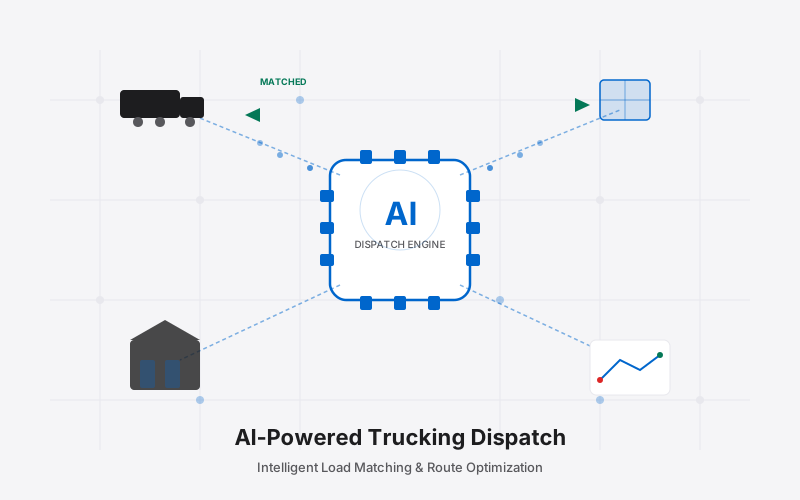
Here's how it works in practice: when a shipper posts a load, the platform's algorithm considers hundreds of variables — historical lane rates, current supply-demand ratios, fuel costs, day of week, seasonal patterns, weather, and available carrier capacity within range. It produces a price recommendation (or in some cases, sets the price automatically) and surfaces the load to carriers whose profiles, equipment, and location match the requirements.
Where AI load matching works well: Simple, high-volume freight. A 40,000 lb dry van load from Dallas to Atlanta on a Tuesday? The algorithm has thousands of historical data points for that exact lane and can price it accurately within seconds. For carriers, the benefit is speed — you see loads matched to your location and equipment instantly rather than scrolling through boards.
Where it struggles: Complex freight exposes AI's limitations fast. Multi-stop loads with varying appointment windows, oversized permits that differ by state, temperature-sensitive pharmaceutical freight, or any situation requiring negotiation and relationship context — these are areas where algorithms consistently underperform experienced dispatchers. The AI doesn't know that broker X always lowballs the first offer by 15%, or that shipper Y's "two-hour appointment window" actually means a six-hour wait. That's institutional knowledge that lives in a good dispatcher's head.
The freight pricing algorithms also have a structural bias toward rate compression on high-volume lanes. When an algorithm sets rates based on historical averages and current supply, it tends to converge prices toward the mean — good for consistency, bad for carriers who could negotiate above-market rates through relationships or timing. This is one reason why professional dispatchers who combine AI tools with human negotiation consistently outperform carriers who rely solely on algorithm-set pricing. Explore our free trucking tools to benchmark your own rates.
AI Dispatch Platforms: What They Actually Do
Beyond the big freight platforms, a new category of AI dispatch tools has emerged. Companies like Dispatch Science and DispatchMVP are marketing AI-powered dispatch specifically to carriers and dispatch services. These platforms promise to automate load selection, route optimization, and driver communication — essentially, an AI dispatcher in a box.
What do they actually do? Most offer some combination of: scanning multiple load boards simultaneously, filtering loads based on your equipment and location, predicting rate trends for upcoming days, optimizing multi-stop routes, and generating automated driver updates. Some integrate with ELD data to factor in hours-of-service availability. The better platforms learn your lane preferences and driver patterns over time, getting more accurate with their recommendations.
The honest reality: these tools are genuinely useful as assistants. They eliminate hours of manual load board searching. They catch rate opportunities that a human scanning boards might miss. They're particularly good for carriers running 3+ trucks, where a single dispatcher is juggling too much information to be optimally efficient on every load.
| Capability | AI Dispatch | Human Dispatcher |
|---|---|---|
| Load board scanning speed | Thousands of loads/second across multiple boards | Manual scanning, limited to 1-2 boards at a time |
| Rate prediction accuracy | Strong on high-volume lanes, weak on niche freight | Market intuition + relationship knowledge of broker pricing |
| Route optimization | Mathematically optimal with traffic and fuel data | Experience-based, knows dock conditions and real wait times |
| Broker negotiation | Can't negotiate — accepts or rejects posted rates | Negotiates $0.10-$0.50+/mile above posted rates regularly |
| Problem resolution | Can flag issues, can't resolve them | Calls broker, reroutes driver, arranges lumper, handles exceptions |
| Relationship building | No capability — purely transactional | Builds preferred carrier status, gets first-call on premium loads |
| 24/7 availability | Always on, instant responses | Business hours typically, on-call for emergencies |
| Consistency | Same quality every time, no bad days | Varies — great dispatchers are great, but quality ranges widely |
Assessment based on current (2026) AI dispatch platform capabilities. AI capabilities are improving rapidly but human advantages in negotiation and relationships remain durable.
The takeaway from this comparison isn't that AI is bad or humans are obsolete — it's that the strengths are complementary. The best dispatch operations in 2026 use AI to handle the data-heavy, repetitive work (scanning, filtering, rate analysis) while human dispatchers focus on negotiation, relationships, and exception handling. Neither alone is as effective as both together.
Double Brokering Detection with AI
Here's an area where AI is delivering genuine, measurable value: fraud detection. Double brokering — where a broker accepts a load, then illegally re-brokers it to another carrier without the shipper's knowledge — costs the trucking industry an estimated $500 million to $800 million annually, according to FreightWaves and CCJ Digital reporting. Carriers get stiffed on payment. Shippers lose visibility on their freight. And the fraudsters get increasingly sophisticated.
AI-powered fraud detection systems work by analyzing patterns across multiple data points simultaneously. The technology flags anomalies that would be impossible for a human to catch at scale: a carrier authority that was activated three days ago trying to book a $15,000 load, GPS tracking signals that don't match the truck's reported position (spoofing detection), payment routing to bank accounts associated with known fraud networks, or communication patterns that suggest a middleman rather than the actual carrier.
Companies like Highway, Carrier411, and RMIS are deploying these systems, and several major brokers have built proprietary fraud detection AI. The FMCSA has also increased enforcement, revoking hundreds of carrier authorities tied to fraud rings in 2025.
What this means for legitimate carriers: AI fraud detection benefits you directly. When double brokers get caught faster, there's less unpaid freight in the system. Legitimate carriers also gain an advantage — clean authority history, consistent tracking data, and established payment records make you flag-free in these systems, which means faster booking and payment processing. If you're a new authority, expect more verification steps during your first 6-12 months. It's annoying but necessary — and it protects you from the fraud too.
Predictive Maintenance: Know Before You Break
An unplanned breakdown doesn't just cost you the repair bill. It costs you the tow ($500-$2,000), the lost load ($1,000-$3,000+ in revenue), potential detention or missed appointment penalties, and the downtime while you wait for parts and shop availability. A single roadside breakdown can cost an owner-operator $5,000-$15,000 when you add it all up. Predictive maintenance AI aims to prevent that by catching problems before they strand you.
OEM Telematics (Built-In)
Detroit Connect, Cummins Connected Diagnostics, PACCAR Connected Truck, and Volvo Remote Diagnostics come factory-installed on 2020+ model trucks. They monitor engine parameters, aftertreatment systems, and drivetrain components in real-time. When sensor readings deviate from normal patterns, the system alerts you and your dealer before a failure occurs.
Free with truck purchase
Aftermarket Platforms
Companies like Uptake, Geotab, and Platform Science offer telematics devices and AI analytics that work on older trucks. They plug into the OBD port and monitor engine codes, fuel consumption patterns, idle time, hard braking events, and component wear indicators.
$25-$75/month per truck
Tire Pressure Monitoring
AI-enhanced TPMS systems track pressure, temperature, and wear patterns across all tires. They predict tire failures and optimize replacement timing. Given that tire blowouts are the #1 cause of roadside breakdowns, this alone can justify the investment.
$200-$500 per truck + sensors
DPF/Aftertreatment Monitoring
The most expensive and frustrating maintenance issue for modern diesel trucks. AI systems track soot loading patterns, regen frequency, DEF consumption, and sensor readings to predict DPF problems weeks in advance — giving you time to schedule service rather than getting forced into a roadside regen or derate.
Usually included in OEM telematics
The ROI math for owner-operators: If predictive maintenance prevents even one roadside breakdown per year (and for trucks running 100,000+ miles annually, that's realistic), the avoided cost of $5,000-$15,000 far exceeds the monthly subscription for aftermarket platforms. For trucks with factory telematics, there's no additional cost — you just need to actually use the app and pay attention to the alerts. The biggest ROI obstacle isn't the technology; it's drivers who ignore the warnings because the truck "still runs fine."
Autonomous Trucks: The Real Timeline
No discussion of AI in trucking is complete without addressing the elephant in the cab: self-driving trucks. And no topic in trucking generates more anxiety and misinformation. So here are the facts as of March 2026.
Aurora Innovation is the furthest along commercially. They completed their first 1,000-mile driverless haul in late 2025 — a significant technical achievement. They're running autonomous loads for FedEx, Uber Freight, and Werner on fixed routes in Texas, primarily the Dallas-Houston-San Antonio triangle and I-10 between El Paso and San Antonio. Their plan calls for 200+ autonomous trucks by late 2026, expanding to other Sun Belt interstate corridors.
Kodiak Robotics, Torc (owned by Daimler), and Waymo Via are also testing autonomous trucks, primarily in Texas, Arizona, and New Mexico. Collectively, these companies might have 500-1,000 autonomous trucks on the road by end of 2026.
Now for perspective: There are approximately 3.5 million registered Class 8 trucks in the United States. Even 1,000 autonomous trucks represent 0.03% of the fleet. The total freight moved autonomously in 2026 will be a rounding error — statistically insignificant compared to human-driven freight volume.
What autonomous trucks can do in 2026: Long-haul, fixed-route, highway-only, good-weather corridors. Think I-10 across Texas in clear weather. That's it. They can't navigate city streets, back into loading docks, chain up for mountain passes, handle construction zones, or operate in severe weather. Every autonomous run requires a human "transfer hub" at each end where a human driver takes over for the first and last miles.
What this means for owner-operators: Autonomous trucks are not coming for your job in 2026, 2027, or likely 2030. The realistic timeline for autonomous trucks to handle even 5% of long-haul freight is 2033-2035 at the earliest. Local P&D, drayage, construction, agricultural, and any freight requiring dock work will remain human-driven far longer than that. If you're 40 years old today, autonomous trucks are unlikely to affect your career before you choose to retire.
That said, the long-haul highway-only segment — which is what autonomous trucks target first — may see competitive pressure in the 2030s. Owner-operators running long-haul interstate freight on high-volume corridors should be aware of this trend and consider building expertise in segments that are harder to automate: specialized equipment, regional routes with complex pickup/delivery requirements, and relationship-driven freight.
Will AI Replace Truck Dispatchers?
Let's answer this directly: No, but it's changing what good dispatchers do.
Five years ago, a significant portion of a dispatcher's day was spent on tasks that AI now handles better and faster: scanning load boards, calculating mileage and fuel costs, checking rate averages for specific lanes, and matching basic load requirements to available trucks. If that's all your dispatcher does, then yes — AI can replace that work, and it's already doing so.
But the dispatchers who are thriving in 2026 aren't the ones who competed with algorithms on data processing speed. They're the ones doing work that AI fundamentally cannot:
Negotiation with Context
A broker posts a load at $2.10/mile. AI sees the market average and might accept it or reject it based on a threshold. A good dispatcher knows that this broker is desperate because their original carrier fell through, the load delivers tomorrow, and they'll pay $2.65 if you push back. That context — knowing the human on the other end of the phone — is worth $0.50/mile on every load.
Relationship Management
Preferred carrier status with a broker means you get first call on their best loads — before they hit the load board, before the AI scanners see them. You can't algorithm your way into a relationship. It takes consistent service, communication during problems, and a human being who answers the phone.
Exception Handling
Your driver breaks down at 2 AM in rural New Mexico with a perishable load. AI can flag the problem. A dispatcher can solve it — calling a backup carrier, negotiating with the receiver on delivery window, arranging roadside service, and keeping the broker informed. These situations happen weekly in trucking, and they require human judgment and communication.
Strategic Positioning
Knowing that produce season is about to ramp in South Georgia and positioning your truck there three days early isn't just data — it's market intuition built from years of experience. AI can show you historical patterns. A great dispatcher acts on those patterns with timing and positioning moves that consider your specific truck, driver preferences, home time schedule, and maintenance needs.
The analogy we use at Truck Dispatch Experts: AI in dispatch is like GPS in a truck. GPS tells you the optimal route. But it doesn't know about the construction zone that started yesterday, the weigh station that's doing Level 1 inspections, or the shortcut that saves 20 minutes through an industrial park. A good driver uses GPS as a tool and overrides it when experience says otherwise. A good dispatcher uses AI the same way — as a powerful tool that still needs human judgment to get the best results.
For carriers evaluating whether to use AI dispatch software or a human dispatcher, the answer increasingly is: find a dispatch service that uses AI tools internally. You get the benefit of both — the speed and data processing of algorithms, plus the negotiation and relationship skills of an experienced human — without having to buy and manage AI software yourself.
What Owner-Operators Should Actually Do
Enough theory. Here are four practical steps you can take right now to make AI work for you instead of against you:
Embrace TMS and Load Board AI Features
If you're using DAT, Truckstop, or any major load board, turn on their AI features. Rate predictions, load recommendations based on your location and equipment, and market trend alerts are all available — often included in your existing subscription. If you're running a TMS like TruckingOffice, Axon, or KeepTruckin, explore their route optimization and load matching tools. You don't need a $500/month AI platform. You need to actually use the AI features built into tools you're already paying for.
Keep Your ELD Data Clean
Here's something most carriers don't realize: your ELD data is increasingly used by brokers and platforms to score your reliability. On-time percentage, HOS compliance, smooth driving patterns, and consistent availability all factor into algorithmic load matching. Carriers with clean data profiles get surfaced first for premium loads. Treat your ELD not just as a compliance tool but as your digital reputation — because that's exactly what brokers' AI systems are using it as.
Focus on Loads AI Can't Optimize
AI is best at commoditized freight — standard dry van loads on high-volume lanes. The more complex and specialized your freight, the less AI can compete with human expertise. Multi-stop routes, hazmat, oversized/overweight, team expedite, high-value cargo, and freight requiring specific equipment configurations all resist algorithmic optimization. If you can run these loads, you're in a segment where AI augments your work rather than competing with it — and rates are typically 20-40% higher than standard freight.
Partner with a Tech-Forward Dispatch Service
The smartest move for most owner-operators isn't buying AI software — it's partnering with a dispatch service that uses AI tools on the backend while providing human expertise on the front end. You get AI-powered load matching, rate analysis, and market intelligence combined with human negotiation, relationship building, and exception handling. The dispatch fee pays for itself when your dispatcher uses technology to find loads you'd never see on a board and negotiates rates above what any algorithm would accept.
Related Resources
- Trucking Industry Trends 2026 — Broader trends shaping the industry this year
- 2026 Industry Forecast — Rate projections, freight volumes, and market outlook
- Load Boards vs. Dispatch vs. Brokers — How different freight-finding methods compare
- FreightWaves — Industry news and freight market data
- CCJ Digital — Commercial carrier technology and business news
- Free Trucking Tools — Rate calculator, deadhead calculator, cost per mile, and more
- Broker Fraud Crackdown 2026 — How AI powers the new fraud detection requirements
- Driver Shortage 2026 — Why AI dispatch matters more as the driver pool shrinks
Truck Dispatch Experts
Published Mar 4, 2026